The Peacemaker
Enneagram Type 9 — The Peacemaker: Core Fear, Desire, Wings & Growth

You keep the peace inside and out, often by dimming your own wants. The engine isn’t laziness — it’s the fear that asserting yourself costs you the people you love.
At a glance
- Core fear
- Loss and separation from others
- Core desire
- To have inner and outer peace
- Passion
- Sloth (self-forgetting)
- Center
- Body (gut)
The core fear
Type 9’s root fear is loss and separation — that conflict, or simply asserting themselves, would fracture the connection and peace they live inside.
The core desire
The core desire is inner stability: peace of mind, unbroken belonging, a world that holds together. It’s a beautiful want pursued at a hidden price — the Nine’s own agenda.
The passion (the pattern’s engine)
The passion is sloth — not laziness but self-forgetting: going along, merging with others’ wants, giving less and less attention to one’s own presence in one’s own life.
Where the pattern comes from
The young Nine concluded that its presence was optional — that wanting things loudly threatened the household peace, and disappearing a little kept everyone comfortable. Merging became a talent. The adult work is re-inhabiting your own life: your preferences were never the threat the pattern believed they were.
In love
In love, Nines accept people wholesale — an ease that heals. They need their preferences actively asked for, or they vanish into the merge.
At work
At work, Nines mediate, steady the room, and see all sides. Friction: priorities blur, and ’no’ arrives late or never.
The two wings
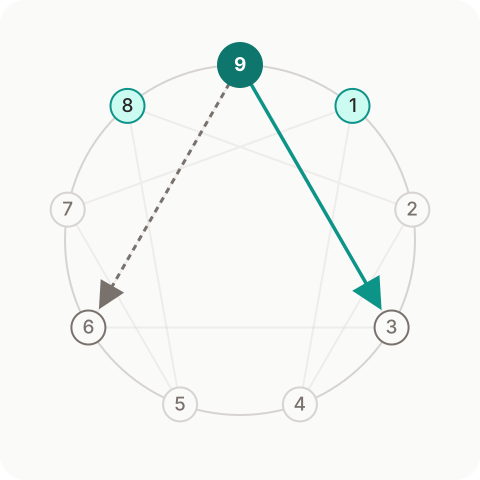
An 8-wing (9w8, The Referee) grounds the calm in earthy immovability; a 1-wing (9w1, The Dreamer) organizes it around quiet principles and order.
The three instinct subtypes
One of the three runs against the type’s usual current — the countertype — which is why some people never look like textbook examples of their own type.
sp 9Self-preservation
The self-preservation Nine merges with comfort: food, routines, sleep, the familiar — appetite standing in for agenda.
so 9Social Countertype
The social Nine is the countertype: fuses with the group and works tirelessly for it — the unselfish workhorse who forgets itself in belonging.
sx 9One-to-one
The one-to-one Nine merges with a person: their plans, their moods, their life — union so complete the self goes missing.
Growth and stress directions
At your best → The Achiever
Moving toward health, Nines gain Three's self-investment: their own goals get calendar time and follow-through.
Under pressure → The Loyalist
Under stress, Nines fret like an unhealthy Six: anxious, reactive, scanning for what could break the peace.
More on how the arrows work: Integration & disintegration
The three bands: healthy, average, unhealthy
One more lens before the practices: the levels of development. Every type spans a wide band, which is why descriptions can feel alternately flattering and harsh — they describe the whole range.
Healthy
Healthy Nines are genuinely present peacemakers: calm with a spine, acceptance that includes themselves.
Average
In the average band the merge deepens — routines thicken, preferences blur, agreement happens in the room and resistance after it.
Under strain
Under strain the fog closes in: important things postponed indefinitely, anger stored until it cracks the floor, and the quiet conviction that showing up fully would cost everything.
Three practices to start with
- Answer today’s first ‘what do you want?’ with an actual preference, however small.
- Do YOUR priority first this morning, before absorbing anyone else’s.
- Notice one disagreement you’re carrying silently. Say one sentence of it out loud.
Commonly confused with
No type is read correctly from behavior alone — these are the pairs this type most often gets tangled with:
Also worth reading: the most common mistypes · countertypes
Confirm by reading, not just testing
No test is the final word — including ours. Read this profile and your second-highest type side by side, and notice which core fear you recognize from the inside. That felt recognition, not a score, is what settles typing.
Two cross-checks help. First, the centers: Type 9 belongs to the gut triad, whose background emotion is anger — if a different emotion is the constant radiation of your life, look at the other centers first. Second, the instincts: a countertype (your dominant instinct running against the type’s current) can make this profile fit poorly even when the engine matches — the subtype lens often resolves what the type description alone cannot.
Frequently asked questions
Is Type 9 lazy?
No — many Nines are extremely busy (the social Nine is the tradition's workhorse). The sloth is self-forgetting: energy for everyone's agenda except their own.
Why do Nines score high on every type?
Their sense of self is diffuse and empathic — they genuinely recognize themselves in every description. That's why our test uses discriminator questions and honest clarity scores.
How does a Nine grow?
Toward Three: self-investment. The first hour of the day for their own priority, preferences stated out loud, 'no' said while it's still small.
9w8 or 9w1?
The 9w8 Referee backs its calm with earthy immovability; the 9w1 Dreamer organizes it around quiet principles and order.
Is a Nine's calm real peace or suppression?
Depends on the season: healthy Nine calm is genuine, grounded presence. Average Nine calm sits on top of unfelt anger and unstated preferences — peace purchased with self-forgetting. The tell: real peace survives voicing a want; the purchased kind fears it.
Know your enneagram type. Understand yourself.
Take the free test