The Enthusiast
Enneagram Type 7 — The Enthusiast: Core Fear, Desire, Wings & Growth
You keep the future stocked with possibilities. The engine isn’t restlessness for its own sake — it’s the refusal to be trapped in a moment that hurts.
At a glance
- Core fear
- Being trapped in pain or deprivation
- Core desire
- To be satisfied and free
- Passion
- Gluttony (for experience)
- Center
- Head
The core fear
Type 7’s root fear is deprivation and entrapment — being stuck in a moment of pain or boredom with no exit.
The core desire
The core desire is satisfaction: a life full enough that nothing essential is ever missed. The strategy — keeping every option open — is exactly what postpones the satisfaction.
The passion (the pattern’s engine)
The passion is gluttony — not for food but for experience: the next plan, the next stimulus, the next tab. ‘Enough’ never arrives on its own; the hand is already reaching.
Where the pattern comes from
The young Seven met pain — often ordinary, sometimes real deprivation — and made a brilliant discovery: attention can move. Toward the next game, the next idea, the future. Mobility became safety. The adult work is learning that the escape hatch works both ways: you can come back, and the feeling you left will finish without destroying you.
In love
In love, Sevens bring adventure and resilience — they metabolize hard days fast. They need a partner who joins the fun without caging it.
At work
At work, Sevens generate options, connections and momentum. Friction: follow-through on the boring middle of projects.
The two wings
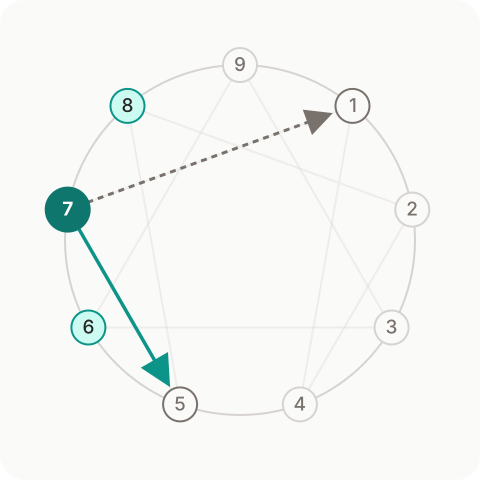
A 6-wing (7w6, The Entertainer) is playful and relational — fun needs company; an 8-wing (7w8, The Realist) is driven and practical — fun needs momentum.
The three instinct subtypes
One of the three runs against the type’s usual current — the countertype — which is why some people never look like textbook examples of their own type.
sp 7Self-preservation
The self-preservation Seven networks for pleasure and security: the pragmatic hedonist with a plan, a partner, and a backup for both.
so 7Social Countertype
The social Seven is the countertype: postpones its own appetite to serve the group's — idealistic, generous, allergic to being seen as selfish.
sx 7One-to-one
The one-to-one Seven dreams the better world and the better beloved: enthusiastic idealization, reality embellished into possibility.
Growth and stress directions
At your best → The Investigator
Moving toward health, Sevens gain Five's depth: fewer things, fully tasted; satisfaction replaces anticipation.
Under pressure → The Reformer
Under stress, Sevens turn harsh like an unhealthy One: critical, impatient, perfectionistic about their escapes.
More on how the arrows work: Integration & disintegration
The three bands: healthy, average, unhealthy
One more lens before the practices: the levels of development. Every type spans a wide band, which is why descriptions can feel alternately flattering and harsh — they describe the whole range.
Healthy
Healthy Sevens are grateful, focused and genuinely joyful — appetite matured into appreciation.
Average
In the average band the calendar inflates: options hoarded, commitments hedged, the present traded for the next thing.
Under strain
Under strain the escape accelerates into desperation — restlessness that can’t land anywhere, excess that numbs instead of delights, and the pain that was outrun all those years finally calling in its debt.
Three practices to start with
- Stay with one activity today until it’s truly finished — including the boring last tenth.
- When the escape plan forms today, name what you’re escaping from first.
- Eat one meal with zero inputs: no screen, no book, no planning. Just the meal.
Commonly confused with
No type is read correctly from behavior alone — these are the pairs this type most often gets tangled with:
Also worth reading: the most common mistypes · countertypes
Confirm by reading, not just testing
No test is the final word — including ours. Read this profile and your second-highest type side by side, and notice which core fear you recognize from the inside. That felt recognition, not a score, is what settles typing.
Two cross-checks help. First, the centers: Type 7 belongs to the head triad, whose background emotion is fear — if a different emotion is the constant radiation of your life, look at the other centers first. Second, the instincts: a countertype (your dominant instinct running against the type’s current) can make this profile fit poorly even when the engine matches — the subtype lens often resolves what the type description alone cannot.
Frequently asked questions
Is Type 7 just extraversion?
No. Introverted Sevens exist — the appetite can run on books, projects and inner plans. The engine is the motion away from pain toward possibility, not the party.
Do Sevens ever feel sad?
Constantly — briefly. The pattern reframes pain fast, which is a real resilience and a real avoidance. Growth is letting the sad thing finish its sentence.
How does a Seven grow?
Toward Five: fewer things, fully tasted. Depth is the Seven's frontier — satisfaction lives there, not in the next tab.
7w6 or 7w8?
The 7w6 Entertainer needs company for the fun; the 7w8 Realist needs momentum and muscle. Same appetite, different fuel.
Is a Seven's happiness real or avoidance?
Usually both at once: the delight in life is genuine, and it's also load-bearing — kept bright partly to outrun pain. The test is stillness: joy that survives a quiet, planless day is the real kind; joy that requires constant motion is the pattern working.
Know your enneagram type. Understand yourself.
Take the free test