The Loyalist
Enneagram Type 6 — The Loyalist: Core Fear, Desire, Wings & Growth

You scan for what could go wrong so it can’t surprise you. The engine isn’t negativity — it’s loyalty to everyone and everything you don’t want to lose.
At a glance
- Core fear
- Being without support or guidance
- Core desire
- To have security and support
- Passion
- Fear (anticipation)
- Center
- Head
The core fear
Type 6’s root fear is being without support and guidance — alone against a world that can’t be trusted to hold.
The core desire
The core desire is security: something solid to stand on — a person, a system, a track record — so that life can be met without bracing.
The passion (the pattern’s engine)
The passion is fear itself — not cowardice but anticipation: the mind running ahead to scan for what could go wrong, so nothing arrives unannounced. Counterphobic Sixes attack the danger instead; the engine is the same.
Where the pattern comes from
The young Six lost faith in the reliability of protection — authority was absent, unpredictable or frightening — and compensated by becoming its own early-warning system. Vigilance felt like safety. The adult work is discovering the inner authority that was there all along: you have survived every day so far, mostly on your own judgment.
In love
In love, Sixes offer loyalty that outlasts moods. They need consistency — surprises and mixed signals wake the inner alarm.
At work
At work, Sixes are the early-warning system and the faithful executor. Friction: ambiguity from leadership reads as danger.
The two wings
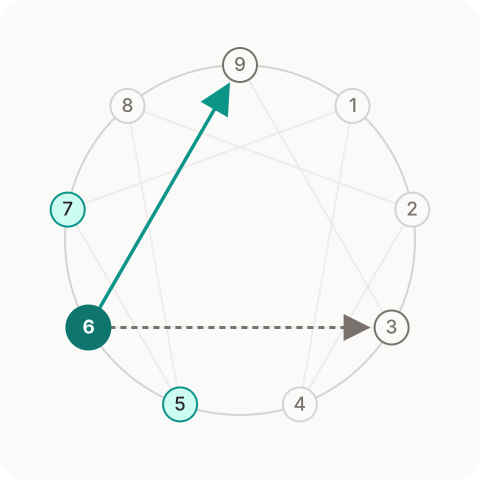
A 5-wing (6w5, The Defender) gets quiet, self-contained and analytical under pressure; a 7-wing (6w7, The Buddy) gets warm, talkative and alliance-building.
The three instinct subtypes
One of the three runs against the type’s usual current — the countertype — which is why some people never look like textbook examples of their own type.
sp 6Self-preservation
The self-preservation Six warms its way to safety: alliances, friendliness, hesitation — protection through being impossible to dislike.
so 6Social
The social Six leans on the system: rules, authorities, reference points — precision and duty as antidotes to doubt.
sx 6One-to-one Countertype
The one-to-one Six is the countertype — counterphobic: attacks what frightens it, cultivates strength and intimidation, doubts turned into daring.
Growth and stress directions
At your best → The Peacemaker
Moving toward health, Sixes gain Nine's calm: trusting themselves and life enough to rest inside it.
Under pressure → The Achiever
Under stress, Sixes perform like an unhealthy Three: workaholic proving, image management, competing for security.
More on how the arrows work: Integration & disintegration
The three bands: healthy, average, unhealthy
One more lens before the practices: the levels of development. Every type spans a wide band, which is why descriptions can feel alternately flattering and harsh — they describe the whole range.
Healthy
Healthy Sixes are courageous and steadfast — the people you want beside you when it matters, precisely because they’ve met their fear.
Average
In the average band vigilance becomes the operating system: scanning, testing, securing reassurance that never quite lands.
Under strain
Under strain the alarm owns the house — suspicion of allies, paralysis before decisions, and the exhausting search for a guarantee that doesn’t exist.
Three practices to start with
- Catch one worst-case scenario today and ask it: what’s your evidence?
- Make one small decision today without consulting anyone. Sign it internally.
- Notice: you’ve survived 100% of the days that were supposed to go wrong.
Commonly confused with
No type is read correctly from behavior alone — these are the pairs this type most often gets tangled with:
Also worth reading: the most common mistypes · countertypes
Confirm by reading, not just testing
No test is the final word — including ours. Read this profile and your second-highest type side by side, and notice which core fear you recognize from the inside. That felt recognition, not a score, is what settles typing.
Two cross-checks help. First, the centers: Type 6 belongs to the head triad, whose background emotion is fear — if a different emotion is the constant radiation of your life, look at the other centers first. Second, the instincts: a countertype (your dominant instinct running against the type’s current) can make this profile fit poorly even when the engine matches — the subtype lens often resolves what the type description alone cannot.
Frequently asked questions
Is Type 6 just anxiety?
No — it's a security strategy. Plenty of Sixes look calm; the constant is the scanning (what could go wrong?) and the relationship to support and authority. Anxiety is one weather pattern of the strategy, not the type.
What is a counterphobic Six?
A Six (usually the one-to-one instinct) that attacks what frightens it instead of avoiding it — reads as bold, tests as an Eight, rehearses like a Six. See the counterphobic guide linked above.
How does a Six grow?
Toward Nine: trusting self and life enough to rest. Practically — one decision a week at 80% certainty, logged, so the gut learns it survives.
6w5 or 6w7?
The 6w5 Defender goes quiet and analytical under pressure; the 6w7 Buddy gets talkative and alliance-building.
Why do Sixes doubt even good news?
The vigilance engine scans everything for the catch — good news included. It's not pessimism as personality but anticipation as protection: if the flaw is found first, it can't ambush. Trusting good news is a Six's advanced practice.
Know your enneagram type. Understand yourself.
Take the free test