The Investigator
Enneagram Type 5 — The Investigator: Core Fear, Desire, Wings & Growth

You guard your energy like a scarce resource and understand before you engage. The engine isn’t shyness — it’s the fear that the world’s demands will outrun what you have.
At a glance
- Core fear
- Being depleted, incapable, overwhelmed
- Core desire
- To be capable and competent
- Passion
- Avarice (hoarding of self)
- Center
- Head
The core fear
Type 5’s root fear is incapacity — being overwhelmed by a world that demands more than their inner reserves can supply.
The core desire
The core desire is competence: to understand enough, to master enough, to finally feel equipped for life rather than braced against it.
The passion (the pattern’s engine)
The passion is avarice — not greed for money but a hoarding of self: time, energy, privacy, knowledge, held tight because every demand feels like depletion.
Where the pattern comes from
The young Five experienced the world as intrusive or depleting — too many demands, too little privacy or provision — and pulled back into the mind, where resources could be managed. Competence became the price of entry into life. The adult work is testing the old arithmetic: the world gives energy back now, when you engage it.
In love
In love, Fives give presence in small, real doses and deep loyalty. They need unhurried space — intimacy grows when it doesn’t demand.
At work
At work, Fives bring depth, clarity and calm analysis. Friction: meetings and interruptions cost more than the work itself.
The two wings
A 4-wing (5w4, The Iconoclast) runs on imagination and meaning; a 6-wing (5w6, The Problem Solver) runs on systems, precision and proof.
The three instinct subtypes
One of the three runs against the type’s usual current — the countertype — which is why some people never look like textbook examples of their own type.
sp 5Self-preservation
The self-preservation Five builds the castle: walls, supplies, few visitors — sanctuary as survival strategy.
so 5Social
The social Five seeks the knowers: expertise as membership, ideals as connection — intimacy with knowledge systems more than with people.
sx 5One-to-one Countertype
The one-to-one Five is the countertype: searches for THE person to trust with everything — a romantic vault looking for its one key.
Growth and stress directions
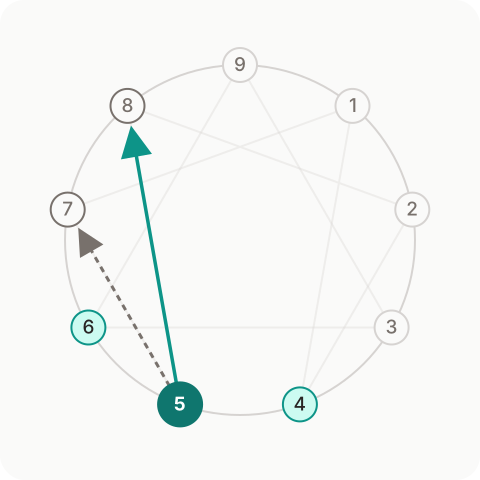
At your best → The Challenger
Moving toward health, Fives gain Eight's embodied confidence: acting on knowledge instead of collecting more.
Under pressure → The Enthusiast
Under stress, Fives scatter into Seven's restlessness: jumpy, distracted, escaping into projects and stimulation.
More on how the arrows work: Integration & disintegration
The three bands: healthy, average, unhealthy
One more lens before the practices: the levels of development. Every type spans a wide band, which is why descriptions can feel alternately flattering and harsh — they describe the whole range.
Healthy
Healthy Fives are visionary and engaged: depth in service of the world, knowledge that acts.
Average
In the average band the drawbridge rises — time and energy rationed, participation replaced by observation, life studied instead of lived.
Under strain
Under strain the fortress becomes the world: contact feels like invasion, needs shrink to almost nothing, and thinking spins free of the ground it was meant to map.
Three practices to start with
- Spend one resource today as if it renews — energy, attention, or a piece of what you know.
- Answer one question today before you feel fully ready to.
- Tell someone something you’re still figuring out — share the draft, not the thesis.
Commonly confused with
No type is read correctly from behavior alone — these are the pairs this type most often gets tangled with:
Also worth reading: the most common mistypes · countertypes
Confirm by reading, not just testing
No test is the final word — including ours. Read this profile and your second-highest type side by side, and notice which core fear you recognize from the inside. That felt recognition, not a score, is what settles typing.
Two cross-checks help. First, the centers: Type 5 belongs to the head triad, whose background emotion is fear — if a different emotion is the constant radiation of your life, look at the other centers first. Second, the instincts: a countertype (your dominant instinct running against the type’s current) can make this profile fit poorly even when the engine matches — the subtype lens often resolves what the type description alone cannot.
Frequently asked questions
Are all Fives introverts?
Mostly, but the engine matters more than the label: the Five manages a perceived scarcity of inner resources. A sociable Five exists — it just budgets the socializing.
Is Five the 'smart type'?
No type owns intelligence. The Five's specialty is depth of focus and conceptual appetite; other types are equally smart in other keys.
How does a Five grow?
Toward Eight: acting on knowledge instead of collecting more. Practically — answer before fully ready, share the draft, stay five minutes past the urge to leave.
What's the difference between 5w4 and 5w6?
The 5w4 Iconoclast runs on imagination and builds a personal vision; the 5w6 Problem Solver runs on systems and proof.
Why do Fives seem cold when they care deeply?
The detachment is resource management, not absence of feeling: emotions are processed later, in private, where they can't deplete the moment's budget. Fives often discover on Saturday what Tuesday meant — the feelings are real, just on a delay.
Know your enneagram type. Understand yourself.
Take the free test