The Individualist
Enneagram Type 4 — The Individualist: Core Fear, Desire, Wings & Growth

You search for what’s missing — in the moment, in others, in yourself. The engine isn’t moodiness — it’s the hunger for an identity that finally feels like yours.
At a glance
- Core fear
- Having no identity or significance
- Core desire
- To be uniquely, authentically themselves
- Passion
- Envy
- Center
- Heart
The core fear
Type 4’s root fear is having no identity or personal significance — being, underneath the moods and the story, nobody in particular.
The core desire
The core desire is to find themselves — an identity that finally feels true, built from inner experience rather than borrowed from outside.
The passion (the pattern’s engine)
The passion is envy: the ache that others received an ease, a belonging, a completeness that was somehow withheld from you. Envy keeps the attention on what’s missing — which keeps the identity feeling incomplete.
Where the pattern comes from
The young Four concluded that something essential was missing — in the family mirror, something didn’t reflect back. Identity became a search project, and melancholy its familiar workshop. The adult work is the surprising discovery that nothing was ever missing: the searching itself was the pattern, not the lack.
In love
In love, Fours offer depth and emotional honesty — they want to be known, not managed. They need steadiness when their weather shifts.
At work
At work, Fours bring taste, meaning and originality. Friction: routine drains them, and comparison stings.
The two wings
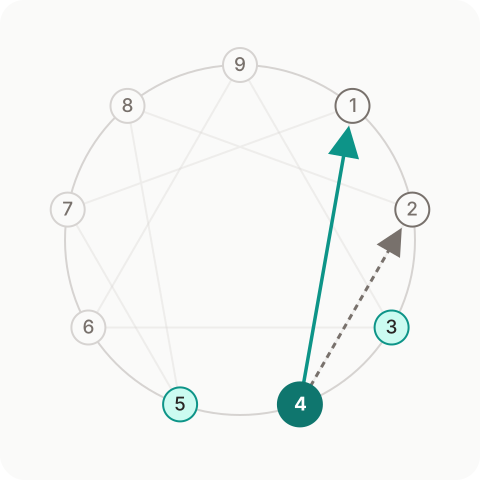
A 3-wing (4w3, The Aristocrat) gives the depth ambition and polish; a 5-wing (4w5, The Bohemian) turns it inward into a private, uncompromising world.
The three instinct subtypes
One of the three runs against the type’s usual current — the countertype — which is why some people never look like textbook examples of their own type.
sp 4Self-preservation Countertype
The self-preservation Four is the countertype: suffers in silence, endures without complaining — long-suffering strength instead of visible drama.
so 4Social
The social Four leads with melancholy: comparing, lamenting, belonging through being the sensitive one — suffering shared as connection.
sx 4One-to-one
The one-to-one Four competes: envy turned outward as demand and intensity — better to be too much than to be overlooked.
Growth and stress directions
At your best → The Reformer
Moving toward health, Fours gain One's discipline: feelings become material for work instead of weather that cancels it.
Under pressure → The Helper
Under stress, Fours grasp like an unhealthy Two: clinging, needing to be needed, testing people's love.
More on how the arrows work: Integration & disintegration
The three bands: healthy, average, unhealthy
One more lens before the practices: the levels of development. Every type spans a wide band, which is why descriptions can feel alternately flattering and harsh — they describe the whole range.
Healthy
Healthy Fours are profoundly creative and emotionally honest — they metabolize experience into meaning for everyone.
Average
In the average band the inner weather takes over: moods curated, ordinary life disdained, the missing thing rehearsed daily.
Under strain
Under strain the story darkens into identity — I am what’s wrong with me — and the melancholy stops being a visitor and signs a lease.
Three practices to start with
- Do the ordinary task first today, before the mood arrives. Notice: the mood follows action.
- Catch one comparison today and finish it differently: ‘…and I have something they don’t.’
- Name three unremarkable things that are working in your life.
Commonly confused with
No type is read correctly from behavior alone — these are the pairs this type most often gets tangled with:
Also worth reading: the most common mistypes · countertypes
Confirm by reading, not just testing
No test is the final word — including ours. Read this profile and your second-highest type side by side, and notice which core fear you recognize from the inside. That felt recognition, not a score, is what settles typing.
Two cross-checks help. First, the centers: Type 4 belongs to the heart triad, whose background emotion is shame — if a different emotion is the constant radiation of your life, look at the other centers first. Second, the instincts: a countertype (your dominant instinct running against the type’s current) can make this profile fit poorly even when the engine matches — the subtype lens often resolves what the type description alone cannot.
Frequently asked questions
Is Type 4 the 'artist type'?
Art is common but not required. The core is identity-through-inner-experience: feelings treated as the true self. Plenty of Fours never paint; plenty of artists are Threes, Sevens or Nines.
Is being emotional the same as being a Four?
No — every type feels. The Four's marker is the relationship to feeling: moods as identity, longing as home base, the sense that something essential is missing.
What helps a Four most?
Action before mood. The One-ward growth direction turns feeling into material for work instead of weather that cancels it. Equanimity — feelings as weather, not verdicts — is the virtue.
4w3 or 4w5?
The 4w3 Aristocrat expresses depth outward — style, polish, presentation. The 4w5 Bohemian turns inward — private, uncompromising, harder to know.
Are all Fours artists?
No — the artistic association is a stereotype. Fours are defined by the identity-through-depth engine, which can express through art, but also through relationships, taste, spirituality or a curated inner life. Plenty of accountants are Fours; plenty of artists aren't.
Know your enneagram type. Understand yourself.
Take the free test