The Achiever
Enneagram Type 3 — The Achiever: Core Fear, Desire, Wings & Growth

You read every room and rise to it. The engine isn’t vanity — it’s the suspicion that without the performance, the applause (and the belonging) stops.
At a glance
- Core fear
- Being worthless without achievement
- Core desire
- To be valuable and worthwhile
- Passion
- Deceit (self-deception)
- Center
- Heart
The core fear
Type 3’s root fear is worthlessness apart from achievement — that without the résumé, the record, the visible success, there would be nothing there worth loving.
The core desire
The core desire is to feel valuable and accepted — chosen not despite who they are, but for it. The tragedy of the average Three is pursuing that through performance, which can never quite deliver it.
The passion (the pattern’s engine)
The passion is deceit — not habitual lying, but self-deception: becoming the image that succeeds until the person underneath loses the thread of what they actually feel and want.
Where the pattern comes from
The young Three discovered that performance gets applause and applause feels like love. Somewhere in the transaction, the performing self and the real self quietly swapped places. The adult work is the slow, brave experiment of being seen without the act — and discovering the affection survives.
In love
In love, Threes bring energy, plans and presentability. They need safety to be seen unpolished — valued for being, not performing.
At work
At work, Threes deliver: goals, momentum, adaptability. Friction: image management can outrun candor, and rest feels like falling behind.
The two wings
A 2-wing (3w2, The Charmer) wins through warmth and connection; a 4-wing (3w4, The Professional) wins through craft, depth and distinction.
The three instinct subtypes
One of the three runs against the type’s usual current — the countertype — which is why some people never look like textbook examples of their own type.
sp 3Self-preservation Countertype
The self-preservation Three is the countertype: achieves quietly, allergic to open bragging — wants to BE good rather than look good, and never stops working.
so 3Social
The social Three shines on stage: titles, brands, applause — the classic achiever who reads every room and wins it.
sx 3One-to-one
The one-to-one Three achieves through attractiveness and devotion to key people — success measured in being chosen.
Growth and stress directions
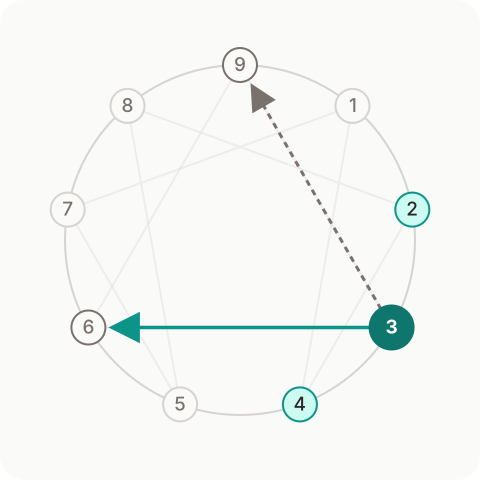
At your best → The Loyalist
Moving toward health, Threes gain Six's loyalty: committed to people and causes beyond their own image.
Under pressure → The Peacemaker
Under stress, Threes shut down into Nine's fog: burned out, going through motions, numb behind the smile.
More on how the arrows work: Integration & disintegration
The three bands: healthy, average, unhealthy
One more lens before the practices: the levels of development. Every type spans a wide band, which is why descriptions can feel alternately flattering and harsh — they describe the whole range.
Healthy
Healthy Threes are authentic achievers: effective and self-accepting, inspiring without performing, honest about failure.
Average
In the average band the image takes the wheel — success is curated, feelings are postponed, and the calendar becomes the personality.
Under strain
Under strain the mask and the person blur: burnout dressed as momentum, hollowness behind the highlight reel, and the fear that stopping would reveal there’s no one there.
Three practices to start with
- Do one thing today with no witness and no mention of it afterward.
- When someone asks how you are today, answer with a feeling, not a status update.
- Notice one moment of image-adjusting today. What were you protecting?
Commonly confused with
No type is read correctly from behavior alone — these are the pairs this type most often gets tangled with:
Also worth reading: the most common mistypes · countertypes
Confirm by reading, not just testing
No test is the final word — including ours. Read this profile and your second-highest type side by side, and notice which core fear you recognize from the inside. That felt recognition, not a score, is what settles typing.
Two cross-checks help. First, the centers: Type 3 belongs to the heart triad, whose background emotion is shame — if a different emotion is the constant radiation of your life, look at the other centers first. Second, the instincts: a countertype (your dominant instinct running against the type’s current) can make this profile fit poorly even when the engine matches — the subtype lens often resolves what the type description alone cannot.
Frequently asked questions
Are all Threes ambitious careerists?
No — the arena varies. A Three performs value wherever value is measured: career, fitness, parenting, even spirituality. The constant is the engine (worth through achievement), not the field.
How do I know I'm a 3 and not a 1 or 8?
Ones serve the method, Threes serve the result; Eights want command, Threes want recognition. The comparison pages linked above walk each pair.
Can a Three ever relax?
Yes — and it's the growth edge. Movement toward Six brings commitment to people beyond the image; practically it starts with rest before it's earned and one witness to the unimpressive version of you.
What is a 3w4?
The Professional: ambition deepened by interiority — craft, distinction, a private intensity. The 3w2 Charmer wins through people instead.
Do Threes know when they're performing?
Often not — that's the pattern's depth: the performance is calibrated so automatically that the Three can lose track of where the image ends. The tell is the pause after 'what do YOU want?' — a question the machinery can't answer.
Know your enneagram type. Understand yourself.
Take the free test