The Helper
Enneagram Type 2 — The Helper: Core Fear, Desire, Wings & Growth
You track what people need the way others track the weather. The engine isn’t niceness — it’s the quiet bet that being essential is what makes you safe to love.
At a glance
- Core fear
- Being unwanted, unloved
- Core desire
- To be loved for who they are
- Passion
- Pride
- Center
- Heart
The core fear
Type 2’s root fear is being unwanted — loved for what they provide rather than who they are, and discarded when the providing stops.
The core desire
The core desire is to be loved fully and particularly — to matter, irreplaceably, in specific people’s lives.
The passion (the pattern’s engine)
The passion is pride: the quiet conviction of being the giver who needs nothing, whose worth lives in being indispensable. The Two’s own needs go underground — and resurface as exhaustion or resentment.
Where the pattern comes from
The young Two learned that love comes to those who earn their place — that being helpful, sweet and attentive kept the connection safe. Needs were a liability, so they went underground. The adult work is unlearning the exchange rate: love that must be earned by giving was never the love you actually needed.
In love
In love, Twos lead with attentiveness — they sense needs early and meet them. They need their own needs asked about, not assumed away.
At work
At work, Twos are the relational glue: mentoring, smoothing, connecting. Friction: unacknowledged effort curdles into resentment.
The two wings
A 1-wing (2w1, The Servant) makes the care dutiful and principled; a 3-wing (2w3, The Host) makes it social, sparkling and visible.
The three instinct subtypes
One of the three runs against the type’s usual current — the countertype — which is why some people never look like textbook examples of their own type.
sp 2Self-preservation Countertype
The self-preservation Two earns care by being charming and a little helpless — the countertype that hesitates to give first, wanting to be taken care of.
so 2Social
The social Two helps from the podium: influential, connected, the power behind thrones — generosity with an audience.
sx 2One-to-one
The one-to-one Two seduces the individual: irresistible, dedicated, boundary-blurring — love as a mission aimed at one person at a time.
Growth and stress directions
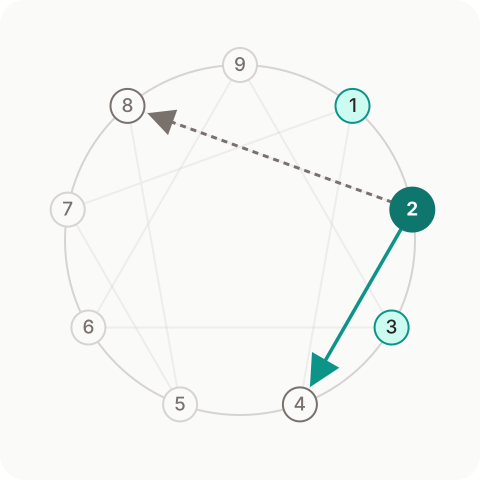
At your best → The Individualist
Moving toward health, Twos gain Four's self-awareness: their own feelings and needs become visible and speakable.
Under pressure → The Challenger
Under stress, Twos erupt into Eight's bluntness: the tally of unthanked favors becomes demands and accusations.
More on how the arrows work: Integration & disintegration
The three bands: healthy, average, unhealthy
One more lens before the practices: the levels of development. Every type spans a wide band, which is why descriptions can feel alternately flattering and harsh — they describe the whole range.
Healthy
Healthy Twos love without the ledger: generous, direct about their own needs, nourishing to be near.
Average
In the average band the giving grows strings — closeness is engineered, needs are hinted rather than said, and appreciation is counted.
Under strain
Under strain the accounting goes public: reminders of favors, sudden reproaches, and the ache of feeling used by the very people the pattern was built to keep.
Three practices to start with
- Before helping anyone today, pause and ask yourself: was I asked?
- Name one thing YOU need today — out loud, to another human.
- Let someone do something for you today without repaying it immediately.
Commonly confused with
No type is read correctly from behavior alone — these are the pairs this type most often gets tangled with:
Also worth reading: the most common mistypes · countertypes
Confirm by reading, not just testing
No test is the final word — including ours. Read this profile and your second-highest type side by side, and notice which core fear you recognize from the inside. That felt recognition, not a score, is what settles typing.
Two cross-checks help. First, the centers: Type 2 belongs to the heart triad, whose background emotion is shame — if a different emotion is the constant radiation of your life, look at the other centers first. Second, the instincts: a countertype (your dominant instinct running against the type’s current) can make this profile fit poorly even when the engine matches — the subtype lens often resolves what the type description alone cannot.
Frequently asked questions
Is Type 2 just being a nice person?
No — many types are kind. The Two's signature is the direction of attention: needs of others register instantly, own needs arrive late or never. The pattern is the automatic other-focus, not the niceness.
Can a Two be a man?
Of course. Cultural scripts push men to express the pattern differently — often as the indispensable provider, mentor or fixer — but the engine (mattering through being needed) is identical.
What's the healthiest thing a Two can do?
Practice needing. Ask for one concrete thing per week and receive without instantly repaying. The pattern says this will cost love; the practice proves it doesn't.
2w1 or 2w3?
The 2w1 serves from duty — quiet, principled, behind the scenes. The 2w3 hosts — visible, warm, at the center of the room.
Why do Twos burn out?
Because the pattern treats their own needs as a liability: giving runs on credit while receiving stays closed. The exhaustion arrives with resentment attached — the ledger's unpaid balance — and the repair is asking, not another act of service.
Know your enneagram type. Understand yourself.
Take the free test