The Reformer
Enneagram Type 1 — The Reformer: Core Fear, Desire, Wings & Growth

You measure yourself against an inner standard that never clocks out. The engine isn’t perfectionism for show — it’s the fear that letting one thing slide would mean something in you is slipping.
At a glance
- Core fear
- Being bad, corrupt, wrong
- Core desire
- To be good and have integrity
- Passion
- Anger (resentment)
- Center
- Body (gut)
The core fear
At the root of Type 1 sits the fear of being bad, corrupt, or defective — that without constant self-correction, something inside would go wrong. This isn’t drama; it’s a quiet background hum that makes rest feel slightly irresponsible.
The core desire
The core desire is integrity: to be good, to have balance, to be beyond reproach in one’s own eyes. Ones don’t primarily want applause — they want to pass their own inspection.
The passion (the pattern’s engine)
The classic passion of the One is resentment: anger that isn’t allowed to be anger, pressed down into simmering irritation at everything that falls short — including, hardest of all, themselves.
Where the pattern comes from
Somewhere early, the young One concluded that mistakes are dangerous and goodness must be earned — that being a good boy or girl was the safe harbor. The conclusion hardened into an inner supervisor that never clocked out. The adult work is discovering that the supervisor’s contract expired long ago: you can be good without being watched.
In love
In love, Ones show care through reliability and improvement — remembering, fixing, keeping promises. They need appreciation for their effort and room to relax their inner critic.
At work
At work, Ones bring standards, structure and follow-through. Friction: criticism lands hard, and ‘good enough’ feels like a betrayal.
The two wings
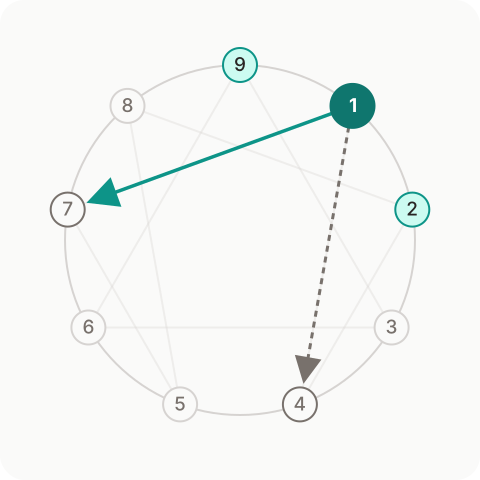
A 9-wing (1w9, often called The Idealist) cools the One into a composed, principled observer; a 2-wing (1w2, The Advocate) warms it into an active improver of people and causes.
The three instinct subtypes
One of the three runs against the type’s usual current — the countertype — which is why some people never look like textbook examples of their own type.
sp 1Self-preservation
Worry works overtime: the self-preservation One perfects survival itself — health, money, order at home — and is the most anxious and least angry-looking One.
so 1Social
The social One models the right way for the group: rules, systems, exemplary conduct — a teacher's temperament with a reformer's agenda.
sx 1One-to-one Countertype
The one-to-one One runs hot, not cold: reforming people directly, with fervor — the countertype that looks more like an Eight than a careful perfectionist.
Growth and stress directions
At your best → The Enthusiast
Moving toward health, Ones relax into Seven's spontaneity: more play, more possibility, less tribunal.
Under pressure → The Individualist
Under sustained stress, Ones slide toward the moody side of Four: alienated, misunderstood, quietly despairing of ever being good enough.
More on how the arrows work: Integration & disintegration
The three bands: healthy, average, unhealthy
One more lens before the practices: the levels of development. Every type spans a wide band, which is why descriptions can feel alternately flattering and harsh — they describe the whole range.
Healthy
At their best, Ones are wise and accepting: discernment without the tribunal, principle with warmth — the reformer the world actually follows.
Average
In the average band the standard tightens: correctness becomes correction, opinions become obligations, and rest becomes contraband.
Under strain
Under real strain the pattern inverts — rigid judgment outside, merciless judgment inside, and the frightening sense that nothing, including oneself, can ever be right enough.
Three practices to start with
- Notice one imperfect thing today that you deliberately leave exactly as it is. What happens in your body?
- When the inner critic speaks today, ask: whose voice is this originally? Answer it once, kindly.
- Schedule 30 unproductive minutes. Guard them like an appointment with someone important — because they are.
Commonly confused with
No type is read correctly from behavior alone — these are the pairs this type most often gets tangled with:
Also worth reading: the most common mistypes · countertypes
Confirm by reading, not just testing
No test is the final word — including ours. Read this profile and your second-highest type side by side, and notice which core fear you recognize from the inside. That felt recognition, not a score, is what settles typing.
Two cross-checks help. First, the centers: Type 1 belongs to the gut triad, whose background emotion is anger — if a different emotion is the constant radiation of your life, look at the other centers first. Second, the instincts: a countertype (your dominant instinct running against the type’s current) can make this profile fit poorly even when the engine matches — the subtype lens often resolves what the type description alone cannot.
Frequently asked questions
Is Type 1 just perfectionism?
No. Perfectionism describes behavior; Type 1 describes a motivation — the fear of being bad or corrupt, managed by an inner standard. Many perfectionists are Threes (image) or Sixes (safety); the One's version is moral at the root.
What's the difference between a 1w9 and a 1w2?
The 1w9 is a composed, private idealist who convinces by example; the 1w2 is an engaged advocate who improves people and causes up close. Same engine, different exhaust.
What does growth look like for a Type 1?
Movement toward Seven: play that doesn't have to be earned, possibility that doesn't need auditing. Practically, it starts with scheduled unproductive time and one imperfection left standing per day.
Which types is a 1 most often confused with?
Threes (both efficient), Sixes (both dutiful) and Nines (adjacent on the circle). The comparison pages linked above separate each pair.
What does a healthy Type 1 look like?
Discernment without the tribunal: standards held with warmth, mistakes metabolized as information, and a capacity to rest that no longer needs to be earned. The critical eye remains — it just stops running the prosecution.
Know your enneagram type. Understand yourself.
Take the free test