Instinct & Subtype Test
Which of the three instincts leads for you? Find your 1-of-27 subtype — including whether you're the countertype that doesn't look like your type.
Start free trial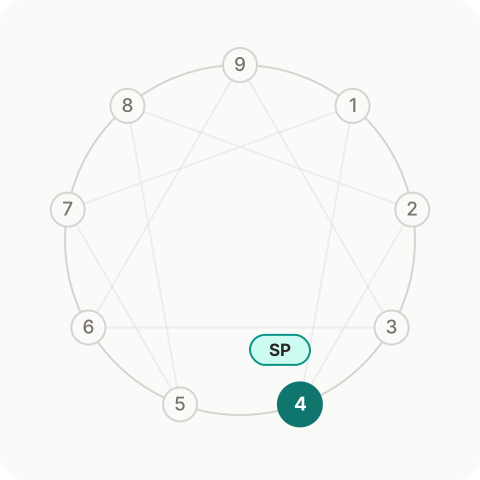
Find the layer that explains what your type couldn’t. The instinct test identifies which of the three drives leads for you — self-preservation, social, or one-to-one — and combines it with your type into your 1-of-27 subtype: the most specific description the framework offers, countertype flag included.
What it measures
The three instincts are older than personality: survival attention aimed at resources (SP), at the group (SO), or at charged one-to-one bonds (SX). One dominates in each person and decides where your type’s passion gets spent — which is why an SP Four looks stoic, a social Four melancholy, and an SX Four fierce, all running the same engine. The items track involuntary attention: what you check first, what you can’t stop monitoring, which loss frightens most viscerally.
The countertype flag
One subtype per type runs against its passion’s usual current — the countertype — and looks unlike its own type’s textbook portrait: the counterphobic Six, the stoic SP Four, the workaholic social Nine. If your type never quite fit, or tests keep missing you, this flag is often the answer. The test reports it explicitly, with your countertype’s full page linked.
What you get
Your instinct stack (dominant, secondary, blind spot — the blind spot is often the most useful finding), your full subtype with its Chestnut name, the countertype flag where it applies, and the reading path: your subtype’s dedicated page, the contrast with your type’s other two subtypes, and the growth notes calibrated to your specific configuration.
Pro
The Instinct & Subtype test is a Pro tool — subtypes are the framework’s deepest layer, and this is the instrument the 27 subtype pages were built to pair with. Included in the subscription with the Compatibility Report and the rest; the free trial covers it. If any tool on this site changes your self-understanding twice, it’s this one: once at the type, once at the subtype.
A worked sample
Your type is Six, but the portrait never quite fit — you’re the one who rides the motorcycle and asks the aggressive question in the town hall. The instinct items track your involuntary attention: what you monitor in new places, what loss frightens most, where your energy goes when threatened. Result: one-to-one dominant — you’re the counterphobic SX Six, the countertype, the Six that attacks its fears instead of managing them. The portrait that never fit gets replaced by one that does, uncomfortably well: the rehearsal before confrontations, the replay after, the tests you run on people you love.
Who it’s for
People whose type fits motivationally but not visibly — the countertype situation this test was practically built for. Anyone whose relationships keep failing at the same instinct fault line (the SX-blind marriage, the SP-blind bank account). And subtype-curious readers of our 27 pages who want their own address on the map rather than a best guess.
Instinct & Subtype Test
Start free trialFrequently asked questions
Do I need my type before taking this?
Yes — the subtype is type × instinct, so the instrument needs your core type first. The free test establishes it; this test adds the instinct layer on top.
What's the 'blind spot' in my stack?
Your least-attended instinct — the arena where consequences keep surprising you: the empty fridge (SP-blind), the missed office politics (SO-blind), the comfortable-but-uncharged life (SX-blind). Often the most actionable finding.
How do I know if I'm a countertype?
The test flags it directly. Independent signs: your type fits motivationally but the visible style contradicts the textbook — bold Six, stoic Four, hardworking Nine. The countertype page for your type settles it.
Can my instinct stack change?
It's considered stable, like type. What changes is attention to the neglected instinct — midlife often forces the blind spot's bill due, which feels like change but is the stack demanding balance.
Is the subtype more important than the wing?
It cuts deeper: wings adjust style while the instinct can invert your type's visible presentation entirely. Order of operations: type, then instinct, then wing.