Growth Path Explorer
Your integration and stress directions with what to practice — the arrows made actionable, calibrated to your type.
Start free trial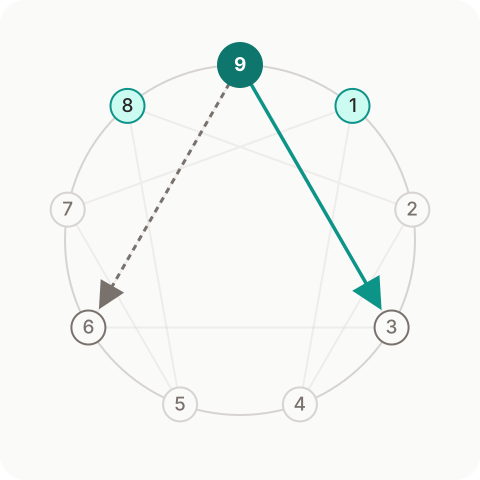
Turn the arrows into a practice plan. The Growth Path Explorer takes your type and renders its two connected lines — where you go under pressure, where you grow — with the specific practices that move you along the healthy direction on purpose instead of waiting for a good season to deliver it.
What it covers
Your stress direction with its early-warning signs — the first two or three signature moves that appear weeks before you’d call yourself stressed, turned into a personal smoke alarm. Your growth direction with its qualities broken into practicable units: not ‘a Nine should integrate to Three’ but the specific momentum-practices a Nine can run this week. And the levels lens: locating your current band honestly, with the practices matched to it — climbing from average needs different work than consolidating health.
The deliberate-growth model
The classical reading treated the arrows as weather: stress happens to you, growth arrives when life is secure. The modern reading — ours — makes the growth line a road you can walk on purpose: borrow your growth type’s healthy qualities deliberately, in small units, before the secure season arrives. The Explorer structures exactly that: one practice at a time, sized to be done this week, with the review question that tells you whether it’s working.
What you get
Your personal arrows map (the same diagram from your type page, annotated for you), the early-warning checklist for your stress direction, a rotating practice queue for your growth direction, and — if you run the Health Check-in — the band-calibrated version: practices matched to where you actually are this season, not where the book assumes you are.
Pro
Growth Path is a Pro tool, bundled with the Health Check-in it pairs with and the rest of the suite. If the test told you what you are, this is the tool for what to do about it — the framework’s actual point. Knowing your type was never the destination; this is the road that starts where the test result ends.
A worked sample
You’re a Nine, average band. The Explorer sets up: early-warning monitoring for your stress line (Six — the doom-scrolling, the sudden catastrophizing) and a first growth-line practice borrowed from Three: one self-chosen goal, stated to one person, reviewed Friday. Week three, the review shows the goal survived two family requests that would previously have absorbed it — the practice graduates, the queue advances to the next unit. Six months later the graph shows what changed: not your type, your grip.
Who it’s for
Anyone who finished their type profile thinking ‘accurate — now what?’ People whose growth reading stays reading: the structure converts knowing into scheduling. And partners doing the work together — the mutual early-warning pact (each watching the other’s first arrow moves) is the tool’s most-loved feature among couples.
Growth Path Explorer
Start free trialFrequently asked questions
How is this different from reading my type's growth section?
The type page teaches; the Explorer schedules: one practice at a time, sized for a week, with review questions and the next practice queued. Structure is the difference between knowing the direction and walking it.
What are stress early-warning signs?
Your stress arrow's first moves — the One's uncharacteristic melancholy, the Nine's doom-scrolling — which appear weeks before full arrow travel. Catching them early is the tool's highest-value feature: load is negotiable at that stage.
Do the practices change over time?
Yes — the queue rotates and recalibrates: practices that became easy retire, and Health Check-in results adjust the difficulty band. Growth work that never updates becomes flattery.
Can I work both arrows at once?
The tool sequences them: early-warning monitoring runs always (it's passive), while active practice focuses on one growth unit at a time. Splitting active effort across both directions reliably dilutes both.
Is this therapy?
No — it's structured self-development on a personality framework, and says so plainly. For clinical concerns, a licensed professional is the right tool; this one is for the ordinary work of loosening a pattern's grip.