SX 9 — One-to-One Nine: 'Fusion'

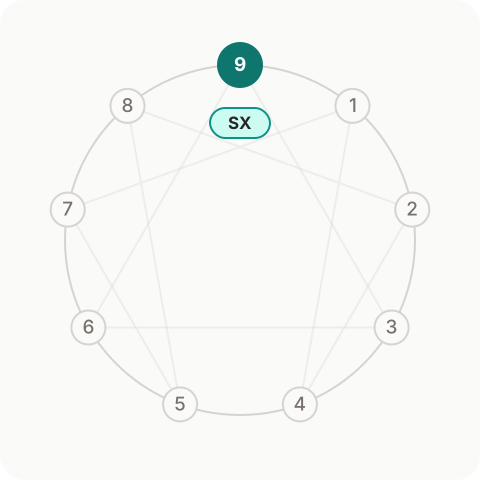
Chestnut names this subtype Fusion: the sexual Nine expresses sloth by merging with the important people in its life — unconsciously taking on the attitudes, opinions and feelings of others, because standing on its own can feel too hard. These are kind, gentle, shy characters, the least assertive of an unassertive type.
How the instinct bends the passion
Sloth filtered through the one-to-one instinct dissolves the boundary with the beloved: where the SP Nine disappears into comfort and the social Nine into the group, the SX Nine disappears into a person. The partner’s tastes become its tastes, the partner’s moods its weather, the partner’s plans its calendar — not by decision but by osmosis. Being through the other substitutes for the harder work of being through oneself.
What it looks like in daily life
The SX Nine is the sweetest presence in the room and the hardest to locate. Ask its favorite restaurant and it names its partner’s; ask its opinion of the film and it looks, subtly, at its companion first. Alone — rare — it drifts pleasantly and slightly lost, waiting, without knowing it, for someone to fuse with. Its love is absolute, restful, and quietly one-directional: everything flows toward accommodation.
A scene that gives it away
The couple’s friends run a playful quiz: each partner answers for the other. The SX Nine scores perfectly on every question about its beloved — coffee order, childhood fear, current worry. The beloved, embarrassed, misses half the questions about the Nine. Later, someone asks the Nine how that felt. ‘Fine,’ it says, sincerely — and notices, that night, the small strange grief of being unknown even to itself.
Against the other two Nines
The SP Nine merges with routines; the social Nine merges with the collective and its workload. The SX Nine merges with one heart — the tenderest Nine, the least assertive, and the one whose disappearance is easiest to mistake for devotion.
How it gets mistyped
The merging devotion reads as Two; the gentle romanticism as Four. Against Two: the Two actively manages the relationship — anticipating needs, engineering closeness; the SX Nine simply absorbs into it, taking the beloved’s shape rather than shaping the bond. Against Four: the Four insists on its distinct inner world; the SX Nine borrows one.
In love and at work
At work this subtype thrives in supportive partnerships — the co-founder’s right hand, the collaborative role with a strong counterpart — and struggles alone, where every direction requires a self to choose it. In love it is the entire pattern: the beloved becomes the operating system. Partners describe extraordinary harmony, then a creeping loneliness — living with someone who agrees with everything is living alone with an echo. The turn comes when the Nine risks its first real ‘actually, I’d rather…’ and the sky doesn’t fall.
The tradition’s tenderness toward this subtype is deserved: the merging began as love’s best available imitation — and the growth work is what makes it finally unnecessary.
Quick self-check
- Do you check your companion’s reaction before knowing your own opinion?
- Could your partner answer everything about you — while you’d score perfectly on them?
- Alone, do you drift pleasantly, waiting without knowing it for someone to fuse with?
Growth notes
The edge is the borrowed-back self: one opinion per day formed before checking the beloved’s, one activity per week done separately and reported honestly. The deeper work is grieving the years of outsourced identity without blaming the person it was outsourced to. The virtue is right action — here, the discovery that the bond survives a boundary, and deepens beside it.
Frequently asked questions
Why is the SX Nine called 'Fusion'?
Because it merges with its beloved: unconsciously taking on the other's attitudes, opinions and feelings until the boundary dissolves. Being through the partner replaces the harder work of being through oneself.
Is the SX Nine the countertype?
No — the countertype is the social Nine ('Participation'), the group workaholic. The SX Nine runs with sloth's current in its most intimate form: self-forgetting through one person.
How do I tell an SX Nine from a Two?
Watch the activity level in the bond. The Two manages the relationship — anticipating, engineering, keeping score; the SX Nine absorbs into it, taking the beloved's shape. Twos shape the bond; SX Nines dissolve into it.
Why do partners of SX Nines feel lonely?
Because perfect agreement is an echo, not a companion: the harmony is real but one-directional, and over years the partner realizes they've never been disagreed with — or truly met.
What's the growth practice for an SX Nine?
The borrowed-back self: one opinion formed daily before checking the beloved's, one separate weekly activity honestly reported. The bond survives the boundary — and deepens beside it.
Know your enneagram type. Understand yourself.
Take the free test