SX 5 — One-to-One Five: 'Confidence'

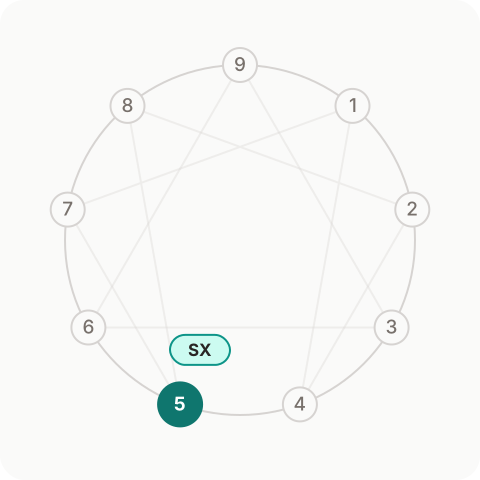
Chestnut names this subtype Confidence, and marks it the countertype of the Fives. The name means trust: the SX Five searches for one exemplar of absolute love — a partner who meets an ideal of total confidence, a person with whom the drawbridge could finally come down. This is the Five with a romantic streak: the most emotionally sensitive of the three, the one that suffers more, resembles Type Four more, and has more overt desires.
How the instinct bends the passion
Avarice filtered through the one-to-one instinct concentrates all the hoarded intimacy into a single search: not walls (SP), not shared knowledge (SO), but the one person worthy of everything behind the walls. The bar is absolute — total trust, total acceptance — and mostly untested, because testing risks the treasury. Meanwhile the vibrant inner life runs at full pressure: imagination, feeling, often artistic creation, all of it rehearsing a communion that daily life rarely gets to see.
What it looks like in daily life
Externally: a reserved, courteous Five. Internally: operas. The SX Five writes letters it doesn’t send, composes for an audience of one, and maintains — sometimes for years — a private candidate for the role of absolute confidant. In relationships it discloses in sudden deep drops rather than gradual layers: nothing for months, then, one night, everything. Friends who receive such a drop describe feeling knighted.
A scene that gives it away
Two years into a friendship the SX Five considers real, the friend casually reveals they didn’t remember some detail the Five had shared in one of its rare disclosures. The wound is instant and invisible: the drawbridge rises without a sound. The friend notices only a new formality. For the SX Five, the test — never announced — was failed; the search resumes.
Against the other two Fives
The SP Five fortifies; the social Five affiliates through ideas. The SX Five romanticizes: its avarice has an address — the ideal other — which makes it the least detached-looking Five and the countertype: desire visible where the type usually hides it.
How it gets mistyped
It reads as Four constantly: emotional depth, artistic bent, the ache for the missing communion. The tell is the default position: the Four lives in its feelings and broadcasts from them; the SX Five lives in observation and admits feeling selectively, to candidates only. Four-envy compares publicly; Five-avarice saves everything for the one.
In love and at work
At work this subtype often produces the field’s most personal work — the researcher with a poetic side, the engineer who writes. It needs autonomy plus one trusted reader. In love it is the slowest to open and the most absolute once opened: the partner becomes the exception to every rule of economy. The danger is the untested ideal — real partners flicker against an imagined absolute. The relationship works when ’enough trust, today’ replaces ’total trust, someday.'
Quick self-check
- Do you disclose in rare deep drops rather than gradual layers?
- Have you ended friendships over failed tests the other person never knew were running?
- Is there a hypothetical perfect confidant your real relationships keep losing to?
Growth notes
The edge is intermediate disclosure: sharing at 40% with several people instead of 100% with a hypothetical one. The deeper work is letting the actual partner be imperfectly trustworthy — testing small and often instead of never. The virtue is non-attachment, arriving here as a gentler grip on the ideal: love received in installments turns out to be love.
Frequently asked questions
Why is SX 5 the countertype of Type 5?
Because desire shows where the type usually hides it: the SX Five overtly wants — one ideal confidant, absolute trust, romantic communion. It's the most emotionally sensitive Five, the one that suffers visibly.
Why is this subtype called 'Confidence'?
In the sense of total trust: the search for one exemplar of absolute love — a person worthy of everything the Five keeps behind its walls. The name describes the bar the candidate must clear.
How do I tell an SX Five from a Four?
Check the default position. The Four lives inside its feelings and broadcasts from them; the SX Five lives in observation and discloses in rare, deep drops to selected candidates only. The ache is similar; the economy differs.
Why do SX Fives lose friends without explanation?
The unannounced test: candidates for absolute trust fail invisibly — a forgotten detail, a small breach — and the drawbridge rises silently. The friend only notices new formality. Naming the wound is the repair.
What's the growth practice for an SX Five?
Intermediate disclosure: 40% shared with several real people instead of 100% reserved for a hypothetical perfect one. Trust tested small and often builds the communion the ideal kept postponing.
Know your enneagram type. Understand yourself.
Take the free test