SP 6 — Self-Preservation Six: 'Warmth'

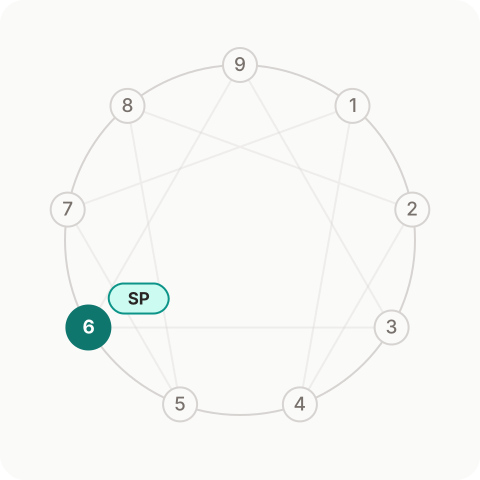
Chestnut names this subtype Warmth: the self-preservation Six answers fear with friendship — a need for protection met by banding together, by being warm, likable and trustworthy so that allies will be there when danger comes. This is the most openly phobic of the three Sixes: fear felt as insecurity, hesitation and chronic self-doubt.
How the instinct bends the passion
Fear filtered through self-preservation seeks protective alliance: the SP Six builds safety out of relationships the way the SP Five builds it out of walls. Anger is difficult to express (it might cost an ally), certainty is elusive (every decision gets re-opened), and warmth is both genuine and strategic — the currency that keeps protectors close. The tradition’s summary: fear shows up as insecurity, and relationships are the answer to feeling unsafe in the world.
What it looks like in daily life
The SP Six is the friend who remembers your birthday and your allergies, the colleague everyone trusts, the neighbor with keys to three houses. It checks decisions with its inner committee and then with the outer one; its questions outnumber its statements. Under the warmth runs a scanning anxiety — reading faces for displeasure, replaying conversations for signs of rupture — because a cooled alliance is a hole in the wall.
A scene that gives it away
Buying a car. The SP Six has researched for weeks, consulted four friends, and arrived at the right choice twice — then un-arrived. At the dealership it calls one more ally ‘just to think out loud.’ The information was never the missing piece; the backing was. Given a warm ‘you’ve got this,’ the decision completes itself in minutes.
Against the other two Sixes
The social Six leans on systems and rules; the SX Six attacks its fears head-on. The SP Six leans on people — the warmest, most hesitant and most openly anxious of the three, and the one whose kindness most disguises its engine.
How it gets mistyped
The warmth and attentiveness read as Two; the caution as Nine. Against Two: the Two gives to be needed and feels entitled to gratitude; the SP Six gives to be protected and feels relief, not pride, when the bond holds. Against Nine: the Nine’s calm is real absence of alarm; the SP Six’s friendliness sits on top of constant alarm, managed.
In love and at work
At work this subtype is the trusted deputy and the team’s connective tissue — loyal, prepared, allergic to office politics it nonetheless tracks perfectly. In love it is devoted and periodically exhausting: reassurance metabolizes fast, and the partner learns the questions repeat (‘are we okay?’) not from doubt about the answer but from the comfort of hearing it again. The relationship strengthens when reassurance is scheduled rather than extracted — and when the Six’s own competence gets cited back to it.
Chestnut names warmth itself as this Six’s strategy — which is why the pattern hides so well: the kindness is real, and it is also the armor.
Quick self-check
- Do you re-open settled decisions to run them past one more person?
- Is your warmth partly a security system — allies kept close against a rainy day?
- Does someone else’s confident ‘you’ve got this’ unlock decisions your research couldn’t?
Growth notes
The edge is the unconsulted decision: one real choice per week made alone and announced after. The deeper work is discovering that its warmth would survive its anger — allies this good aren’t lost over one honest no. The virtue is courage: not fearlessness, but action taken at 80% certainty with the committee still in session.
Frequently asked questions
Why is the SP Six called 'Warmth'?
Because friendliness is its security system: fear answered by building protective alliances — being warm, likable and trustworthy so allies stay close. The most openly phobic Six, and the kindest.
Is the SP Six the countertype?
No — the countertype is the SX Six ('Strength/Beauty'), the counterphobic Six that attacks what it fears. The SP Six runs with fear's current: felt openly, managed through connection.
How do I tell an SP Six from a Two?
Check the payoff. The Two gives to be needed and quietly expects gratitude; the SP Six gives to be protected and feels relief when the bond holds. Two-warmth bestows; Six-warmth secures.
Why do SP Sixes keep asking for reassurance?
Reassurance metabolizes fast in this subtype: the question repeats not from doubt about the answer but for the comfort of hearing it again. Scheduled, generous reassurance works better than resented extraction.
What's the growth practice for an SP Six?
The unconsulted decision: one real choice per week made alone, announced afterward. Evidence accumulates that its judgment holds — and that alliances survive an honest no.
Know your enneagram type. Understand yourself.
Take the free test