SP 5 — Self-Preservation Five: 'Castle'

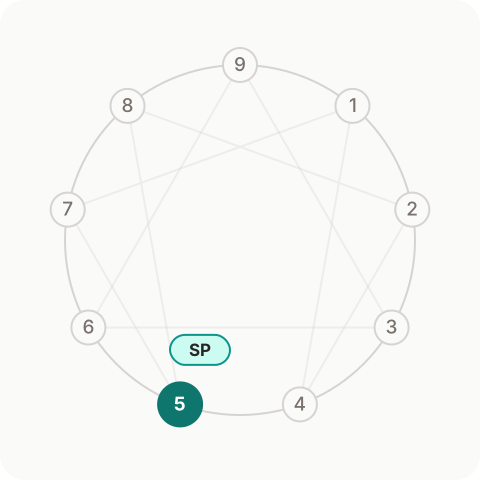
Chestnut names this subtype Castle: the self-preservation Five expresses avarice through a focus on boundaries — the need to be encastled in a sanctuary, protected from intrusion, in control of who and what gets in. Its passion is having walls, and knowing that everything needed for survival is already inside them.
How the instinct bends the passion
Avarice filtered through self-preservation becomes spatial and material: the home office nobody enters, the private schedule, the reserves of money, food and time that guarantee independence. This is the least expressive of the three Fives — and the most radical minimalist: it limits its needs and wants on purpose, because every need is a door someone could knock on. Wanting little isn’t asceticism here; it’s fortification.
What it looks like in daily life
The SP Five guards hours the way others guard money. It has a sanctuary — a room, a shed, a corner with headphones — and its week is engineered around guaranteed retreat. Socially it’s pleasant and bounded: parties attended briefly, visits scheduled, drop-ins experienced as home invasion. Its possessions are few and totemic; its files, backups and provisions quietly complete. Colleagues describe it as self-sufficient to the point of mystery.
A scene that gives it away
The doorbell rings unannounced. Watch the SP Five freeze mid-motion, silent, calculating whether the visitor knows they’re home — then either not answer at all or answer with warmth that has a departure time built into it. The friend is genuinely liked. The unscheduled breach is the problem. Nothing personal, everything structural.
Against the other two Fives
The social Five connects through shared knowledge and ideals; the SX Five searches for one absolute confidant. The SP Five wants neither audience nor merger — it wants the door closed and the stores full: the most private of an already private type.
How it gets mistyped
The withdrawal and thrift can read as an extreme introvert Nine or a fearful Six. Against Nine: the Nine merges comfortably and drifts; the SP Five’s solitude is defended, structured and productive. Against Six: the Six stockpiles allies; the SP Five stockpiles independence — its security plan has no other people in it.
In love and at work
At work this subtype is the deep specialist behind a closed door: give it a problem and privacy, and excellence returns on schedule. Open-plan offices and stand-up meetings tax it brutally. In love it is loyal, undemanding and rationed: affection real but scheduled, cohabitation negotiated room by room. Partners learn that the closed door is not rejection — and the SP Five learns, slowly, that some doors can stay open without the castle falling.
The tradition’s image of being ’encastled’ is worth keeping literal: check whether your life’s architecture — rooms, schedules, accounts — is built for connection or for controlled access.
Quick self-check
- Does an unscheduled visit register in your body as a small invasion?
- Do you keep your needs low on purpose, so nothing can be owed?
- Is your week engineered around guaranteed retreat?
A note for partners and friends: the walls predate you and aren’t about you. What opens them isn’t pressure but predictability — visits announced, asks bounded, exits honored. Trust, for this subtype, is accumulated through respected boundaries the way others accumulate it through shared confidences.
Growth notes
The edge is a spent reserve: giving unbudgeted time to a person, on impulse, and observing that the stores refill. The deeper work is discovering that needs voiced don’t become invasions. The virtue is non-attachment — which, for the Five, paradoxically means holding less tightly to the hoard, including the hoard of solitude.
Frequently asked questions
Why is the SP Five called 'Castle'?
Because its avarice builds walls: a protected sanctuary, controlled boundaries, and stores of time, money and provisions that guarantee no dependence on anyone. Needing little is the fortification strategy.
Is the SP Five the countertype?
No — the countertype is the SX Five ('Confidence'), the romantic Five that seeks one absolute confidant. The SP Five runs with avarice's current at full strength: maximum privacy, minimum need.
How do I tell an SP Five from a Nine?
Check the solitude's texture. The Nine drifts into comfortable merging and its alone-time is diffuse; the SP Five's solitude is defended, scheduled and productive — a fortress, not a fog.
Is the SP Five's minimalism the same as frugality?
It's deeper: limiting wants on purpose so that no need becomes a door others can knock on. The point isn't saving money — it's engineering a life that depends on no one.
What's the growth practice for an SP Five?
Spending a reserve on impulse: unbudgeted time given to a person, and one need voiced out loud. The stores refill — which is the evidence the castle never lets itself collect.
Know your enneagram type. Understand yourself.
Take the free test