SO 9 — Social Nine: 'Participation'

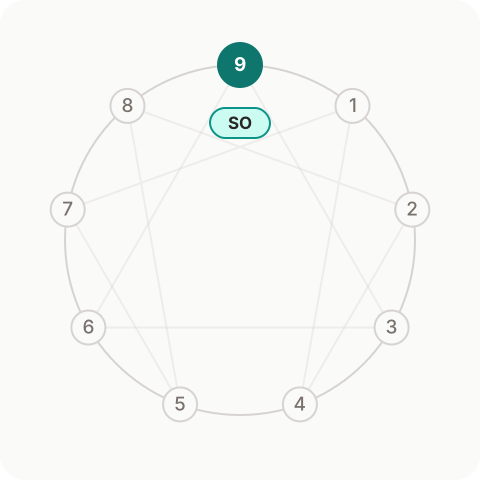
Chestnut names this subtype Participation, and marks it the countertype of the Nines. The paradox is delicious: this Nine is a workaholic — fun-loving, sociable, congenial, working hard for every group it belongs to. The laziness isn’t about effort; it’s about the inner life: the social Nine acts out sloth toward its own feelings and priorities by pouring boundless energy into the group’s.
How the instinct bends the passion
Sloth filtered through the social instinct becomes fusion-with-the-herd at industrial scale: the group’s needs are prioritized above its own so completely that its own stop being locatable. High activity is the disguise — the tradition marks this Nine as the countertype precisely because it doesn’t look lazy: committees chaired, events run, everyone’s logistics handled. The engine underneath is still Nine: belonging kept safe by never asserting a separate self.
What it looks like in daily life
The social Nine is the community’s load-bearing wall: church council, school fundraiser, office party, family reunion — all of it somehow runs through this person. Cheerful, unpretentious, universally liked, it works longer hours for the group than anyone — and goes strangely vague when asked what it would prefer. Its calendar is full of everyone; its own column is empty.
A scene that gives it away
The volunteer committee’s tenth meeting this quarter. The social Nine has brought the spreadsheet, the snacks and the patience — as always. Afterward, a newer member asks, casually, which part of the project the Nine actually cares about most. The pause is genuine: it has detailed opinions about what the group needs and none, findable, about what it wants. The workload was the membership fee — and also the hiding place.
Against the other two Nines
The SP Nine merges with comfort; the SX Nine merges with one beloved. The social Nine merges with the collective — and, uniquely, works itself hard in the process, which is why it’s the countertype: sloth wearing overalls.
How it gets mistyped
The tireless service reads as Two; the group-competence as Three or a dutiful Six. Against Two: the Two’s giving is aimed at specific people and tracks gratitude; the social Nine’s is diffuse — the group must be okay — and it forgets its own contributions entirely. Against Three: the Three works for the win and the credit; the social Nine deflects credit and keeps working.
In love and at work
At work this subtype is beloved and consumed: the person every committee wants, promoted for reliability, burned out by belonging. Its own ambitions surface late or never. In love it merges the couple into the community — hosting, organizing, showing up for everyone’s everything — while the partner slowly wonders where the private us went. The relationship recovers when the Nine spends belonging-energy on the marriage itself: one evening a week that no group can claim.
Naranjo’s label for this pattern — acting out laziness through hyperactivity for the group — remains the tradition’s best one-line description of a hidden Nine.
Quick self-check
- Is your calendar full of every group’s needs — with your own column empty?
- Asked which part of the project YOU care about, is the pause genuine?
- Do you work hardest precisely where you’ll never have to assert a separate opinion?
Growth notes
The edge is the personal column: one commitment per week that serves nobody’s agenda but its own. The deeper work is tolerating the exposure of a stated preference — the group’s warmth survives it, every time. The virtue is right action: effort finally pointed at the life it kept postponing on everyone’s behalf.
Frequently asked questions
Why is SO 9 the countertype of Type 9?
Because it doesn't look lazy: this Nine is a workaholic for its groups. The sloth operates inward — tireless activity for the collective replacing any contact with its own feelings and priorities.
Why is this subtype called 'Participation'?
Because belonging is secured through work: joining, organizing, carrying the group's load. Participation is both the membership fee and the hiding place for a self that never asserts separately.
How do I tell a social Nine from a Two?
Check the aim and the ledger. The Two serves specific people and remembers what it gave; the social Nine serves the group diffusely and forgets its own contributions. Two-giving wants love back; Nine-work wants belonging kept.
Why does the social Nine burn out?
Because the workload is structural: every group's needs outrank its own, and its own never get scheduled. The burnout arrives disguised as one more season of showing up for everyone.
What's the growth practice for a social Nine?
The personal column: one weekly commitment serving only its own agenda, and one stated preference per meeting. The group's warmth survives the assertion — every time.
Know your enneagram type. Understand yourself.
Take the free test