SO 6 — Social Six: 'Duty'

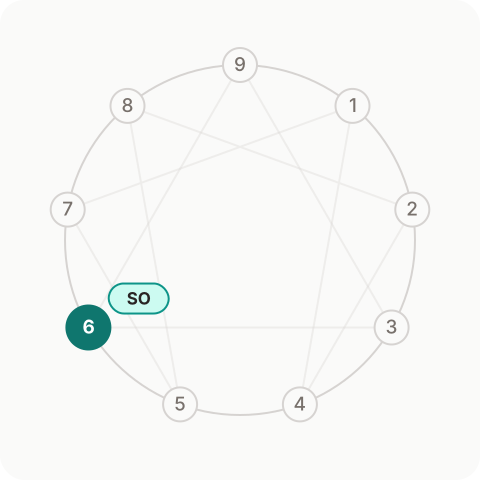
Chestnut names this subtype Duty: the social Six manages anxiety by leaning on abstract reason, ideologies and frames of reference — knowing the rules and obeying legitimate authority as a way of feeling safe in the world. Unlike the hesitant SP Six, this Six has more certainty — the tradition notes it can be ’too sure’ of things, precisely as a defense against the anxiety of uncertainty.
How the instinct bends the passion
Fear filtered through the social instinct outsources safety to systems: the law, the doctrine, the methodology, the party, the church, the style guide. Where the SP Six banks on warm allies, the social Six banks on knowing exactly what the guidelines are and following them precisely — a protective authority made of rules rather than persons. Precision and efficiency become emotional necessities: ambiguity is the enemy, procedure the shelter.
What it looks like in daily life
The social Six reads the manual, all of it. It knows the bylaws, the precedents, the correct form for every submission; teams rely on it as the process conscience. Ideologically it commits — to frameworks, methods, causes — and defends the commitments with a certainty that surprises people who know how anxious it privately runs. The paradox is structural: the more anxiety, the harder the grip on the system.
A scene that gives it away
The reorganization. New management announces the old process will change, details to follow. Colleagues shrug and wait; the social Six cannot — it needs the new rules now, asks for specifics twice in the all-hands, and drafts an interim procedure for its own team by Friday. The discomfort isn’t the change; it’s the gap between systems, the unguided stretch where anything could be the wrong move.
Against the other two Sixes
The SP Six secures itself with friendships; the SX Six intimidates its fears away. The social Six secures itself with reference points — the most rule-oriented, most ideological, and most certain-sounding of the three, its certainty being exactly where its fear hides.
How it gets mistyped
The precision and principle read as One; the system-loyalty as an institutional Three. Against One: the tradition’s line is exact — the One follows internal standards with confidence, while the social Six follows external frames against the fear of getting in trouble. Ask who authored the rulebook: the One wrote its own; the Six adopted one, gratefully.
In love and at work
At work this subtype is compliance, QA, the keeper of the runbook — indispensable wherever getting it wrong costs. The shadow is rigidity when the map and the terrain diverge. In love it is loyal by policy as well as feeling: anniversaries kept, roles honored, the relationship’s implicit contract taken seriously. Partners get a rock — and occasionally a rulebook. The relationship softens when the Six can ask ‘what do we want?’ before ‘what’s the done thing?’
Quick self-check
- When a system changes, is the gap between rulebooks the most uncomfortable part?
- Do you defend your framework’s certainty hardest exactly when you feel least certain?
- Is ‘what’s the done thing?’ your first question — before ‘what do I want?’
Growth notes
The edge is one guideline-free judgment per week: a call made on the merits, without checking the framework or its authorities. The deeper work is meeting the anxiety the certainty was hired to silence. The virtue is courage — here, the discovery that it can survive being wrong without a rule to blame.
Frequently asked questions
Why is the social Six called 'Duty'?
Because safety comes from knowing and following the rules: frameworks, doctrines and legitimate authorities function as a protective structure. Duty done correctly is this Six's shelter from uncertainty.
Is the social Six the countertype?
No — the countertype is the SX Six ('Strength/Beauty'), which attacks fear instead of obeying it. The social Six manages fear through systems: precision, procedure and ideological certainty.
How do I tell a social Six from a One?
Ask who wrote the rulebook. The One is guided confidently by internal standards it authored; the social Six adopts external frames and follows them precisely — its fear is of getting in trouble with the authority, not of betraying its own conscience.
Why does this anxious type sound so certain?
The certainty is the defense: being 'too sure' of the framework silences the anxiety of uncertainty. The grip on the system tightens exactly when the inner ground shakes.
What's the growth practice for a social Six?
One guideline-free judgment per week — a decision on the merits without consulting the framework. Surviving being wrong without a rule to blame is where this subtype's courage compounds.
Know your enneagram type. Understand yourself.
Take the free test