SO 5 — Social Five: 'Totem'

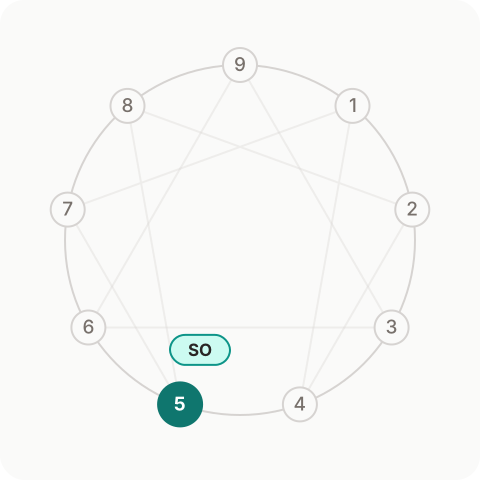
Chestnut names this subtype Totem: the social Five channels its need for people into a thirst for knowledge — relating to others through shared interests, expertise and super-ideals rather than emotional connection. The name points to its passion for high ideals: idealizing experts, seeking the knowledge tied to whatever ultimate values it serves, and searching for meaning to avoid experiencing life as meaningless.
How the instinct bends the passion
Avarice filtered through the social instinct hoards significance: this Five needs to be near the sources — the masters, the canon, the frontier of its field — and to matter within the small tribe that shares its totem. Emotional needs get converted to informational ones: where others seek warmth from a group, the social Five seeks the group’s knowledge, and offers its own as the membership fee. Connection happens shoulder-to-shoulder, looking at the shared object, never face-to-face.
What it looks like in daily life
The social Five is the person alive at the conference and absent at the reception afterward. It knows the literature, the lineages, who studied under whom; it collects mentors, forums and rare books rather than acquaintances. In its chosen domain it’s generous — lectures, answers, corrections — while remaining personally unknown to people who’ve read everything it ever wrote. Small talk starves it; shop talk feeds it indefinitely.
A scene that gives it away
Two hours deep in a discussion of its field, the social Five is expansive, funny, generous — a different person from the silent figure at dinner. Then someone asks a personal question — ‘how are you, though?’ — and the aperture visibly closes: a brief, polite answer, and a redirect to the subject. The tribe gets everything except the member.
Against the other two Fives
The SP Five wants walls; the SX Five wants one perfect confidant. The social Five wants a shared totem: belonging mediated by knowledge, closeness at the safe distance of a common subject. It is the most visible and most affiliative of the three — and its affiliations are entirely curated around ideas.
How it gets mistyped
The expertise-seeking and rule-respect read as Six; the idealism as One. Against Six: the Six cites authorities to be backed; the social Five audits authorities and keeps only the ones that survive. Against One: the One’s ideals are moral standards to enforce; the social Five’s are meaning-structures to contemplate — it wants to understand the ultimate, not legislate it.
In love and at work
At work this subtype is the standards body: the archivist, reviewer, keeper of how-things-actually-work, indispensable at the whiteboard and missing at the offsite. In love it connects through teaching and shared projects — the couple that reads together, builds together, talks about things. The partner’s challenge is reaching the person behind the expertise; the Five’s is discovering that being known personally doesn’t dissolve the meaning the knowledge was guarding.
Quick self-check
- Are your closest relationships organized around a shared subject rather than shared feelings?
- Do personal questions make you redirect to the topic within two sentences?
- Do you idealize certain experts — and audit everyone else?
Growth notes
The edge is one exchange per week with no informational content: presence without expertise. The deeper work is noticing that the search for ultimate meaning postpones the available kind — dinner, weather, the friend’s ordinary day. The virtue is non-attachment: knowledge held openly, meaning found smaller and nearer than the totem promised.
Frequently asked questions
Why is the social Five called 'Totem'?
Because it organizes belonging around shared knowledge and ultimate values: idealized experts, canonical texts, the small tribe that serves the same intellectual totem. Connection runs through ideas, not feelings.
Is the social Five the countertype?
No — the countertype is the SX Five ('Confidence'), the romantic, emotionally sensitive Five. The social Five channels avarice into knowledge: the thirst for information replacing the need for emotional contact.
How do I tell a social Five from a Six?
Watch what they do with authorities. The Six cites experts for backing and safety; the social Five audits experts and keeps only those who survive scrutiny — the framework serves meaning, not security.
Can a social Five be popular?
Within its domain, genuinely: generous teacher, respected expert, central node of its field's network. The visibility is real — and entirely mediated by the subject. Few of its admirers know anything personal about it.
What's the growth practice for a social Five?
One exchange per week with no informational content: presence without expertise, questions about someone's ordinary day. Meaning turns out to live nearer than the totem — in the dinner, not just the doctrine.
Know your enneagram type. Understand yourself.
Take the free test