SO 4 — Social Four: 'Shame'

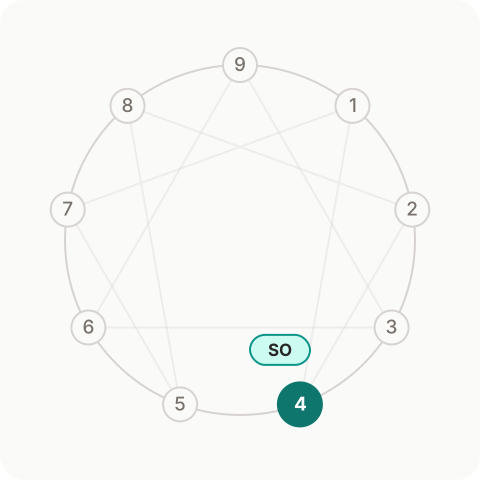
Chestnut names this subtype Shame: the social Four suffers more, feels more shame, and is more sensitive than the other two Fours. Its strategy — largely unconscious — is to attract care by intensifying pain and suffering: the lament as invitation, the wound as membership card.
How the instinct bends the passion
Envy filtered through the social instinct becomes comparison against the group — and the comparison is always lost. The social Four doesn’t compete (that’s the SX Four); it ranks itself at the bottom and dwells there, finding what the tradition calls a strange comfort in melancholy. Shame becomes the home emotion: too much lamenting, the victim position, a focus on its own inferiority that is simultaneously painful and — this is the pattern’s secret — identity-confirming. If the suffering is special, the sufferer is too.
What it looks like in daily life
The social Four is the friend whose bad news arrives beautifully told; the group member whose sensitivity everyone manages around; the artist whose work mines its own wounds with real skill. Emotionally honest to a degree that shames more defended types, it can also weaponize the honesty: sadness deployed where a request would do. Its gatherings of choice are small and deep; its enemies are brunch smalltalk and forced positivity.
A scene that gives it away
The group plans a celebration for someone else’s milestone. The social Four attends, contributes, and at some point — softly, sincerely — recenters an hour of it on its own current sorrow. Nobody minds much; it’s who they are. But watch the relief afterward: not because the pain lessened, but because it was witnessed. Unwitnessed suffering, for this subtype, barely counts as real.
Against the other two Fours
The SP Four hides the suffering and outworks it; the SX Four converts it into demand and competition. The social Four displays it — the most openly melancholy of the three, the closest to the textbook portrait, and the one whose envy compares rather than fights.
How it gets mistyped
Mistyping is rarer here — this is the recognizable Four. Confusion runs toward Six (the sensitivity and doubt) or a depressive Nine. Against Six: the Six’s turbulence is about threat, the Four’s about identity and lack. Against Nine: the Nine’s sadness is fog — diffuse, unclaimed; the social Four’s is a possession, named and tended.
In love and at work
At work this subtype thrives where sensitivity is the skill — counseling, the arts, care professions — and struggles under managers who read feeling as fragility. In love it is deeply attuned and periodically submerged: partners describe extraordinary empathy alternating with seasons of being recruited into the melancholy. The relationship matures when pain becomes something shared with the partner rather than hosted by the relationship.
Chestnut’s key distinction bears repeating: this Four compares rather than competes — the ranking is run inward, and lost on purpose.
Quick self-check
- When you’re hurting, do you feel a pull to have the pain witnessed — and a strange emptiness when nobody sees it?
- Do you rank yourself against the group and reliably land at the bottom?
- Does an ordinary, uneventful good day feel vaguely like losing yourself?
Growth notes
The edge is the direct request: asking for what the suffering used to summon. The deeper work is separating identity from injury — the terrifying possibility that being well would not erase them. The virtue is equanimity: sadness that visits without moving in, and a self that survives an ordinary, unremarkable, good day.
Frequently asked questions
Why is the social Four called 'Shame'?
Because shame is its home emotion: this Four compares itself to the group, finds itself lacking, and dwells in the resulting melancholy — attracting care through visible suffering rather than hiding or weaponizing it.
Is the social Four the countertype?
No — the countertype is the SP Four ('Tenacity'), the stoic who hides its pain. The social Four runs with envy's current: suffering felt fully, displayed openly, woven into identity.
How is the social Four different from the SX Four?
The social Four compares and laments — envy turned on itself as inferiority. The SX Four competes and demands — envy turned outward as 'I deserve what you have.' One sinks, the other fights.
Does the social Four enjoy suffering?
Not exactly — the tradition says it finds comfort in melancholy: the suffering is painful AND identity-confirming. Being the sensitive one is a role with real costs and real payoffs, which is why it persists.
What's the growth practice for a social Four?
The direct request: asking plainly for what the displayed sadness used to summon. And practicing ordinary good days — discovering that identity survives the absence of crisis.
Know your enneagram type. Understand yourself.
Take the free test