Enneagram Type 7 vs Type 9: How to Tell Them Apart
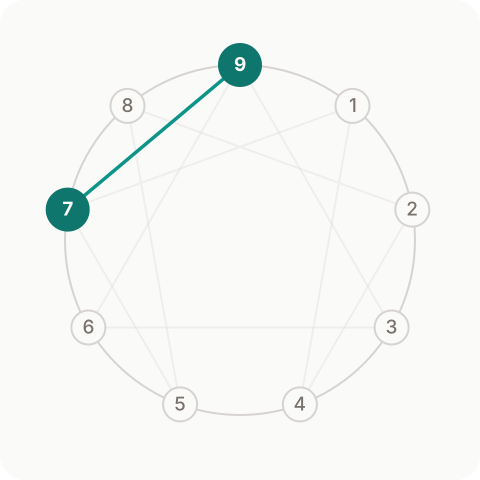
Two different engines
Type 7 (The Enthusiast)
runs on possibility — the fear of being trapped in pain, the drive to keep the future stocked.
Type 9 (The Peacemaker)
runs on peace — the fear of separation, the drive to keep the inner and outer world unruffled.
Where the confusion comes from
Both are pleasant, optimistic conflict-avoiders who keep things light — and both deflect the negative, one by reframing it, one by not receiving it. Easygoing is the shared costume.
The same scene, two engines
Sunday: the Seven wants the coast road, the new town, the seafood place someone mentioned. The Nine wants the porch. Watch the negotiation: the Seven sells the trip with escalating enthusiasm; the Nine agrees pleasantly — and moves slowly enough that departure quietly dies. Both got their Sunday: the Seven eventually went alone and had a story; the Nine had the porch and no conflict. Sunshine and shade, unreconciled.
Two questions that settle it
- Is your contentment made of stimulation or of stillness?
- When you resist a plan, do you say so — or slow down until it evaporates?
The shared surface, mapped
The tradition grounds this sunny pair in Jung: both are sensation types — the Seven extraverted sensation, the Nine introverted — and both have repressed the darker parts of their inner worlds, though for different projects: Nines to maintain their idealized identifications with the people they love; Sevens to suppress potentially overwhelming pain and anxiety. So both look upbeat and easygoing, and both change the subject when things get heavy. The energy signature separates them fastest: the Seven’s positivity is high-velocity — plans multiplying, calendar filling, stimulation sought — while the Nine’s is low-velocity — comfort deepening, routines settling, stimulation filtered. One outruns the dark; the other upholsters over it.
Why the map itself confuses them
These types share no wing border and no arrow line — the confusion is pure surface-lookalike, which makes it easier to resolve than neighbor or arrow mistypes: the engines have no structural bridge, so once you’re looking at motivation instead of behavior, the two rarely stay confusable for long. The stress-costumes are worth ruling out all the same: a stressed Seven hardens toward One — critical, impatient, perfectionistic about its escapes, while a stressed Nine frets toward Six — anxious, reactive, scanning for what could break the peace — check whether the type you tested as might be the costume of the other under load. Instinct subtypes are the other usual culprit: a countertype wears its type unusually, and can land on exactly this kind of distant lookalike.
Under load, side by side
Watch what a bad month does to each: a stressed Seven hardens toward One — critical, impatient, perfectionistic about its escapes — whereas a stressed Nine frets toward Six — anxious, reactive, scanning for what could break the peace. That divergence is useful precisely because it’s involuntary; nobody curates their overload behavior. If the calm portraits blur together, the loaded ones rarely do. Just don’t type yourself from the loaded portrait: verify against a season when things were working.
Three quick tells
- →Is your good mood fast — plans, motion, appetite (Seven) — or slow — comfort, routine, calm (Nine)?
- →Do you avoid pain by accelerating into the next thing (Seven) or by cushioning the present one (Nine)?
- →Does an empty weekend excite you with possibilities (Seven) or please you with peace (Nine)?
Settle it
Still torn between The Enthusiast and The Peacemaker? The test separates the 7-9 confusion with dedicated forced-choice questions, and reads best alongside the full Type 7 and Type 9 profiles — weight the core-fear sections triple.
Frequently asked questions
Why do Type 7 and Type 9 get confused?
Both are pleasant, optimistic conflict-avoiders who keep things light — and both deflect the negative, one by reframing it, one by not receiving it. Easygoing is the shared costume.
What single question best separates Type 7 from Type 9?
Is your contentment made of stimulation or of stillness? Your honest answer usually settles it faster than any full test.
What are the core fears of Type 7 and Type 9?
Type 7 fears being trapped in pain or deprivation; Type 9 fears loss and separation from others. Behaviors overlap, but these two alarms never do — identify which one has been ringing your whole life and the question usually settles.
Can a subtype make a Type 7 look like a Type 9?
Often, yes. The social 7 is Type 7's countertype and runs against its type's usual current, while the social 9 does the same for Type 9 — either can wear the other type's surface. If neither standard portrait fits cleanly, read both countertype pages before deciding.
How do the passions of Type 7 and Type 9 differ?
Type 7's passion is gluttony (for experience); Type 9's is sloth (self-forgetting). Watch a full week of your own behavior and ask which appetite quietly organized it — the passion is harder to fake than any answer on a test.
Know your enneagram type. Understand yourself.
Take the free test