Enneagram Type 7 vs Type 8: How to Tell Them Apart
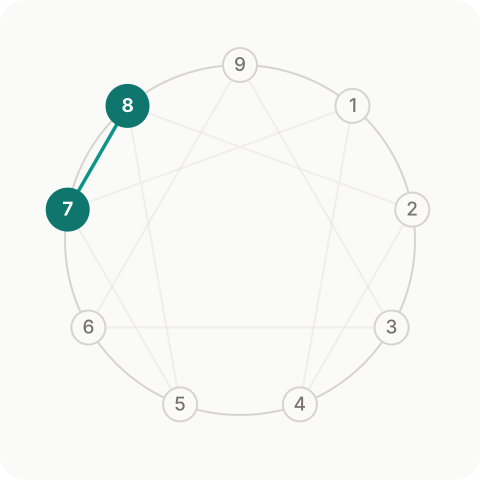
Two different engines
Type 7 (The Enthusiast)
runs on possibility — the fear of being trapped in pain, the drive to keep the future stocked.
Type 8 (The Challenger)
runs on strength — the fear of being controlled, the drive to press its full weight into life.
Where the confusion comes from
Both are big-appetite, forward-driving types who dominate rooms and resist limits — the 7w8/8w7 zone especially. Gusto is the shared surface; its target (experience versus territory) is the split.
The same scene, two engines
A business opportunity lands in both laps. The Seven sees doors: the concept’s five variations, the partnerships it could spawn, the life it might unlock — and keeps all versions alive as long as possible, because choosing one closes four. The Eight sees territory: the market entered, the resources committed, the competitor displaced — one door, kicked open, held. Appetite is common to both; only the Eight’s has a single target.
Two questions that settle it
- Do you keep options alive or kill them decisively?
- Is your appetite for tasting the world — or for owning your corner of it?
The shared surface, mapped
Both are aggressive, appetite-driven types who take what they want from life, and the tradition splits them on two axes: variety versus intensity, and freedom versus power. Sevens are practical in order to pursue the experiences they want — breadth is the point, the next thing always calling. Eights care less about variety than about having intense experiences they enjoy — depth of impact over range. And Eights want power, both to maintain independence and to assert dominance in their environment, while Sevens are notably uninterested in power: the work of maintaining it looks like a tax on their freedom. Offer each an empire: the Eight takes the throne; the Seven asks about the travel schedule.
A useful dinner-table lens: both hold court — the Seven with five stories that each spawn two more; the Eight with one story, told slower, that quietly establishes who runs the table.
Why the map itself confuses them
Wings do the heavy lifting here: the 7w8 and 8w7 sit in a genuinely blended zone, and a strong wing can outshine the core. The practical rule for neighbors: ask which side of the border your fear lives on, not your behavior — behavior is exactly what the shared wing blurs. Reading the two wing pages (7w8 and 8w7) side by side often settles what the type descriptions alone can’t.
Under load, side by side
Strain pulls the two in different directions: a stressed Seven hardens toward One — critical, impatient, perfectionistic about its escapes; at the same time, a stressed Eight withdraws toward Five — secretive, strategizing alone, trusting no one. A person met only in a hard year can be typed exactly backwards, because the stress-face borrows another number’s wardrobe. Come back to this comparison from stable ground, and watch the recovery: how each pattern climbs back to normal is a signature the crisis can’t fake.
Three quick tells
- →Do you want many experiences (Seven) — or total command of the few that matter (Eight)?
- →Does holding power appeal (Eight), or does its maintenance feel like a leash (Seven)?
- →When bored, do you change the scene (Seven) or raise the stakes (Eight)?
- →Do people describe your energy as fun that occasionally dominates (Seven) — or force that occasionally plays (Eight)?
- →Is your confrontation style a quick spark that passes (Seven) or a sustained front (Eight)?
Settle it
Still torn between The Enthusiast and The Challenger? The test separates the 7-8 confusion with dedicated forced-choice questions, and reads best alongside the full Type 7 and Type 8 profiles — weight the core-fear sections triple.
Frequently asked questions
Why do Type 7 and Type 8 get confused?
Both are big-appetite, forward-driving types who dominate rooms and resist limits — the 7w8/8w7 zone especially. Gusto is the shared surface; its target (experience versus territory) is the split.
What single question best separates Type 7 from Type 8?
Do you keep options alive or kill them decisively? Your honest answer usually settles it faster than any full test.
What are the core fears of Type 7 and Type 8?
Type 7 fears being trapped in pain or deprivation; Type 8 fears being controlled or violated. Behaviors overlap, but these two alarms never do — identify which one has been ringing your whole life and the question usually settles.
What core desire separates Type 7 from Type 8?
Type 7 wants to be satisfied and free; Type 8 wants to protect themselves and stay in charge. Imagine both fully granted tomorrow: which one would actually let you rest? People usually know instantly — and that answer is the type.
Could my subtype explain why I test between 7 and 8?
Often, yes. The social 7 is Type 7's countertype and runs against its type's usual current, while the social 8 does the same for Type 8 — either can wear the other type's surface. If neither standard portrait fits cleanly, read both countertype pages before deciding.
Know your enneagram type. Understand yourself.
Take the free test