Enneagram Type 6 vs Type 8: How to Tell Them Apart
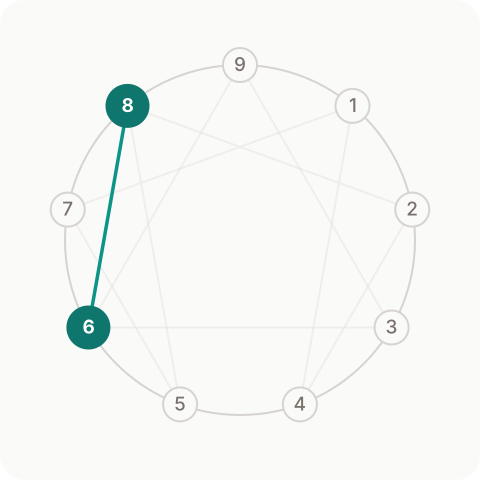
Two different engines
Type 6 (The Loyalist)
runs on security — the fear of being without support, the drive to anticipate what could go wrong.
Type 8 (The Challenger)
runs on strength — the fear of being controlled, the drive to press its full weight into life.
The tell
Both can be tough, confrontational, protective of their people. The root differs: the Eight’s force is appetite — expansion, control of its own terrain, pressure as a form of contact — while the Six’s force is reaction: vigilance armed, the counterattack of someone who refuses to be caught off guard. Eights rarely doubt themselves; Sixes are doubt, managed. After the conflict, the Eight moves on; the Six replays it. If pressure energizes you before any threat appears, read Eight. If your strength has a scanner behind it, read Six.
Where the confusion comes from
Both can be tough, confrontational and protective, and the counterphobic Six is the enneagram’s most famous Eight-impersonator. The shared armor conceals opposite relationships to fear.
The same scene, two engines
A manager mistreats their teammate. The Six documents: dates, witnesses, the HR policy’s exact clause — the case built patiently because power fights back and you’d better be bulletproof. The Eight walks in: the door closed, the manager told, the behavior ended that afternoon — the case unnecessary because the Eight is the enforcement mechanism. Both protected the teammate. One filed; one fought.
Two questions that settle it
- Do you build the case or become the consequence?
- Is your toughness a shield you check for cracks — or a weight you barely notice carrying?
The shared surface, mapped
The tradition’s structural note: these types are similar at exactly one level of the spectrum — the belligerent, authoritarian middle-low band — and different everywhere else, arriving at that similarity from opposite routes: Sixes become aggressive because they don’t want to be pushed around anymore; Eights become aggressive to push others even more. The everyday contrast is posture: Eights reveal little softness, have little desire to please or ingratiate, and rather than look to others for protection they offer it — patronage in return for hard work and loyalty. The Six oscillates — compliant then defiant, warm then suspicious — where the Eight holds one steady line. Add the counterphobic Six’s deliberate boldness and the confusion completes; the oscillation tell resolves it.
Why the map itself confuses them
These types share no wing border and no arrow line — the confusion is pure surface-lookalike, which makes it easier to resolve than neighbor or arrow mistypes: the engines have no structural bridge, so once you’re looking at motivation instead of behavior, the two rarely stay confusable for long. The stress-costumes are worth ruling out all the same: a stressed Six performs toward Three — workaholic proving, image management, competing for standing, while a stressed Eight withdraws toward Five — secretive, strategizing alone, trusting no one — check whether the type you tested as might be the costume of the other under load. Instinct subtypes are the other usual culprit: a countertype wears its type unusually, and can land on exactly this kind of distant lookalike.
Under load, side by side
Overload splits this pair cleanly: a stressed Six performs toward Three — workaholic proving, image management, competing for standing, and on the other side a stressed Eight withdraws toward Five — secretive, strategizing alone, trusting no one. Because both stress-faces impersonate other numbers, a difficult stretch is the worst evidence to type from — and also the best tiebreaker to remember afterwards. Note which collapse was yours, then confirm from a steadier month before you settle the question.
Three quick tells
- →Is your aggression a counterattack against being pushed (Six) — or the ordinary pressure of your forward motion (Eight)?
- →Do you seek backing before a confrontation (Six) or simply have the confrontation (Eight)?
- →Do you swing between compliance and defiance (Six), or hold one steady line (Eight)?
Settle it
Still torn between The Loyalist and The Challenger? The test separates the 6-8 confusion with dedicated forced-choice questions, and reads best alongside the full Type 6 and Type 8 profiles — weight the core-fear sections triple.
Frequently asked questions
Why do Type 6 and Type 8 get confused?
Both can be tough, confrontational and protective, and the counterphobic Six is the enneagram's most famous Eight-impersonator. The shared armor conceals opposite relationships to fear.
What single question best separates Type 6 from Type 8?
Do you build the case or become the consequence? Your honest answer usually settles it faster than any full test.
What are the core fears of Type 6 and Type 8?
Type 6 fears being without support or guidance; Type 8 fears being controlled or violated. Behaviors overlap, but these two alarms never do — identify which one has been ringing your whole life and the question usually settles.
What core desire separates Type 6 from Type 8?
Type 6 wants to have security and support; Type 8 wants to protect themselves and stay in charge. Imagine both fully granted tomorrow: which one would actually let you rest? People usually know instantly — and that answer is the type.
Could my subtype explain why I test between 6 and 8?
Often, yes. The one-to-one 6 is Type 6's countertype and runs against its type's usual current, while the social 8 does the same for Type 8 — either can wear the other type's surface. If neither standard portrait fits cleanly, read both countertype pages before deciding.
Know your enneagram type. Understand yourself.
Take the free test