Enneagram Type 6 vs Type 7: How to Tell Them Apart
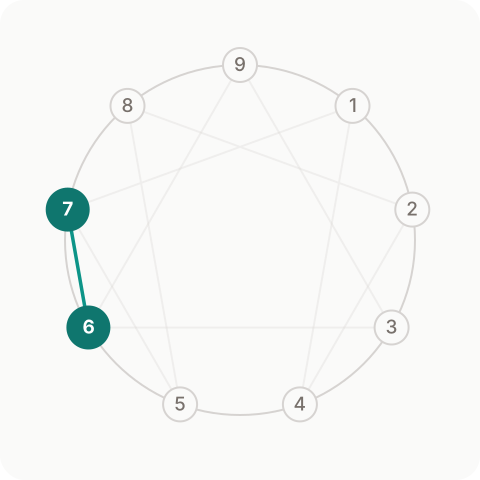
Two different engines
Type 6 (The Loyalist)
runs on security — the fear of being without support, the drive to anticipate what could go wrong.
Type 7 (The Enthusiast)
runs on possibility — the fear of being trapped in pain, the drive to keep the future stocked.
The tell
Both are quick head types wired on anxiety — they just run it in opposite directions. The Six turns toward what could go wrong: rehearsing, checking, securing commitments. The Seven turns away: reframing, optioning, keeping the exits open. Structure soothes the Six and suffocates the Seven. If your mind defaults to ‘what’s the risk?’, read Six. If it defaults to ‘what’s next?’, read Seven.
Where the confusion comes from
Adjacent head types sharing an anxious engine: the 6w7 and 7w6 differ mainly in which way they run with the same fear — toward securing it or away from feeling it.
The same scene, two engines
Their flight is cancelled at midnight. The Six knew this could happen: the alternate route researched at booking, the airline’s rebooking policy already understood, the hotel shortlist in a note — anxiety redeemed as competence. The Seven discovers it delightedly: the airport becomes an adventure, a rental car materializes, a coastal detour is proposed — disruption redeemed as material. She plans for the downside; he lives off the plot twist.
Two questions that settle it
- Does disruption reveal your preparation or your improvisation?
- Is your relationship to the future contractual or promissory?
The shared surface, mapped
Both are head types wired around anxiety, the tradition notes — the difference is the response. Sixes react to their fears, whether phobically or counterphobically; anxiety makes them more pessimistic and negative about themselves and their prospects, full of self-doubt while suspicious of others’ motives. Sevens respond to the identical signal by fleeing forward: extremely optimistic, they look for enjoyable distractions, suppress self-doubt as much as possible, keep everything upbeat, and deny the dark corners of their situations. One type metabolizes anxiety into vigilance; the other converts it into velocity. A busy, funny Six planning contingencies can look Seven-ish for an evening — but ask what the planning is for: escape routes (Six) or itineraries (Seven).
Why the map itself confuses them
Wings do the heavy lifting here: the 6w7 and 7w6 sit in a genuinely blended zone, and a strong wing can outshine the core. The practical rule for neighbors: ask which side of the border your fear lives on, not your behavior — behavior is exactly what the shared wing blurs. Reading the two wing pages (6w7 and 7w6) side by side often settles what the type descriptions alone can’t.
Under load, side by side
Watch what a bad month does to each: a stressed Six performs toward Three — workaholic proving, image management, competing for standing — whereas a stressed Seven hardens toward One — critical, impatient, perfectionistic about its escapes. That divergence is useful precisely because it’s involuntary; nobody curates their overload behavior. If the calm portraits blur together, the loaded ones rarely do. Just don’t type yourself from the loaded portrait: verify against a season when things were working.
Three quick tells
- →Does anxiety make you scan for what could go wrong (Six) — or book something fun immediately (Seven)?
- →Is your self-talk heavy with doubt (Six) or scrubbed of it (Seven)?
- →Are your plans contingencies (Six) or options (Seven)?
Settle it
Still torn between The Loyalist and The Enthusiast? The test separates the 6-7 confusion with dedicated forced-choice questions, and reads best alongside the full Type 6 and Type 7 profiles — weight the core-fear sections triple.
Frequently asked questions
Why do Type 6 and Type 7 get confused?
Adjacent head types sharing an anxious engine: the 6w7 and 7w6 differ mainly in which way they run with the same fear — toward securing it or away from feeling it.
What single question best separates Type 6 from Type 7?
Does disruption reveal your preparation or your improvisation? Your honest answer usually settles it faster than any full test.
What are the core fears of Type 6 and Type 7?
Type 6 fears being without support or guidance; Type 7 fears being trapped in pain or deprivation. Behaviors overlap, but these two alarms never do — identify which one has been ringing your whole life and the question usually settles.
Can a subtype make a Type 6 look like a Type 7?
Often, yes. The one-to-one 6 is Type 6's countertype and runs against its type's usual current, while the social 7 does the same for Type 7 — either can wear the other type's surface. If neither standard portrait fits cleanly, read both countertype pages before deciding.
How do the passions of Type 6 and Type 7 differ?
Type 6's passion is fear (anticipation); Type 7's is gluttony (for experience). Watch a full week of your own behavior and ask which appetite quietly organized it — the passion is harder to fake than any answer on a test.
Know your enneagram type. Understand yourself.
Take the free test