Enneagram Type 5 vs Type 7: How to Tell Them Apart
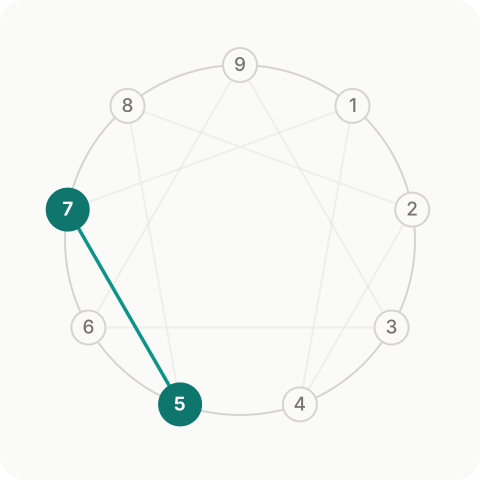
Two different engines
Type 5 (The Investigator)
runs on capacity — the fear of depletion, the drive to understand before engaging.
Type 7 (The Enthusiast)
runs on possibility — the fear of being trapped in pain, the drive to keep the future stocked.
Where the confusion comes from
Both are curious, idea-hungry head types — and the growth/stress line between them runs both ways: scattered Fives look Seven-ish, depleted Sevens look Five-ish. Appetite for knowing is the shared surface.
The same scene, two engines
A completely free weekend appears. The Five descends: the one project, the closed door, the phone on silent — depth as luxury, emerging Sunday night nourished and slightly surprised it’s dark. The Seven ascends: the market, the friends, the impulse drive, the new place — breadth as luxury, arriving Sunday night full and slightly relieved it’s over. Both call it a perfect weekend. Neither believes the other.
Two questions that settle it
- Does stimulation cost you energy or generate it?
- Is your ideal freedom a closed door or an open road?
The shared surface, mapped
The tradition draws this pair’s line through entertainment itself: Fives prefer cerebral entertainment — projects, reading, music, the pleasures of a furnished mind — while Sevens are gregarious and active, enjoying a good read too but growing impatient with extended sitting. The gift formulation is the cleanest version: the gift of the Five is intense focus and concentration; the gift of the Seven is breadth, speed and appetite. Both are curious head types who collect ideas; the collection strategy differs — the Five mines one vein to depletion, the Seven prospects the whole territory. Ask what a perfect free day contains, and how long one interest holds, and the pair separates in minutes.
A useful vacation lens: both book the trip — the Five to one quiet city with three museums and a reading list; the Seven to four cities, with the itinerary still growing at the airport.
Why the map itself confuses them
The arrows connect these two directly: Type 5’s stress line points at Type 7, so extended periods of stress make a 5 genuinely wear 7’s costume — a stressed Five scatters toward Seven — jumpy, distracted, escaping into projects and stimulation. If you tested during an unusual season of your life, that’s the first thing to rule out: re-read both types from a calmer month. The arrows guide covers the mechanics.
Under load, side by side
Overload splits this pair cleanly: a stressed Five scatters toward Seven — jumpy, distracted, escaping into projects and stimulation, and on the other side a stressed Seven hardens toward One — critical, impatient, perfectionistic about its escapes. Because both stress-faces impersonate other numbers, a difficult stretch is the worst evidence to type from — and also the best tiebreaker to remember afterwards. Note which collapse was yours, then confirm from a steadier month before you settle the question.
Three quick tells
- →Is your ideal entertainment cerebral and stationary (Five) — or active and social (Seven)?
- →Does one interest hold you for months (Five) or weeks at most before the next (Seven)?
- →Is your curiosity a drill (Five) or a net (Seven)?
- →Do you leave a party early to get back to a project (Five) — or extend it into a second location (Seven)?
One more field note: at a conference, the Five attends two talks and leaves with one deep contact; the Seven attends nine, leaves with thirty cards, and reads none of the proceedings.
Settle it
Still torn between The Investigator and The Enthusiast? The test separates the 5-7 confusion with dedicated forced-choice questions, and reads best alongside the full Type 5 and Type 7 profiles — weight the core-fear sections triple.
Frequently asked questions
Why do Type 5 and Type 7 get confused?
Both are curious, idea-hungry head types — and the growth/stress line between them runs both ways: scattered Fives look Seven-ish, depleted Sevens look Five-ish. Appetite for knowing is the shared surface.
What single question best separates Type 5 from Type 7?
Does stimulation cost you energy or generate it? Your honest answer usually settles it faster than any full test.
What are the core fears of Type 5 and Type 7?
Type 5 fears being depleted, incapable, overwhelmed; Type 7 fears being trapped in pain or deprivation. Behaviors overlap, but these two alarms never do — identify which one has been ringing your whole life and the question usually settles.
What core desire separates Type 5 from Type 7?
Type 5 wants to be capable and competent; Type 7 wants to be satisfied and free. Imagine both fully granted tomorrow: which one would actually let you rest? People usually know instantly — and that answer is the type.
Could my subtype explain why I test between 5 and 7?
Often, yes. The one-to-one 5 is Type 5's countertype and runs against its type's usual current, while the social 7 does the same for Type 7 — either can wear the other type's surface. If neither standard portrait fits cleanly, read both countertype pages before deciding.
Know your enneagram type. Understand yourself.
Take the free test