Enneagram Type 5 vs Type 6: How to Tell Them Apart
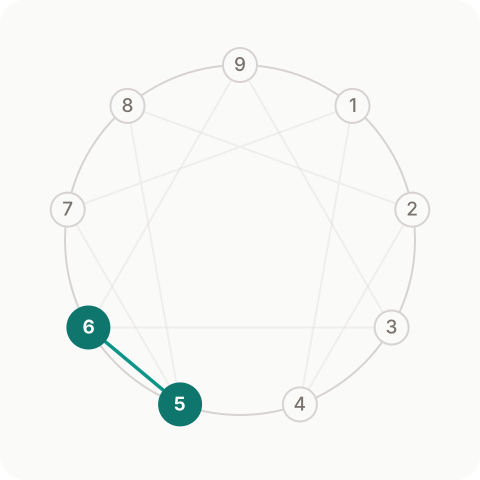
Two different engines
Type 5 (The Investigator)
runs on capacity — the fear of depletion, the drive to understand before engaging.
Type 6 (The Loyalist)
runs on security — the fear of being without support, the drive to anticipate what could go wrong.
Where the confusion comes from
Both are vigilant head types who research before trusting, and the 5w6/6w5 zone blurs completely at the surface. The tradition’s own test: where does certainty come from — inside or outside?
The same scene, two engines
Both buy travel insurance. The Five reads the policy — actually reads it — and decides from the document: coverage understood, probabilities weighed, decision closed, never revisited. The Six reads the policy, then the reviews of the insurer, then asks two friends who traveled last year, then buys — and rechecks the confirmation email twice before the flight. Same purchase; the Five’s certainty is self-made, the Six’s is crowd-checked.
Two questions that settle it
- Does your certainty come from your own analysis — or from its confirmation?
- After deciding, is the case closed, or does it reopen at 2 a.m.?
The shared surface, mapped
The tradition offers a cultural diagnosis for this head-type tangle: academia itself teaches Six values — work with advisers and mentors, cite sources, back arguments with authorities, follow proper procedure — so educated Sixes routinely read their trained diligence as Five-ness. The structural difference underneath: Fives are much more nonlinear thinkers, interested in finding out where accepted wisdom breaks, drawn to gaps and anomalies, comfortable concluding against every authority in the field. The Six’s thinking is thorough inside sanctioned frames; the Five’s dissolves the frames. Watch the citations: the Six cites to be backed; the Five cites to show its own conclusion survives the literature.
A useful classroom lens: assign each a thesis — the Six builds it brick by cited brick on the advisor’s framework; the Five’s most alive chapter is the one arguing the framework itself is wrong.
Why the map itself confuses them
Wings do the heavy lifting here: the 5w6 and 6w5 sit in a genuinely blended zone, and a strong wing can outshine the core. The practical rule for neighbors: ask which side of the border your fear lives on, not your behavior — behavior is exactly what the shared wing blurs. Reading the two wing pages (5w6 and 6w5) side by side often settles what the type descriptions alone can’t.
Under load, side by side
Watch what a bad month does to each: a stressed Five scatters toward Seven — jumpy, distracted, escaping into projects and stimulation — whereas a stressed Six performs toward Three — workaholic proving, image management, competing for standing. That divergence is useful precisely because it’s involuntary; nobody curates their overload behavior. If the calm portraits blur together, the loaded ones rarely do. Just don’t type yourself from the loaded portrait: verify against a season when things were working.
Three quick tells
- →Do authorities in your field back you up (Six) — or mostly provide the wisdom you test for cracks (Five)?
- →Is your certainty complete when the sources agree (Six), or when your own analysis closes regardless of them (Five)?
- →Does proper procedure reassure you (Six) or vaguely bore you (Five)?
- →When an expert disagrees with you, do you re-examine your position (Six) — or theirs (Five)?
- →Do you trust your own analysis over the field’s consensus (Five), or feel safer inside it (Six)?
Settle it
Still torn between The Investigator and The Loyalist? The test separates the 5-6 confusion with dedicated forced-choice questions, and reads best alongside the full Type 5 and Type 6 profiles — weight the core-fear sections triple.
Frequently asked questions
Why do Type 5 and Type 6 get confused?
Both are vigilant head types who research before trusting, and the 5w6/6w5 zone blurs completely at the surface. The tradition's own test: where does certainty come from — inside or outside?
What single question best separates Type 5 from Type 6?
Does your certainty come from your own analysis — or from its confirmation? Your honest answer usually settles it faster than any full test.
What are the core fears of Type 5 and Type 6?
Type 5 fears being depleted, incapable, overwhelmed; Type 6 fears being without support or guidance. Behaviors overlap, but these two alarms never do — identify which one has been ringing your whole life and the question usually settles.
Can a subtype make a Type 5 look like a Type 6?
Often, yes. The one-to-one 5 is Type 5's countertype and runs against its type's usual current, while the one-to-one 6 does the same for Type 6 — either can wear the other type's surface. If neither standard portrait fits cleanly, read both countertype pages before deciding.
How do the passions of Type 5 and Type 6 differ?
Type 5's passion is avarice (hoarding of self); Type 6's is fear (anticipation). Watch a full week of your own behavior and ask which appetite quietly organized it — the passion is harder to fake than any answer on a test.
Know your enneagram type. Understand yourself.
Take the free test