Enneagram Type 4 vs Type 7: How to Tell Them Apart
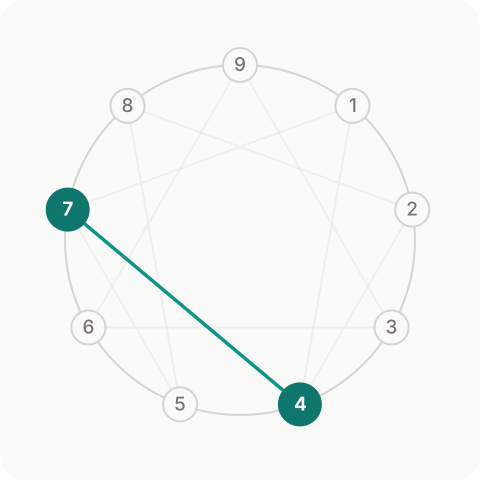
Two different engines
Type 4 (The Individualist)
runs on identity — the fear of being nobody in particular, the drive to find what’s authentically its own.
Type 7 (The Enthusiast)
runs on possibility — the fear of being trapped in pain, the drive to keep the future stocked.
Where the confusion comes from
Opposite strategies for the same wound — both organize life around avoiding the ordinary. The Seven’s gold-plated future and the Four’s dark-velvet interior are two answers to one deprivation.
The same scene, two engines
Both visit the museum. The Four finds one room and stays: the small dark portrait that knows something about them, twenty minutes of communion, the visit remembered by its wound. The Seven completes the museum: every wing, the special exhibit, the café, the gift shop, two facts about Flemish light saved for dinner conversation — the visit remembered by its abundance. Depth versus breadth, chosen automatically.
Two questions that settle it
- Do you collect intensities or experiences?
- When sadness arrives, do you sit down with it — or does your calendar suddenly fill?
The shared surface, mapped
The tradition compares these two at the same average level and finds parallel excess with opposite content: the Seven as Excessive Materialist — acquisitive, demanding, going to extremes of experience — and the Four as Self-Indulgent Aesthete, equally excessive but emotionally: going for the big emotional charge in fantasy, allowing itself every intensity of feeling. Both organize life around avoiding the ordinary; both know self-indulgence from inside. The axis is the direction of the binge: the Seven’s excess consumes the outer world (purchases, trips, sensations), the Four’s consumes the inner one (moods, fantasies, dramas of meaning). One escapes into more; the other into deeper.
Why the map itself confuses them
These types share no wing border and no arrow line — the confusion is pure surface-lookalike, which makes it easier to resolve than neighbor or arrow mistypes: the engines have no structural bridge, so once you’re looking at motivation instead of behavior, the two rarely stay confusable for long. The stress-costumes are worth ruling out all the same: a stressed Four clings toward Two — over-involved, needing to be needed, testing people’s love, while a stressed Seven hardens toward One — critical, impatient, perfectionistic about its escapes — check whether the type you tested as might be the costume of the other under load. Instinct subtypes are the other usual culprit: a countertype wears its type unusually, and can land on exactly this kind of distant lookalike.
Under load, side by side
Overload splits this pair cleanly: a stressed Four clings toward Two — over-involved, needing to be needed, testing people’s love, and on the other side a stressed Seven hardens toward One — critical, impatient, perfectionistic about its escapes. Because both stress-faces impersonate other numbers, a difficult stretch is the worst evidence to type from — and also the best tiebreaker to remember afterwards. Note which collapse was yours, then confirm from a steadier month before you settle the question.
Three quick tells
- →Is your excess acquisitive — experiences, purchases, plans (Seven) — or emotional — moods, fantasies, intensities (Four)?
- →Do you flee pain outward into stimulation (Seven) or inward into significance (Four)?
- →Which feels like starvation: a limited calendar (Seven) or a shallow inner life (Four)?
One more field note: both romanticize the unlived life, but the Seven books a ticket toward it while the Four writes a letter to it — motion versus meaning, again and always.
Settle it
Still torn between The Individualist and The Enthusiast? The test separates the 4-7 confusion with dedicated forced-choice questions, and reads best alongside the full Type 4 and Type 7 profiles — weight the core-fear sections triple.
Frequently asked questions
Why do Type 4 and Type 7 get confused?
Opposite strategies for the same wound — both organize life around avoiding the ordinary. The Seven's gold-plated future and the Four's dark-velvet interior are two answers to one deprivation.
What single question best separates Type 4 from Type 7?
Do you collect intensities or experiences? Your honest answer usually settles it faster than any full test.
What are the core fears of Type 4 and Type 7?
Type 4 fears having no identity or significance; Type 7 fears being trapped in pain or deprivation. Behaviors overlap, but these two alarms never do — identify which one has been ringing your whole life and the question usually settles.
What core desire separates Type 4 from Type 7?
Type 4 wants to be uniquely, authentically themselves; Type 7 wants to be satisfied and free. Imagine both fully granted tomorrow: which one would actually let you rest? People usually know instantly — and that answer is the type.
Could my subtype explain why I test between 4 and 7?
Often, yes. The self-preservation 4 is Type 4's countertype and runs against its type's usual current, while the social 7 does the same for Type 7 — either can wear the other type's surface. If neither standard portrait fits cleanly, read both countertype pages before deciding.
Know your enneagram type. Understand yourself.
Take the free test