Enneagram Type 4 vs Type 6: How to Tell Them Apart
Two different engines
Type 4 (The Individualist)
runs on identity — the fear of being nobody in particular, the drive to find what’s authentically its own.
Type 6 (The Loyalist)
runs on security — the fear of being without support, the drive to anticipate what could go wrong.
Where the confusion comes from
Both are anxious romantics of a kind — emotionally reactive, doubt-prone, attached to what they fear losing. A Six’s emotional storms read Four-ish; a Four’s catastrophic imagination reads Six-ish.
The same scene, two engines
A strange symptom sends both to the doctor. The Four metabolizes it into meaning: what would it say about my life if this were serious — the mortality thread woven, by evening, into the old fabric of being singularly fated. The Six metabolizes it into scenarios: the three possible diagnoses researched, the second opinion scheduled, the family history re-mapped. The Four feels the threat as story; the Six works it as case.
Two questions that settle it
- Does fear arrive as imagery about your fate — or as scenarios needing plans?
- Do you trust your feelings’ report of reality more than your research, or less?
The shared surface, mapped
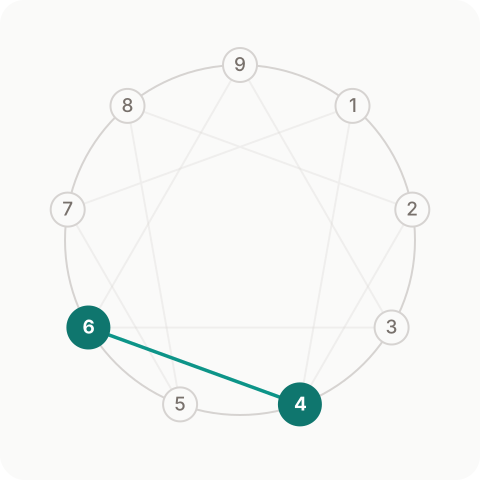
The tradition observes that the confusion runs principally from the Six side, and grounds the real difference in psychic structure: Fours are true introverts, while Sixes are true ambiverts — a blend of both orientations — and bonding comes more easily to Sixes than to Fours. Both types are emotionally reactive, doubt-prone and attached to what they fear losing; both know anxiety intimately. The separator is what the emotionality serves: the Four’s storms are about identity (who am I, why am I outside), the Six’s about security (what’s coming, who’s with me). A Six reading Four descriptions recognizes the turbulence and misses that its own turbulence has a threat-shape, not a self-shape.
Why the map itself confuses them
These types share no wing border and no arrow line — the confusion is pure surface-lookalike, which makes it easier to resolve than neighbor or arrow mistypes: the engines have no structural bridge, so once you’re looking at motivation instead of behavior, the two rarely stay confusable for long. The stress-costumes are worth ruling out all the same: a stressed Four clings toward Two — over-involved, needing to be needed, testing people’s love, while a stressed Six performs toward Three — workaholic proving, image management, competing for standing — check whether the type you tested as might be the costume of the other under load. Instinct subtypes are the other usual culprit: a countertype wears its type unusually, and can land on exactly this kind of distant lookalike.
Under load, side by side
Watch what a bad month does to each: a stressed Four clings toward Two — over-involved, needing to be needed, testing people’s love — whereas a stressed Six performs toward Three — workaholic proving, image management, competing for standing. That divergence is useful precisely because it’s involuntary; nobody curates their overload behavior. If the calm portraits blur together, the loaded ones rarely do. Just don’t type yourself from the loaded portrait: verify against a season when things were working.
Three quick tells
- →Are your emotional storms about who you are (Four) — or about what might happen (Six)?
- →Does bonding come with relative ease once trust is set (Six), or remain effortful even in love (Four)?
- →Is your imagination drawn to your own depths (Four) or to tomorrow’s scenarios (Six)?
Settle it
Still torn between The Individualist and The Loyalist? The test separates the 4-6 confusion with dedicated forced-choice questions, and reads best alongside the full Type 4 and Type 6 profiles — weight the core-fear sections triple.
Frequently asked questions
Why do Type 4 and Type 6 get confused?
Both are anxious romantics of a kind — emotionally reactive, doubt-prone, attached to what they fear losing. A Six's emotional storms read Four-ish; a Four's catastrophic imagination reads Six-ish.
What single question best separates Type 4 from Type 6?
Does fear arrive as imagery about your fate — or as scenarios needing plans? Your honest answer usually settles it faster than any full test.
What are the core fears of Type 4 and Type 6?
Type 4 fears having no identity or significance; Type 6 fears being without support or guidance. Behaviors overlap, but these two alarms never do — identify which one has been ringing your whole life and the question usually settles.
Can a subtype make a Type 4 look like a Type 6?
Often, yes. The self-preservation 4 is Type 4's countertype and runs against its type's usual current, while the one-to-one 6 does the same for Type 6 — either can wear the other type's surface. If neither standard portrait fits cleanly, read both countertype pages before deciding.
How do the passions of Type 4 and Type 6 differ?
Type 4's passion is envy; Type 6's is fear (anticipation). Watch a full week of your own behavior and ask which appetite quietly organized it — the passion is harder to fake than any answer on a test.
Know your enneagram type. Understand yourself.
Take the free test