Enneagram Type 4 vs Type 5: How to Tell Them Apart
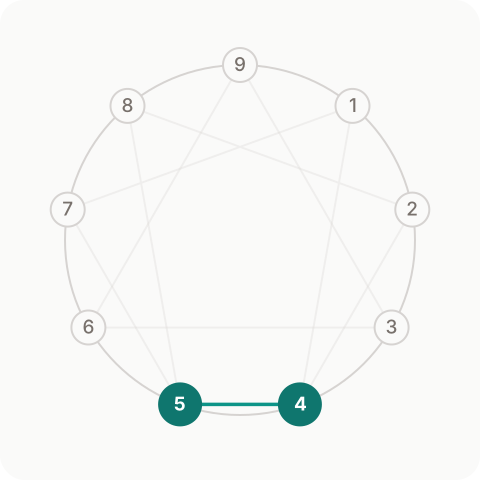
Two different engines
Type 4 (The Individualist)
runs on identity — the fear of being nobody in particular, the drive to find what’s authentically its own.
Type 5 (The Investigator)
runs on capacity — the fear of depletion, the drive to understand before engaging.
The tell
Both withdraw, both live in rich inner worlds, both feel ‘different’. The split is what leads: the Four meets life feelings-first — the inner weather is the news — while the Five meets it mind-first, stepping back to observe before anything is allowed to land emotionally. A Four processes a hard day by feeling it fully, often out loud; a Five files it for later and may never open the file. If expressing the feeling is part of surviving it, think Four. If understanding it from a safe distance is, think Five.
Where the confusion comes from
Both are withdrawn, intense interiors drawn to depth and put off by small talk — the 4w5/5w4 zone is genuinely liminal. The confusion is structural: both types meet the world at one remove.
The same scene, two engines
Both process the same loss. The Four enters it: the grief inhabited, expressed, composed into something — the feeling is the processing. The Five encircles it: the grief observed, understood, filed for scheduled visits — the understanding is the processing, and the feeling is released in private installments, sometimes years later. Neither is avoiding; they’re digesting in opposite organs.
Two questions that settle it
- Do you digest pain by feeling it or by understanding it?
- Is expression part of your survival — or a cost you rarely pay?
The shared surface, mapped
The tradition names two false shortcuts feeding this mistype. First, depth-of-feeling: Fives, sensing they have deep feelings, presume they must be Fours — especially, the casework notes, female Fives, for whom the cultural script makes ‘feeling type’ the expected reading. Second, occupational typecasting: Fives get portrayed as scientists and Fours as artists, when in fact there are as many Five artists as Four artists. The real division is processing: the Four inhabits its feelings and expresses them as identity; the Five observes its feelings — deep as they are — from one remove, and releases them privately, on a delay, sometimes years later. Depth is common to both; residence differs. One lives in the feeling; the other visits it, takes notes, and files the visit.
Why the map itself confuses them
Wings do the heavy lifting here: the 4w5 and 5w4 sit in a genuinely blended zone, and a strong wing can outshine the core. The practical rule for neighbors: ask which side of the border your fear lives on, not your behavior — behavior is exactly what the shared wing blurs. Reading the two wing pages (4w5 and 5w4) side by side often settles what the type descriptions alone can’t.
Under load, side by side
Strain pulls the two in different directions: a stressed Four clings toward Two — over-involved, needing to be needed, testing people’s love; at the same time, a stressed Five scatters toward Seven — jumpy, distracted, escaping into projects and stimulation. A person met only in a hard year can be typed exactly backwards, because the stress-face borrows another number’s wardrobe. Come back to this comparison from stable ground, and watch the recovery: how each pattern climbs back to normal is a signature the crisis can’t fake.
Three quick tells
- →Do you live inside your feelings (Four) — or observe and catalog them from one step back (Five)?
- →Is expression part of surviving an emotion (Four), or a cost you rarely pay (Five)?
- →Does your art or work express your interior (Four) or your understanding (Five)?
Settle it
Still torn between The Individualist and The Investigator? The test separates the 4-5 confusion with dedicated forced-choice questions, and reads best alongside the full Type 4 and Type 5 profiles — weight the core-fear sections triple.
Frequently asked questions
Why do Type 4 and Type 5 get confused?
Both are withdrawn, intense interiors drawn to depth and put off by small talk — the 4w5/5w4 zone is genuinely liminal. The confusion is structural: both types meet the world at one remove.
What single question best separates Type 4 from Type 5?
Do you digest pain by feeling it or by understanding it? Your honest answer usually settles it faster than any full test.
What are the core fears of Type 4 and Type 5?
Type 4 fears having no identity or significance; Type 5 fears being depleted, incapable, overwhelmed. Behaviors overlap, but these two alarms never do — identify which one has been ringing your whole life and the question usually settles.
What core desire separates Type 4 from Type 5?
Type 4 wants to be uniquely, authentically themselves; Type 5 wants to be capable and competent. Imagine both fully granted tomorrow: which one would actually let you rest? People usually know instantly — and that answer is the type.
Could my subtype explain why I test between 4 and 5?
Often, yes. The self-preservation 4 is Type 4's countertype and runs against its type's usual current, while the one-to-one 5 does the same for Type 5 — either can wear the other type's surface. If neither standard portrait fits cleanly, read both countertype pages before deciding.
Know your enneagram type. Understand yourself.
Take the free test