Enneagram Type 3 vs Type 9: How to Tell Them Apart
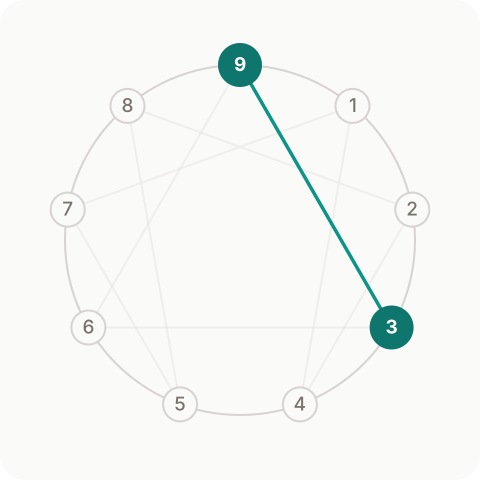
Two different engines
Type 3 (The Achiever)
runs on value-through-achievement — the fear of worthlessness, the drive to be seen succeeding.
Type 9 (The Peacemaker)
runs on peace — the fear of separation, the drive to keep the inner and outer world unruffled.
Where the confusion comes from
The bridge is disintegration: burned-out Threes fog into Nine and rest-mode Threes test as Nines. Both are also adaptable — one adapts to win the room, the other to keep it calm.
The same scene, two engines
Give both a free Sunday afternoon. The Three’s rest has a structure: the run (tracked), the reading (professional), the family time (photographed, a little) — recovery as another performance surface. The Nine’s rest is genuinely restful: the couch, the puttering, the afternoon that dissolves pleasantly without record. The tell is the discomfort: idle time makes the Three itch; scheduled productivity makes the Nine tired in advance.
Two questions that settle it
- Does rest need a purpose to be permitted?
- When you ‘go along’ with plans, is it strategy — or the path of least presence?
The shared surface, mapped
The tradition’s contrast is motivational ignition: Threes are highly motivated self-starters who launch into projects certain they’ll succeed and have trouble slowing down; Nines can be highly accomplished and hugely successful — but many such Nines have friends or spouses who keep them motivated and on track. The achievement exists in both cases; its fuel source differs. The Three’s drive is internal and constant; the accomplished Nine runs on borrowed ignition — a partner’s agenda, a mentor’s belief, an institution’s structure — and idles when the external engine disconnects. Ask where the last big push actually started, and whether momentum survives alone time, and the two separate cleanly.
A useful weekend lens: hand each an empty Saturday — the Three fills it with the goal list by breakfast; the Nine genuinely rests, and Sunday night wonders, mildly, where the time went.
Why the map itself confuses them
The arrows connect these two directly: Type 3’s stress line points at Type 9, so extended periods of stress make a 3 genuinely wear 9’s costume — a stressed Three fogs toward Nine — numb, disengaged, going through motions behind the smile. If you tested during an unusual season of your life, that’s the first thing to rule out: re-read both types from a calmer month. The arrows guide covers the mechanics.
Under load, side by side
Pressure rewrites both profiles at once: a stressed Three fogs toward Nine — numb, disengaged, going through motions behind the smile, while a stressed Nine frets toward Six — anxious, reactive, scanning for what could break the peace. Neither of those faces matches the type at rest, so a rough season is a misleading window for self-typing. If this page still feels unresolved, reread both profiles from a calmer month — and pay attention to the road each of you takes back to baseline, which is often more telling than the strain itself.
Three quick tells
- →Does your drive self-start (Three) — or reliably need a person or structure to ignite it (Nine)?
- →When left completely alone for a month, does your output hold (Three) or gently drift (Nine)?
- →Are your goals unmistakably yours (Three), or adopted from people you love (Nine)?
- →Does ambition feel native to your body (Three) or like a coat someone handed you (Nine)?
Settle it
Still torn between The Achiever and The Peacemaker? The test separates the 3-9 confusion with dedicated forced-choice questions, and reads best alongside the full Type 3 and Type 9 profiles — weight the core-fear sections triple.
Frequently asked questions
Why do Type 3 and Type 9 get confused?
The bridge is disintegration: burned-out Threes fog into Nine and rest-mode Threes test as Nines. Both are also adaptable — one adapts to win the room, the other to keep it calm.
What single question best separates Type 3 from Type 9?
Does rest need a purpose to be permitted? Your honest answer usually settles it faster than any full test.
What are the core fears of Type 3 and Type 9?
Type 3 fears being worthless without achievement; Type 9 fears loss and separation from others. Behaviors overlap, but these two alarms never do — identify which one has been ringing your whole life and the question usually settles.
Can a subtype make a Type 3 look like a Type 9?
Often, yes. The self-preservation 3 is Type 3's countertype and runs against its type's usual current, while the social 9 does the same for Type 9 — either can wear the other type's surface. If neither standard portrait fits cleanly, read both countertype pages before deciding.
How do the passions of Type 3 and Type 9 differ?
Type 3's passion is deceit (self-deception); Type 9's is sloth (self-forgetting). Watch a full week of your own behavior and ask which appetite quietly organized it — the passion is harder to fake than any answer on a test.
Know your enneagram type. Understand yourself.
Take the free test