Enneagram Type 3 vs Type 8: How to Tell Them Apart
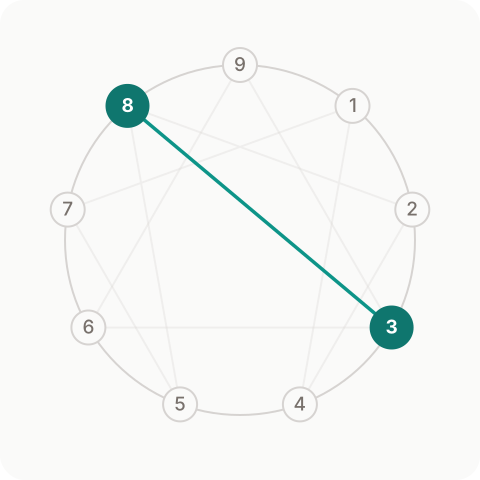
Two different engines
Type 3 (The Achiever)
runs on value-through-achievement — the fear of worthlessness, the drive to be seen succeeding.
Type 8 (The Challenger)
runs on strength — the fear of being controlled, the drive to press its full weight into life.
Where the confusion comes from
Both are assertive winners who take charge and get results, and org charts promote them interchangeably. The confusion lives in competition — watch what victory is for.
The same scene, two engines
Both negotiate a promotion. The Three builds the case: the numbers, the visibility, the year’s wins arranged into an undeniable narrative — and reads the boss’s face throughout, adjusting. The Eight states the position: the value delivered, the number expected, the alternative if not — and reads nothing, because the point wasn’t to be liked. The Three wins by being wanted; the Eight wins by being costly to refuse.
Two questions that settle it
- In negotiation, do you track the other side’s impression of you — or only their resistance?
- Would you rather be admired or be feared-respected?
The shared surface, mapped
The tradition attributes this mistype to flattering-identity shopping — the same motive that sends Threes toward Seven and Five descriptions — plus a real overlap: both are assertive, competitive drivers who want things their way. The competition differs in content: Eights compete for material, political or sexual dominance, rarely over purely social or status issues, and they don’t spend much time comparing themselves with others — certainly never to the degree Threes do. Eights want their way immediately so they don’t waste time fighting; Threes want the scoreboard to say they won. Strip the audience from a victory and the Eight’s satisfaction is untouched; the Three’s needs the ranking witnessed.
Why the map itself confuses them
These types share no wing border and no arrow line — the confusion is pure surface-lookalike, which makes it easier to resolve than neighbor or arrow mistypes: the engines have no structural bridge, so once you’re looking at motivation instead of behavior, the two rarely stay confusable for long. The stress-costumes are worth ruling out all the same: a stressed Three fogs toward Nine — numb, disengaged, going through motions behind the smile, while a stressed Eight withdraws toward Five — secretive, strategizing alone, trusting no one — check whether the type you tested as might be the costume of the other under load. Instinct subtypes are the other usual culprit: a countertype wears its type unusually, and can land on exactly this kind of distant lookalike.
Under load, side by side
Overload splits this pair cleanly: a stressed Three fogs toward Nine — numb, disengaged, going through motions behind the smile, and on the other side a stressed Eight withdraws toward Five — secretive, strategizing alone, trusting no one. Because both stress-faces impersonate other numbers, a difficult stretch is the worst evidence to type from — and also the best tiebreaker to remember afterwards. Note which collapse was yours, then confirm from a steadier month before you settle the question.
Three quick tells
- →Do you compare yourself constantly against peers (Three) — or barely track the comparison at all (Eight)?
- →Is the win about dominance over territory and resources (Eight) or about status and being seen as the best (Three)?
- →When challenged publicly, do you manage your image first (Three) or apply force first (Eight)?
Settle it
Still torn between The Achiever and The Challenger? The test separates the 3-8 confusion with dedicated forced-choice questions, and reads best alongside the full Type 3 and Type 8 profiles — weight the core-fear sections triple.
Frequently asked questions
Why do Type 3 and Type 8 get confused?
Both are assertive winners who take charge and get results, and org charts promote them interchangeably. The confusion lives in competition — watch what victory is *for*.
What single question best separates Type 3 from Type 8?
In negotiation, do you track the other side's impression of you — or only their resistance? Your honest answer usually settles it faster than any full test.
What are the core fears of Type 3 and Type 8?
Type 3 fears being worthless without achievement; Type 8 fears being controlled or violated. Behaviors overlap, but these two alarms never do — identify which one has been ringing your whole life and the question usually settles.
What core desire separates Type 3 from Type 8?
Type 3 wants to be valuable and worthwhile; Type 8 wants to protect themselves and stay in charge. Imagine both fully granted tomorrow: which one would actually let you rest? People usually know instantly — and that answer is the type.
Could my subtype explain why I test between 3 and 8?
Often, yes. The self-preservation 3 is Type 3's countertype and runs against its type's usual current, while the social 8 does the same for Type 8 — either can wear the other type's surface. If neither standard portrait fits cleanly, read both countertype pages before deciding.
Know your enneagram type. Understand yourself.
Take the free test