Enneagram Type 3 vs Type 6: How to Tell Them Apart
Two different engines
Type 3 (The Achiever)
runs on value-through-achievement — the fear of worthlessness, the drive to be seen succeeding.
Type 6 (The Loyalist)
runs on security — the fear of being without support, the drive to anticipate what could go wrong.
Where the confusion comes from
Both are hard workers oriented to expectations — the Three to the audience’s, the Six to the authority’s. Duty and ambition produce the same overtime; the fuel gauge shows different fears.
The same scene, two engines
Both pitch to investors. The Three walks in believing — the deck gleams, objections are reframed as opportunities in real time, and doubt is something that happens to other founders. The Six walks in prepared for disbelief: appendix slides for every attack, the weakness disclosed before it’s discovered, credibility built by showing the risk register. The Three sells the upside; the Six sells the survivability.
Two questions that settle it
- Does your confidence run ahead of your evidence, or trail behind it?
- When you succeed, do you own it instantly — or wait for the catch?
The shared surface, mapped
Both work hard toward expectations, and the tradition splits them at the spotlight: Sixes — especially in stress — feel awkward taking it (’everyone takes pot shots at the guy out front’), working instead to ingratiate themselves with superiors and convince others of their dependability. Threes want the front position and are smooth and composed in it, selling their desirability. The texture difference is visible in any meeting: the Three polished and at ease under attention; the Six harder-working than it looks, more nervous than it admits, building its standing through reliability rather than shine. Both overwork; the Three overworks to be admired, the Six to be safe.
A useful workplace lens: give each a stalled project — the Three rebrands it and relaunches under its own name; the Six quietly diagnoses the risk that stalled it and shores that up before touching anything visible.
Why the map itself confuses them
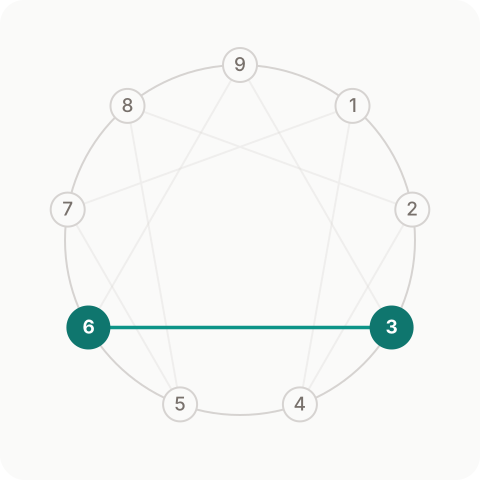
The arrows connect these two directly: Type 3’s growth line points at Type 6, so extended periods of security make a 3 genuinely wear 6’s costume — a secure 3 borrows 6-qualities so convincingly it can test as one. If you tested during an unusual season of your life, that’s the first thing to rule out: re-read both types from a calmer month. The arrows guide covers the mechanics.
Under load, side by side
Strain pulls the two in different directions: a stressed Three fogs toward Nine — numb, disengaged, going through motions behind the smile; at the same time, a stressed Six performs toward Three — workaholic proving, image management, competing for standing. A person met only in a hard year can be typed exactly backwards, because the stress-face borrows another number’s wardrobe. Come back to this comparison from stable ground, and watch the recovery: how each pattern climbs back to normal is a signature the crisis can’t fake.
Three quick tells
- →Is the spotlight a home (Three) — or a target zone (Six)?
- →Do you sell your desirability (Three) or your dependability (Six)?
- →When your work succeeds publicly, do you expand into the credit (Three) or feel exposed by it (Six)?
- →Is networking upward natural self-promotion (Three) or careful alliance-building (Six)?
One more field note: when a boss praises them publicly, the Three files the moment as fuel, while the Six half-enjoys it and half-scans the room for whoever now resents them.
Settle it
Still torn between The Achiever and The Loyalist? The test separates the 3-6 confusion with dedicated forced-choice questions, and reads best alongside the full Type 3 and Type 6 profiles — weight the core-fear sections triple.
Frequently asked questions
Why do Type 3 and Type 6 get confused?
Both are hard workers oriented to expectations — the Three to the audience's, the Six to the authority's. Duty and ambition produce the same overtime; the fuel gauge shows different fears.
What single question best separates Type 3 from Type 6?
Does your confidence run ahead of your evidence, or trail behind it? Your honest answer usually settles it faster than any full test.
What are the core fears of Type 3 and Type 6?
Type 3 fears being worthless without achievement; Type 6 fears being without support or guidance. Behaviors overlap, but these two alarms never do — identify which one has been ringing your whole life and the question usually settles.
What core desire separates Type 3 from Type 6?
Type 3 wants to be valuable and worthwhile; Type 6 wants to have security and support. Imagine both fully granted tomorrow: which one would actually let you rest? People usually know instantly — and that answer is the type.
Could my subtype explain why I test between 3 and 6?
Often, yes. The self-preservation 3 is Type 3's countertype and runs against its type's usual current, while the one-to-one 6 does the same for Type 6 — either can wear the other type's surface. If neither standard portrait fits cleanly, read both countertype pages before deciding.
Know your enneagram type. Understand yourself.
Take the free test