Enneagram Type 3 vs Type 5: How to Tell Them Apart
Two different engines
Type 3 (The Achiever)
runs on value-through-achievement — the fear of worthlessness, the drive to be seen succeeding.
Type 5 (The Investigator)
runs on capacity — the fear of depletion, the drive to understand before engaging.
Where the confusion comes from
Both are competence-led and emotionally contained, and both get described as ‘brilliant but hard to know’. The workplace rewards both masks identically — performance conceals the difference.
The same scene, two engines
Both prep for the same job interview. The Three researches the interviewers: their posts, their wins, the company’s language — then builds the version of itself this room will hire. The Five researches the domain: the technical stack, the industry’s open problems — then walks in as the person who understands the work, presentation unconsidered. The Three performs competence; the Five is competence, unperformed.
Two questions that settle it
- Do you prepare the material — or the impression?
- After being overlooked, do you upgrade your visibility or retreat into your expertise?
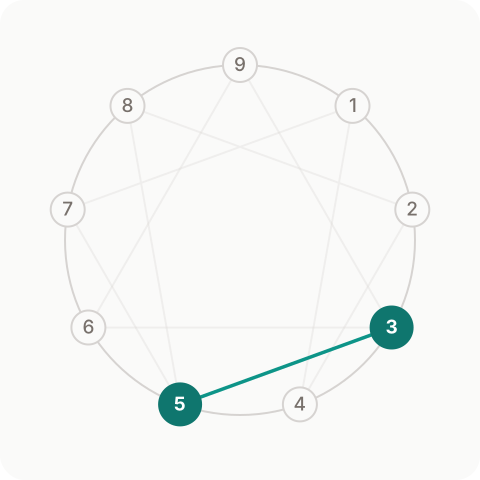
The shared surface, mapped
The tradition offers an origin story for this confusion: Threes are set up to fulfill the hidden expectations of their families, so a Three raised where intelligence and intellectual brilliance were the currency grows up needing to be brilliant to be worthwhile — an intellectual Three that reads Five descriptions with recognition. The tradition also blames the literature itself: narrow or unflattering portraits of the Three push thoughtful Threes toward the more dignified-sounding Five. The engine test cuts through: the Five accumulates knowledge to feel capable, indifferent to audience; the intellectual Three accumulates it to be recognized as capable. Publish-or-perish anxiety, credential display, the wound when expertise goes unacknowledged — those are Three signals wearing academic dress.
Why the map itself confuses them
These types share no wing border and no arrow line — the confusion is pure surface-lookalike, which makes it easier to resolve than neighbor or arrow mistypes: the engines have no structural bridge, so once you’re looking at motivation instead of behavior, the two rarely stay confusable for long. The stress-costumes are worth ruling out all the same: a stressed Three fogs toward Nine — numb, disengaged, going through motions behind the smile, while a stressed Five scatters toward Seven — jumpy, distracted, escaping into projects and stimulation — check whether the type you tested as might be the costume of the other under load. Instinct subtypes are the other usual culprit: a countertype wears its type unusually, and can land on exactly this kind of distant lookalike.
Under load, side by side
Pressure rewrites both profiles at once: a stressed Three fogs toward Nine — numb, disengaged, going through motions behind the smile, while a stressed Five scatters toward Seven — jumpy, distracted, escaping into projects and stimulation. Neither of those faces matches the type at rest, so a rough season is a misleading window for self-typing. If this page still feels unresolved, reread both profiles from a calmer month — and pay attention to the road each of you takes back to baseline, which is often more telling than the strain itself.
Three quick tells
- →Does unrecognized expertise still satisfy you (Five) — or quietly lose its point (Three)?
- →Do you research past the deadline because understanding is the goal (Five), or deliver impressively on schedule because the goal is the win (Three)?
- →Is your intellect your sanctuary (Five) or your credential (Three)?
Settle it
Still torn between The Achiever and The Investigator? The test separates the 3-5 confusion with dedicated forced-choice questions, and reads best alongside the full Type 3 and Type 5 profiles — weight the core-fear sections triple.
Frequently asked questions
Why do Type 3 and Type 5 get confused?
Both are competence-led and emotionally contained, and both get described as 'brilliant but hard to know'. The workplace rewards both masks identically — performance conceals the difference.
What single question best separates Type 3 from Type 5?
Do you prepare the material — or the impression? Your honest answer usually settles it faster than any full test.
What are the core fears of Type 3 and Type 5?
Type 3 fears being worthless without achievement; Type 5 fears being depleted, incapable, overwhelmed. Behaviors overlap, but these two alarms never do — identify which one has been ringing your whole life and the question usually settles.
Can a subtype make a Type 3 look like a Type 5?
Often, yes. The self-preservation 3 is Type 3's countertype and runs against its type's usual current, while the one-to-one 5 does the same for Type 5 — either can wear the other type's surface. If neither standard portrait fits cleanly, read both countertype pages before deciding.
How do the passions of Type 3 and Type 5 differ?
Type 3's passion is deceit (self-deception); Type 5's is avarice (hoarding of self). Watch a full week of your own behavior and ask which appetite quietly organized it — the passion is harder to fake than any answer on a test.
Know your enneagram type. Understand yourself.
Take the free test