Enneagram Type 3 vs Type 4: How to Tell Them Apart
Two different engines
Type 3 (The Achiever)
runs on value-through-achievement — the fear of worthlessness, the drive to be seen succeeding.
Type 4 (The Individualist)
runs on identity — the fear of being nobody in particular, the drive to find what’s authentically its own.
Where the confusion comes from
The 3w4/4w3 zone produces genuinely ambiguous cases: image-fluent depth, or deep image-fluency. Both care intensely about identity — one builds it for the market, one excavates it from within.
The same scene, two engines
Both launch a creative project. The Three ships on schedule with a landing page, a launch thread and three follow-up posts — reception engineered, momentum maintained. The Four misses the date because the third section still isn’t true yet, ships eventually to a silence it half-expected, and treats the sparse response as confirmation of the world’s shallow taste — while secretly checking the numbers at 2 a.m.
Two questions that settle it
- Would you rather ship something effective or something true?
- Is the audience’s silence a problem to solve — or a wound to interpret?
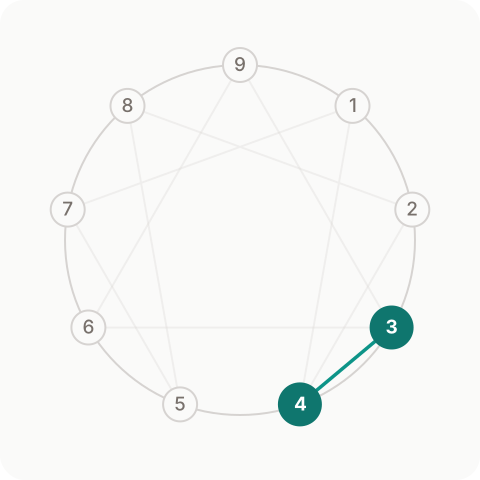
The shared surface, mapped
The tradition’s discriminator for this image-adjacent pair is the speed-bump line: as Threes become less healthy, they treat their own feelings as speed bumps — annoyances that interfere with effectiveness, to be processed later, time permitting. Fours are almost the exact opposite: when difficult feelings arise, they want to stop everything and go into them, and struggle to mobilize for tasks until the interior is sorted. Both types care intensely about identity and presentation — the 3w4/3w4 wing zone genuinely blurs — but the operating priority never lies: one postpones feeling for function, the other postpones function for feeling. Ask which sacrifice feels like survival and which feels like betrayal, and the pair separates.
Why the map itself confuses them
Wings do the heavy lifting here: the 3w4 and 4w3 sit in a genuinely blended zone, and a strong wing can outshine the core. The practical rule for neighbors: ask which side of the border your fear lives on, not your behavior — behavior is exactly what the shared wing blurs. Reading the two wing pages (3w4 and 4w3) side by side often settles what the type descriptions alone can’t.
Under load, side by side
Overload splits this pair cleanly: a stressed Three fogs toward Nine — numb, disengaged, going through motions behind the smile, and on the other side a stressed Four clings toward Two — over-involved, needing to be needed, testing people’s love. Because both stress-faces impersonate other numbers, a difficult stretch is the worst evidence to type from — and also the best tiebreaker to remember afterwards. Note which collapse was yours, then confirm from a steadier month before you settle the question.
Three quick tells
- →When a difficult feeling arrives mid-task, do you file it and finish (Three) — or does the task lose all claim until the feeling is met (Four)?
- →Is your identity built from what you’ve achieved (Three) or from what you’ve felt and survived (Four)?
- →Which loss frightens more: being unimpressive (Three) or being inauthentic (Four)?
- →Do you edit your presentation to fit the audience (Three) or refuse to, on principle, even at cost (Four)?
One more field note: give both a compliment and watch the handling — the Three banks it as evidence the strategy works; the Four inspects it for whether the real self was seen.
Settle it
Still torn between The Achiever and The Individualist? The test separates the 3-4 confusion with dedicated forced-choice questions, and reads best alongside the full Type 3 and Type 4 profiles — weight the core-fear sections triple.
Frequently asked questions
Why do Type 3 and Type 4 get confused?
The 3w4/4w3 zone produces genuinely ambiguous cases: image-fluent depth, or deep image-fluency. Both care intensely about identity — one builds it for the market, one excavates it from within.
What single question best separates Type 3 from Type 4?
Would you rather ship something effective or something true? Your honest answer usually settles it faster than any full test.
What are the core fears of Type 3 and Type 4?
Type 3 fears being worthless without achievement; Type 4 fears having no identity or significance. Behaviors overlap, but these two alarms never do — identify which one has been ringing your whole life and the question usually settles.
What core desire separates Type 3 from Type 4?
Type 3 wants to be valuable and worthwhile; Type 4 wants to be uniquely, authentically themselves. Imagine both fully granted tomorrow: which one would actually let you rest? People usually know instantly — and that answer is the type.
Could my subtype explain why I test between 3 and 4?
Often, yes. The self-preservation 3 is Type 3's countertype and runs against its type's usual current, while the self-preservation 4 does the same for Type 4 — either can wear the other type's surface. If neither standard portrait fits cleanly, read both countertype pages before deciding.
Know your enneagram type. Understand yourself.
Take the free test