Enneagram Type 2 vs Type 9: How to Tell Them Apart
Two different engines
Type 2 (The Helper)
runs on connection — the fear of being unwanted, the drive to matter in specific people’s lives.
Type 9 (The Peacemaker)
runs on peace — the fear of separation, the drive to keep the inner and outer world unruffled.
The tell
Both are warm, both accommodate, both put others first. The tell is the direction of the giving: the Two gives toward specific people — actively, personally, and with a quiet ledger of being needed — while the Nine gives way, merging with whatever the room wants and asking nothing back. Twos feel hurt when their care goes unacknowledged; Nines are genuinely surprised anyone was keeping score. If your generosity has an ache in it, read Two. If it has a fog in it, read Nine.
Where the confusion comes from
Both are the accommodating warm presence of any group, and both struggle to name their own needs. Nine’s merging reads as Two’s giving from three meters away; the ledger is the invisible difference.
The same scene, two engines
Both keep the extended family running. The Two runs it actively: calls made, conflicts mediated by intervention, the aunt’s feelings managed before the lunch. The Nine runs it passively: presence itself the glue, conflicts dissolved by an atmosphere in which raising them feels needless. Remove the Two and the family notices the missing engine; remove the Nine and it notices the missing floor.
Two questions that settle it
- Is your care an activity or an atmosphere?
- Does unacknowledged giving make you resentful — or did you barely notice you gave?
The shared surface, mapped
The tradition’s diagnosis is definitional: some Nines believe Two is ’the loving type,’ and since they see themselves as loving, conclude they must be Twos — but the capacity to love is restricted to no type; like aggression or anxiety, love is expressed differently through each pattern. The Two’s love is active and directed: it seeks out needs, initiates care, and keeps a quiet ledger of the giving. The Nine’s love is receptive and wholesale: unselfconscious support without tracking, contentment with fewer responses, and — the tradition’s subtle observation — a self-protective undertow: Nines stay connected while withdrawing inwardly to keep from being affected too strongly. The female skew mirrors the male 2-8 pattern: average female Nines, especially in caregiving roles, read the script and mistype as Twos.
Why the map itself confuses them
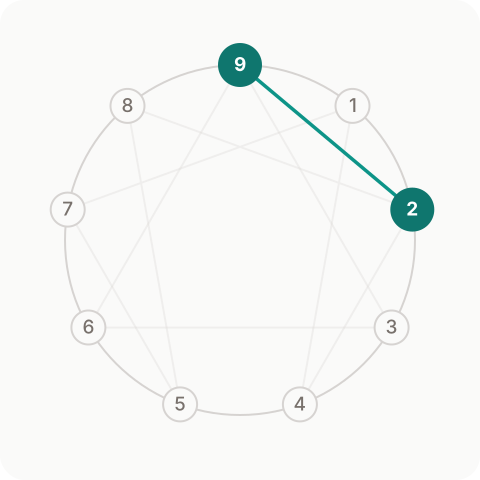
These types share no wing border and no arrow line — the confusion is pure surface-lookalike, which makes it easier to resolve than neighbor or arrow mistypes: the engines have no structural bridge, so once you’re looking at motivation instead of behavior, the two rarely stay confusable for long. The stress-costumes are worth ruling out all the same: a stressed Two erupts toward Eight — blunt, demanding, suddenly loud about every unthanked favor, while a stressed Nine frets toward Six — anxious, reactive, scanning for what could break the peace — check whether the type you tested as might be the costume of the other under load. Instinct subtypes are the other usual culprit: a countertype wears its type unusually, and can land on exactly this kind of distant lookalike.
Under load, side by side
Watch what a bad month does to each: a stressed Two erupts toward Eight — blunt, demanding, suddenly loud about every unthanked favor — whereas a stressed Nine frets toward Six — anxious, reactive, scanning for what could break the peace. That divergence is useful precisely because it’s involuntary; nobody curates their overload behavior. If the calm portraits blur together, the loaded ones rarely do. Just don’t type yourself from the loaded portrait: verify against a season when things were working.
Three quick tells
- →Does your care actively hunt for needs to meet (Two) — or accept and support whatever arrives (Nine)?
- →Do unthanked favors sting and accumulate (Two), or did you barely register that you gave (Nine)?
- →Is your attention on the other person sharpened and specific (Two) or diffuse and atmospheric (Nine)?
Settle it
Still torn between The Helper and The Peacemaker? The test separates the 2-9 confusion with dedicated forced-choice questions, and reads best alongside the full Type 2 and Type 9 profiles — weight the core-fear sections triple.
Frequently asked questions
Why do Type 2 and Type 9 get confused?
Both are the accommodating warm presence of any group, and both struggle to name their own needs. Nine's merging reads as Two's giving from three meters away; the ledger is the invisible difference.
What single question best separates Type 2 from Type 9?
Is your care an activity or an atmosphere? Your honest answer usually settles it faster than any full test.
What are the core fears of Type 2 and Type 9?
Type 2 fears being unwanted, unloved; Type 9 fears loss and separation from others. Behaviors overlap, but these two alarms never do — identify which one has been ringing your whole life and the question usually settles.
Can a subtype make a Type 2 look like a Type 9?
Often, yes. The self-preservation 2 is Type 2's countertype and runs against its type's usual current, while the social 9 does the same for Type 9 — either can wear the other type's surface. If neither standard portrait fits cleanly, read both countertype pages before deciding.
How do the passions of Type 2 and Type 9 differ?
Type 2's passion is pride; Type 9's is sloth (self-forgetting). Watch a full week of your own behavior and ask which appetite quietly organized it — the passion is harder to fake than any answer on a test.
Know your enneagram type. Understand yourself.
Take the free test