Enneagram Type 2 vs Type 7: How to Tell Them Apart
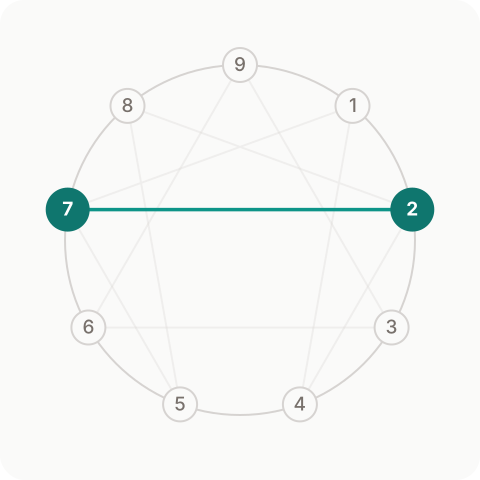
Two different engines
Type 2 (The Helper)
runs on connection — the fear of being unwanted, the drive to matter in specific people’s lives.
Type 7 (The Enthusiast)
runs on possibility — the fear of being trapped in pain, the drive to keep the future stocked.
Where the confusion comes from
Both are the party’s warm center — expressive, enthusiastic, others-oriented on the surface. The difference hides in what the enthusiasm is for: the person in front of them, or the experience around them.
The same scene, two engines
Both plan a friend’s birthday. The Two builds it around the friend: her favorite restaurant, the people she misses, the cake from that bakery she mentioned in March. The Seven builds it around the event: the surprise trip, the escalating itinerary, the story everyone will tell for years. Both parties succeed. But notice whose face each planner watched: the Two watched the friend’s; the Seven watched everyone’s.
Two questions that settle it
- Do you design experiences around one person’s heart — or around the collective thrill?
- When the party ends, do you replay the guest of honor’s joy, or already plan the next one?
The shared surface, mapped
The tradition compares these two as the enneagram’s histrionic pair — both dramatize emotion, both light up rooms — and then splits them by emotional duration and range: the Seven’s feelings are shorter-lived and wide-ranging, swinging from elation to giddiness to flightiness and, on the negative side, to open frustration and rage at others. The Two’s expression is steadier and aimed: warmth sustained toward particular people, with the hostile register largely suppressed. The deeper split is what the display is for — the Seven’s exuberance celebrates experience and keeps the inner weather bright; the Two’s warmth cultivates connection and secures a place in specific hearts. Take away the audience and the Seven keeps enjoying; take away the relationship and the Two’s sparkle loses its point.
Why the map itself confuses them
These types share no wing border and no arrow line — the confusion is pure surface-lookalike, which makes it easier to resolve than neighbor or arrow mistypes: the engines have no structural bridge, so once you’re looking at motivation instead of behavior, the two rarely stay confusable for long. The stress-costumes are worth ruling out all the same: a stressed Two erupts toward Eight — blunt, demanding, suddenly loud about every unthanked favor, while a stressed Seven hardens toward One — critical, impatient, perfectionistic about its escapes — check whether the type you tested as might be the costume of the other under load. Instinct subtypes are the other usual culprit: a countertype wears its type unusually, and can land on exactly this kind of distant lookalike.
Under load, side by side
Pressure rewrites both profiles at once: a stressed Two erupts toward Eight — blunt, demanding, suddenly loud about every unthanked favor, while a stressed Seven hardens toward One — critical, impatient, perfectionistic about its escapes. Neither of those faces matches the type at rest, so a rough season is a misleading window for self-typing. If this page still feels unresolved, reread both profiles from a calmer month — and pay attention to the road each of you takes back to baseline, which is often more telling than the strain itself.
Three quick tells
- →Are your emotional displays wide-ranging and quickly replaced (Seven) — or sustained and aimed at particular people (Two)?
- →When the party ends, do you replay the experience (Seven) or inventory who felt cared for (Two)?
- →Does your anger flash openly and pass (Seven), or does hostility feel almost forbidden (Two)?
Settle it
Still torn between The Helper and The Enthusiast? The test separates the 2-7 confusion with dedicated forced-choice questions, and reads best alongside the full Type 2 and Type 7 profiles — weight the core-fear sections triple.
Frequently asked questions
Why do Type 2 and Type 7 get confused?
Both are the party's warm center — expressive, enthusiastic, others-oriented on the surface. The difference hides in what the enthusiasm is *for*: the person in front of them, or the experience around them.
What single question best separates Type 2 from Type 7?
Do you design experiences around one person's heart — or around the collective thrill? Your honest answer usually settles it faster than any full test.
What are the core fears of Type 2 and Type 7?
Type 2 fears being unwanted, unloved; Type 7 fears being trapped in pain or deprivation. Behaviors overlap, but these two alarms never do — identify which one has been ringing your whole life and the question usually settles.
Can a subtype make a Type 2 look like a Type 7?
Often, yes. The self-preservation 2 is Type 2's countertype and runs against its type's usual current, while the social 7 does the same for Type 7 — either can wear the other type's surface. If neither standard portrait fits cleanly, read both countertype pages before deciding.
How do the passions of Type 2 and Type 7 differ?
Type 2's passion is pride; Type 7's is gluttony (for experience). Watch a full week of your own behavior and ask which appetite quietly organized it — the passion is harder to fake than any answer on a test.
Know your enneagram type. Understand yourself.
Take the free test