Enneagram Type 2 vs Type 6: How to Tell Them Apart
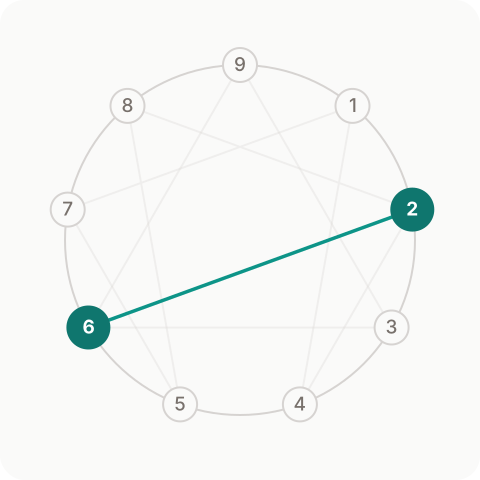
Two different engines
Type 2 (The Helper)
runs on connection — the fear of being unwanted, the drive to matter in specific people’s lives.
Type 6 (The Loyalist)
runs on security — the fear of being without support, the drive to anticipate what could go wrong.
Where the confusion comes from
Both are loyal, warm and alert to others’ states, and both build safety through relationships. The Six’s warmth is often mistaken for Two-giving; the Two’s alliance-building for Six-security.
The same scene, two engines
A new person joins the friend group. The Two adopts them by Thursday: coffee scheduled, birthday noted, a place already set at the table — warmth extended on credit. The Six watches for a season: friendly, pleasant, and quietly running the background check — consistency observed, stories cross-referenced, loyalty extended only after the probation nobody knew was happening. The Two trusts first and hurts later; the Six tests first and bonds later.
Two questions that settle it
- Do you extend trust on credit — or after verification?
- When you help someone new, is it to bond with them or to bank goodwill against uncertainty?
The shared surface, mapped
Both are warm, loyal, alert to others — and the tradition separates them by the posture of the warmth. Sixes ingratiate from wariness: they invite selected others in carefully, testing as they go, seeking reassurance and alliance. Twos ingratiate from an implied position of superiority — warm and friendly, but offering their love, approval and advice rather than seeking the other’s, at least at first. The feeling-tone, the tradition says flatly, is completely different: the Six’s friendliness has a checking quality (are you safe? are you loyal?), while the Two’s has a bestowing quality (let me take care of you). Watch who’s auditioning whom: the Six auditions the other for trustworthiness; the Two positions itself as the one whose care is worth earning.
Why the map itself confuses them
These types share no wing border and no arrow line — the confusion is pure surface-lookalike, which makes it easier to resolve than neighbor or arrow mistypes: the engines have no structural bridge, so once you’re looking at motivation instead of behavior, the two rarely stay confusable for long. The stress-costumes are worth ruling out all the same: a stressed Two erupts toward Eight — blunt, demanding, suddenly loud about every unthanked favor, while a stressed Six performs toward Three — workaholic proving, image management, competing for standing — check whether the type you tested as might be the costume of the other under load. Instinct subtypes are the other usual culprit: a countertype wears its type unusually, and can land on exactly this kind of distant lookalike.
Under load, side by side
Overload splits this pair cleanly: a stressed Two erupts toward Eight — blunt, demanding, suddenly loud about every unthanked favor, and on the other side a stressed Six performs toward Three — workaholic proving, image management, competing for standing. Because both stress-faces impersonate other numbers, a difficult stretch is the worst evidence to type from — and also the best tiebreaker to remember afterwards. Note which collapse was yours, then confirm from a steadier month before you settle the question.
Three quick tells
- →Does your friendliness check the other person for safety (Six) — or offer them your care from day one (Two)?
- →Do you bond by proving reliable over time (Six) or by being indispensable quickly (Two)?
- →Is your loyalty about keeping alliances solid (Six) or about being the person they can’t do without (Two)?
Settle it
Still torn between The Helper and The Loyalist? The test separates the 2-6 confusion with dedicated forced-choice questions, and reads best alongside the full Type 2 and Type 6 profiles — weight the core-fear sections triple.
Frequently asked questions
Why do Type 2 and Type 6 get confused?
Both are loyal, warm and alert to others' states, and both build safety through relationships. The Six's warmth is often mistaken for Two-giving; the Two's alliance-building for Six-security.
What single question best separates Type 2 from Type 6?
Do you extend trust on credit — or after verification? Your honest answer usually settles it faster than any full test.
What are the core fears of Type 2 and Type 6?
Type 2 fears being unwanted, unloved; Type 6 fears being without support or guidance. Behaviors overlap, but these two alarms never do — identify which one has been ringing your whole life and the question usually settles.
What core desire separates Type 2 from Type 6?
Type 2 wants to be loved for who they are; Type 6 wants to have security and support. Imagine both fully granted tomorrow: which one would actually let you rest? People usually know instantly — and that answer is the type.
Could my subtype explain why I test between 2 and 6?
Often, yes. The self-preservation 2 is Type 2's countertype and runs against its type's usual current, while the one-to-one 6 does the same for Type 6 — either can wear the other type's surface. If neither standard portrait fits cleanly, read both countertype pages before deciding.
Know your enneagram type. Understand yourself.
Take the free test