Enneagram Type 2 vs Type 5: How to Tell Them Apart
Two different engines
Type 2 (The Helper)
runs on connection — the fear of being unwanted, the drive to matter in specific people’s lives.
Type 5 (The Investigator)
runs on capacity — the fear of depletion, the drive to understand before engaging.
Where the confusion comes from
Rarely confused in themselves — the mistype happens through partners and tests: both can look ‘introverted and kind’, and a reserved SP Two can test Five-ish. The engines could hardly differ more.
The same scene, two engines
Their partner lands in the hospital. The Two becomes the ward’s unofficial staff: pillows adjusted, nurses befriended, visitors scheduled, needs anticipated before the patient names them. The Five becomes the case’s unofficial researcher: the condition studied to journal level, the doctors’ plan stress-tested, the practical logistics quietly handled from the corridor. Both are devotion. One pours presence; the other pours competence.
Two questions that settle it
- Is your first instinct in crisis to hold the person’s hand — or to master the person’s problem?
- Does constant company nourish you or tax you?
The shared surface, mapped
The tradition calls these two almost opposites who nonetheless get confused through one narrow bridge: both keep loved ones close in thought while appearing available, and both are easily hurt by rejection. The divergence is nearly total: the Two is emotionally expressive and profoundly people-oriented; the Five is emotionally detached — the true loner of the enneagram. The coping styles complete the contrast: wounded Twos cope by winning people over — redoubling the warmth until the connection is restored — while wounded Fives cope by detaching from the hurt and isolating further. One moves toward, the other moves away, from the identical sting. The mistype usually happens on paper rather than in person: a reserved, bookish SP Two or a warm 5w4 reading trait lists instead of engines.
Why the map itself confuses them
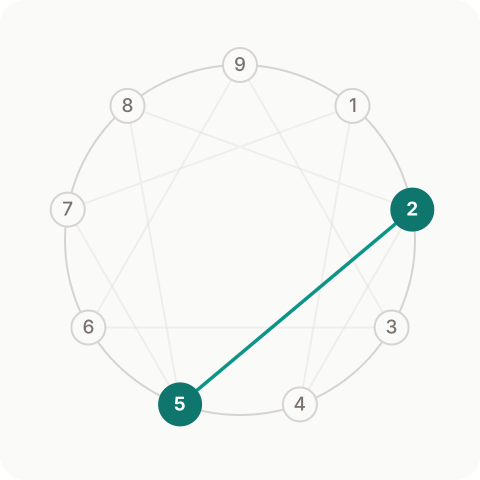
These types share no wing border and no arrow line — the confusion is pure surface-lookalike, which makes it easier to resolve than neighbor or arrow mistypes: the engines have no structural bridge, so once you’re looking at motivation instead of behavior, the two rarely stay confusable for long. The stress-costumes are worth ruling out all the same: a stressed Two erupts toward Eight — blunt, demanding, suddenly loud about every unthanked favor, while a stressed Five scatters toward Seven — jumpy, distracted, escaping into projects and stimulation — check whether the type you tested as might be the costume of the other under load. Instinct subtypes are the other usual culprit: a countertype wears its type unusually, and can land on exactly this kind of distant lookalike.
Under load, side by side
Watch what a bad month does to each: a stressed Two erupts toward Eight — blunt, demanding, suddenly loud about every unthanked favor — whereas a stressed Five scatters toward Seven — jumpy, distracted, escaping into projects and stimulation. That divergence is useful precisely because it’s involuntary; nobody curates their overload behavior. If the calm portraits blur together, the loaded ones rarely do. Just don’t type yourself from the loaded portrait: verify against a season when things were working.
Three quick tells
- →When rejected, do you campaign to win the person back (Two) — or file the loss and add a wall (Five)?
- →Is contact with people your fuel (Two) or your expenditure (Five)?
- →Do you know others’ needs better than your own (Two), or your own analysis better than anyone’s needs (Five)?
Settle it
Still torn between The Helper and The Investigator? The test separates the 2-5 confusion with dedicated forced-choice questions, and reads best alongside the full Type 2 and Type 5 profiles — weight the core-fear sections triple.
Frequently asked questions
Why do Type 2 and Type 5 get confused?
Rarely confused in themselves — the mistype happens through partners and tests: both can look 'introverted and kind', and a reserved SP Two can test Five-ish. The engines could hardly differ more.
What single question best separates Type 2 from Type 5?
Is your first instinct in crisis to hold the person's hand — or to master the person's problem? Your honest answer usually settles it faster than any full test.
What are the core fears of Type 2 and Type 5?
Type 2 fears being unwanted, unloved; Type 5 fears being depleted, incapable, overwhelmed. Behaviors overlap, but these two alarms never do — identify which one has been ringing your whole life and the question usually settles.
Can a subtype make a Type 2 look like a Type 5?
Often, yes. The self-preservation 2 is Type 2's countertype and runs against its type's usual current, while the one-to-one 5 does the same for Type 5 — either can wear the other type's surface. If neither standard portrait fits cleanly, read both countertype pages before deciding.
How do the passions of Type 2 and Type 5 differ?
Type 2's passion is pride; Type 5's is avarice (hoarding of self). Watch a full week of your own behavior and ask which appetite quietly organized it — the passion is harder to fake than any answer on a test.
Know your enneagram type. Understand yourself.
Take the free test