Enneagram Type 2 vs Type 4: How to Tell Them Apart
Two different engines
Type 2 (The Helper)
runs on connection — the fear of being unwanted, the drive to matter in specific people’s lives.
Type 4 (The Individualist)
runs on identity — the fear of being nobody in particular, the drive to find what’s authentically its own.
Where the confusion comes from
Both are feeling-first types who measure life by relationships and get called ’too emotional’ by cooler types. Twos in long stress also visit Four’s melancholy, completing the confusion.
The same scene, two engines
A friend cancels on both, twice. The Two moves toward: a soup on the doorstep, a no-pressure text — reconnection is manufactured through care, and the hurt converts to helpfulness. The Four moves inward: the cancellation joins the long private file of evidence that closeness always thins, and the reply, when it comes, has a tested distance in it. The Two fights abandonment with casseroles; the Four rehearses it in advance.
Two questions that settle it
- When closeness wobbles, do you reach out with care — or pull back and watch?
- Is your attention on what they need — or on what their behavior means about you?
The shared surface, mapped
The tradition’s first correction is about depression: some Twos mistype as Fours after a depressive season or a painful breakup, having learned that Fours are ’the depressive type’ — but all nine types can be depressed, and sadness itself indicates no type at all. The second correction is about romance: Twos who see themselves as romantic borrow the Four’s label. What actually separates these feeling-types is the direction of emotional attention — the Two’s flows out to the other’s needs and states; the Four’s returns to its own interior and its meanings — plus the relationship to being needed: the Two moves toward people to be helpful; the Four withdraws to see whether it will be missed. Female Fours from traditional or strongly religious environments, the tradition adds, may mistype as Twos — the caregiving script overriding the interior signal.
Why the map itself confuses them
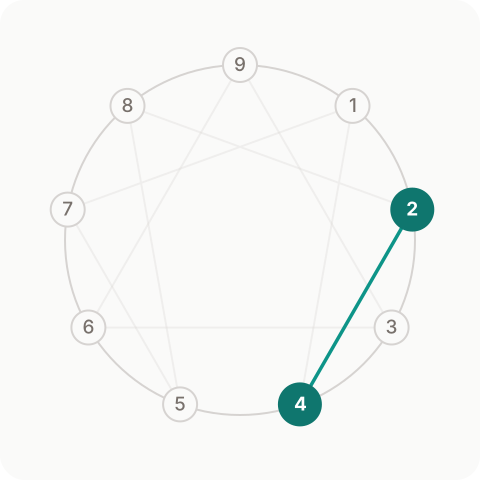
The arrows connect these two directly: Type 2’s growth line points at Type 4, so extended periods of security make a 2 genuinely wear 4’s costume — a secure 2 borrows 4-qualities so convincingly it can test as one. If you tested during an unusual season of your life, that’s the first thing to rule out: re-read both types from a calmer month. The arrows guide covers the mechanics.
Under load, side by side
Strain pulls the two in different directions: a stressed Two erupts toward Eight — blunt, demanding, suddenly loud about every unthanked favor; at the same time, a stressed Four clings toward Two — over-involved, needing to be needed, testing people’s love. A person met only in a hard year can be typed exactly backwards, because the stress-face borrows another number’s wardrobe. Come back to this comparison from stable ground, and watch the recovery: how each pattern climbs back to normal is a signature the crisis can’t fake.
Three quick tells
- →In a friend’s crisis, does your attention lock onto their state (Two) — or onto what their crisis stirs in you (Four)?
- →Do you cope with hurt by moving toward people helpfully (Two) or by withdrawing to see if you’re missed (Four)?
- →Is your romanticism about the beloved’s needs met beautifully (Two) or about the longing itself (Four)?
Settle it
Still torn between The Helper and The Individualist? The test separates the 2-4 confusion with dedicated forced-choice questions, and reads best alongside the full Type 2 and Type 4 profiles — weight the core-fear sections triple.
Frequently asked questions
Why do Type 2 and Type 4 get confused?
Both are feeling-first types who measure life by relationships and get called 'too emotional' by cooler types. Twos in long stress also visit Four's melancholy, completing the confusion.
What single question best separates Type 2 from Type 4?
When closeness wobbles, do you reach out with care — or pull back and watch? Your honest answer usually settles it faster than any full test.
What are the core fears of Type 2 and Type 4?
Type 2 fears being unwanted, unloved; Type 4 fears having no identity or significance. Behaviors overlap, but these two alarms never do — identify which one has been ringing your whole life and the question usually settles.
What core desire separates Type 2 from Type 4?
Type 2 wants to be loved for who they are; Type 4 wants to be uniquely, authentically themselves. Imagine both fully granted tomorrow: which one would actually let you rest? People usually know instantly — and that answer is the type.
Could my subtype explain why I test between 2 and 4?
Often, yes. The self-preservation 2 is Type 2's countertype and runs against its type's usual current, while the self-preservation 4 does the same for Type 4 — either can wear the other type's surface. If neither standard portrait fits cleanly, read both countertype pages before deciding.
Know your enneagram type. Understand yourself.
Take the free test