Enneagram Type 2 vs Type 3: How to Tell Them Apart
Two different engines
Type 2 (The Helper)
runs on connection — the fear of being unwanted, the drive to matter in specific people’s lives.
Type 3 (The Achiever)
runs on value-through-achievement — the fear of worthlessness, the drive to be seen succeeding.
Where the confusion comes from
Both are warm, socially fluent achievers of connection, and the 2w3/3w2 wing zone is the enneagram’s most charming blur. Both read rooms instantly; the question is whether the room is audience or patient.
The same scene, two engines
Both host the charity gala. The Two spends the night in the kitchen doorway, tracking who hasn’t eaten, who came alone, whose coat got lost — the room’s needs are the evening. The Three spends it on the floor, working the donors, the mic, the moment — the room’s response is the evening. Both go home exhausted and glowing. Ask each what they remember: the Two lists people; the Three lists wins.
Two questions that settle it
- At the end of a social evening, do you inventory who felt cared for — or how you came across?
- Which starves you faster: being unneeded, or being unimpressive?
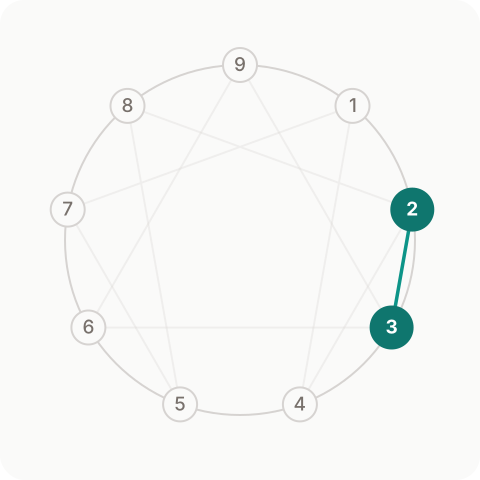
The shared surface, mapped
The tradition frames the confusion around the word ‘seductive’ — long applied to Twos, but every type seduces in its own way, and Threes very much included. The discriminator is how each seduces attention: Twos get others to like them by doing good things for them, focusing appreciative attention on the other person (‘how are you feeling this afternoon? You look sad’) — pleasing as a route to closeness. Threes get others to like them by developing the excellence of their own package, becoming so outstanding that the other wants to focus on them. The intimacy consequence is documented: Twos are openly sentimental and emote easily; Threes stay composed, struggle to access feelings — and, wanting relationships, actually fear intimacy, growing uneasier as closeness deepens.
Why the map itself confuses them
Wings do the heavy lifting here: the 2w3 and 3w2 sit in a genuinely blended zone, and a strong wing can outshine the core. The practical rule for neighbors: ask which side of the border your fear lives on, not your behavior — behavior is exactly what the shared wing blurs. Reading the two wing pages (2w3 and 3w2) side by side often settles what the type descriptions alone can’t.
Under load, side by side
Pressure rewrites both profiles at once: a stressed Two erupts toward Eight — blunt, demanding, suddenly loud about every unthanked favor, while a stressed Three fogs toward Nine — numb, disengaged, going through motions behind the smile. Neither of those faces matches the type at rest, so a rough season is a misleading window for self-typing. If this page still feels unresolved, reread both profiles from a calmer month — and pay attention to the road each of you takes back to baseline, which is often more telling than the strain itself.
Three quick tells
- →At a gathering, does your attention flow out to the guests (Two) — or work the room’s read of you (Three)?
- →Do you win people by attending to them (Two) or by being impressive enough that they attend to you (Three)?
- →As a relationship deepens, do you relax into it (Two) or feel a subtle urge to re-establish distance (Three)?
Settle it
Still torn between The Helper and The Achiever? The test separates the 2-3 confusion with dedicated forced-choice questions, and reads best alongside the full Type 2 and Type 3 profiles — weight the core-fear sections triple.
Frequently asked questions
Why do Type 2 and Type 3 get confused?
Both are warm, socially fluent achievers of connection, and the 2w3/3w2 wing zone is the enneagram's most charming blur. Both read rooms instantly; the question is whether the room is audience or patient.
What single question best separates Type 2 from Type 3?
At the end of a social evening, do you inventory who felt cared for — or how you came across? Your honest answer usually settles it faster than any full test.
What are the core fears of Type 2 and Type 3?
Type 2 fears being unwanted, unloved; Type 3 fears being worthless without achievement. Behaviors overlap, but these two alarms never do — identify which one has been ringing your whole life and the question usually settles.
Can a subtype make a Type 2 look like a Type 3?
Often, yes. The self-preservation 2 is Type 2's countertype and runs against its type's usual current, while the self-preservation 3 does the same for Type 3 — either can wear the other type's surface. If neither standard portrait fits cleanly, read both countertype pages before deciding.
How do the passions of Type 2 and Type 3 differ?
Type 2's passion is pride; Type 3's is deceit (self-deception). Watch a full week of your own behavior and ask which appetite quietly organized it — the passion is harder to fake than any answer on a test.
Know your enneagram type. Understand yourself.
Take the free test