Enneagram Type 1 vs Type 9: How to Tell Them Apart
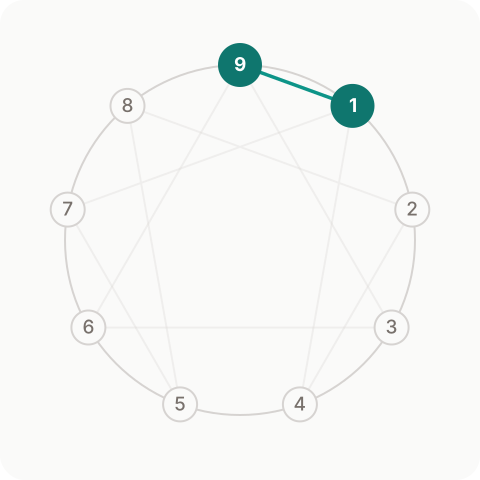
Two different engines
Type 1 (The Reformer)
runs on an inner standard — the fear of being bad, the drive to be right with its own conscience.
Type 9 (The Peacemaker)
runs on peace — the fear of separation, the drive to keep the inner and outer world unruffled.
The tell
Adjacent types, often confused through the wing. Both can be idealistic and steady; the fracture line is conflict. The One will spend the peace to make the point — the principle outranks the mood of the room — while the Nine will spend the point to keep the peace. Ones struggle to rest while anything’s unresolved; Nines can rest remarkably well precisely by not resolving it. If you argue for the truth even when it ruffles everyone, read One. If you weigh whether truth is worth the ruffle, read Nine.
Where the confusion comes from
Adjacent types with a live wing between them: the 1w9 and 9w1 genuinely overlap in calm orderliness and quiet idealism. Both dislike conflict’s mess — one overrides the dislike, the other obeys it.
The same scene, two engines
The neighbor’s dog ruins both their gardens. The One knocks on the door that evening — unpleasant, but the principle of the thing can’t wait, and the conversation is scripted for fairness. The Nine mentions it three weeks later, mildly, after the fence is already half-fixed by their own quiet labor — the conversation was drafted nightly and postponed nightly, because the relationship’s weather outranked the roses.
Two questions that settle it
- Can you rest with a wrong unaddressed — or does it keep knocking?
- When you finally speak up, is it at the time of the offense, or long after?
The shared surface, mapped
The tradition treats this as primarily a wing question — is the person a 9w1 or a 1w9? — and admits that with a strong wing it can be a genuinely difficult call. Both can be idealistic, philosophical and somewhat withdrawn; neither is comfortable with anger. The cleanest discriminator the tradition offers is conflict: average Nines hold strong convictions but don’t want to argue them — especially with people they’re attached to — while for Ones the principle is foremost: they will drive the point home to convert others even at the cost of upsets, because the truth is the truth. The work-rest tell seconds it: Nines are convincible that a break would be useful and struggle to shift gears between rest and activity; Ones can barely tear themselves from projects and feel anxious when unproductive.
Why the map itself confuses them
Wings do the heavy lifting here: the 1w9 and 9w1 sit in a genuinely blended zone, and a strong wing can outshine the core. The practical rule for neighbors: ask which side of the border your fear lives on, not your behavior — behavior is exactly what the shared wing blurs. Reading the two wing pages (1w9 and 9w1) side by side often settles what the type descriptions alone can’t.
Under load, side by side
Overload splits this pair cleanly: a stressed One slides toward Four — moody, alienated, convinced nobody understands the burden, and on the other side a stressed Nine frets toward Six — anxious, reactive, scanning for what could break the peace. Because both stress-faces impersonate other numbers, a difficult stretch is the worst evidence to type from — and also the best tiebreaker to remember afterwards. Note which collapse was yours, then confirm from a steadier month before you settle the question.
Three quick tells
- →Will you spend the room’s peace to make a true point (One) — or spend the point to keep the room’s peace (Nine)?
- →Is rest something you slide into easily and struggle to leave (Nine), or something you must earn and can barely tolerate (One)?
- →Do your convictions campaign (One) or quietly persist without recruitment (Nine)?
Settle it
Still torn between The Reformer and The Peacemaker? The test separates the 1-9 confusion with dedicated forced-choice questions, and reads best alongside the full Type 1 and Type 9 profiles — weight the core-fear sections triple.
Frequently asked questions
Why do Type 1 and Type 9 get confused?
Adjacent types with a live wing between them: the 1w9 and 9w1 genuinely overlap in calm orderliness and quiet idealism. Both dislike conflict's mess — one overrides the dislike, the other obeys it.
What single question best separates Type 1 from Type 9?
Can you rest with a wrong unaddressed — or does it keep knocking? Your honest answer usually settles it faster than any full test.
What are the core fears of Type 1 and Type 9?
Type 1 fears being bad, corrupt, wrong; Type 9 fears loss and separation from others. Behaviors overlap, but these two alarms never do — identify which one has been ringing your whole life and the question usually settles.
What core desire separates Type 1 from Type 9?
Type 1 wants to be good and have integrity; Type 9 wants to have inner and outer peace. Imagine both fully granted tomorrow: which one would actually let you rest? People usually know instantly — and that answer is the type.
Could my subtype explain why I test between 1 and 9?
Often, yes. The one-to-one 1 is Type 1's countertype and runs against its type's usual current, while the social 9 does the same for Type 9 — either can wear the other type's surface. If neither standard portrait fits cleanly, read both countertype pages before deciding.
Know your enneagram type. Understand yourself.
Take the free test