Enneagram Type 1 vs Type 8: How to Tell Them Apart
Two different engines
Type 1 (The Reformer)
runs on an inner standard — the fear of being bad, the drive to be right with its own conscience.
Type 8 (The Challenger)
runs on strength — the fear of being controlled, the drive to press its full weight into life.
Where the confusion comes from
Both are forceful, justice-minded and unafraid of confrontation, and both get called ‘intense’ and ‘controlling’ by the same people. The shared surface is will; the difference is what licenses it.
The same scene, two engines
A contractor does shoddy work on both their houses. The One documents: photos, the contract clause, the calm devastating email — the fight is won by being right, correctly. The Eight calls: voice level rising, refund demanded, and it’s settled by Friday — the fight is won by being stronger, immediately. Both got the refund. The One needed the paper trail to feel clean; the Eight needed the confrontation to feel real.
Two questions that settle it
- In a fight, do you reach for the rulebook or for the leverage?
- Afterward, do you replay whether you were right — or whether you won?
The shared surface, mapped
Both are action-oriented wills with strong notions about how things should be done, and the tradition locates their deepest tangle in a shared concern: justice — pursued through incompatible jurisprudences. The One persuades from moral imperative: it tries to convert resisters through logical argument for the evidently right position, growing irritated (and less logical) as resistance continues. The Eight relies on self-confidence and sheer personal charisma — the tradition quotes the stance exactly: ‘I don’t know if it’s the right way, but it’s my way.’ Ones try to convert those who resist; Eights power through them. Both get called controlling and intense by the same colleagues, which fuels the mistype — but one is enforcing the law, and the other is exercising sovereignty.
Why the map itself confuses them
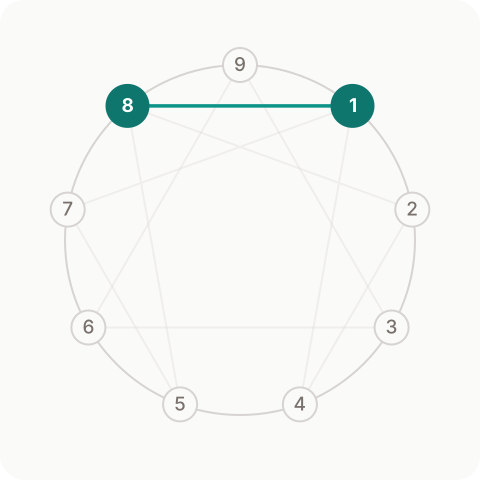
These types share no wing border and no arrow line — the confusion is pure surface-lookalike, which makes it easier to resolve than neighbor or arrow mistypes: the engines have no structural bridge, so once you’re looking at motivation instead of behavior, the two rarely stay confusable for long. The stress-costumes are worth ruling out all the same: a stressed One slides toward Four — moody, alienated, convinced nobody understands the burden, while a stressed Eight withdraws toward Five — secretive, strategizing alone, trusting no one — check whether the type you tested as might be the costume of the other under load. Instinct subtypes are the other usual culprit: a countertype wears its type unusually, and can land on exactly this kind of distant lookalike.
Under load, side by side
Watch what a bad month does to each: a stressed One slides toward Four — moody, alienated, convinced nobody understands the burden — whereas a stressed Eight withdraws toward Five — secretive, strategizing alone, trusting no one. That divergence is useful precisely because it’s involuntary; nobody curates their overload behavior. If the calm portraits blur together, the loaded ones rarely do. Just don’t type yourself from the loaded portrait: verify against a season when things were working.
Three quick tells
- →When resisted, do you argue the rightness harder (One) or simply apply more force (Eight)?
- →Is your justice about the correct outcome (One) or about protecting your people and territory (Eight)?
- →After winning, do you audit whether you were right (One) or move to the next front (Eight)?
Settle it
Still torn between The Reformer and The Challenger? The test separates the 1-8 confusion with dedicated forced-choice questions, and reads best alongside the full Type 1 and Type 8 profiles — weight the core-fear sections triple.
Frequently asked questions
Why do Type 1 and Type 8 get confused?
Both are forceful, justice-minded and unafraid of confrontation, and both get called 'intense' and 'controlling' by the same people. The shared surface is will; the difference is what licenses it.
What single question best separates Type 1 from Type 8?
In a fight, do you reach for the rulebook or for the leverage? Your honest answer usually settles it faster than any full test.
What are the core fears of Type 1 and Type 8?
Type 1 fears being bad, corrupt, wrong; Type 8 fears being controlled or violated. Behaviors overlap, but these two alarms never do — identify which one has been ringing your whole life and the question usually settles.
Can a subtype make a Type 1 look like a Type 8?
Often, yes. The one-to-one 1 is Type 1's countertype and runs against its type's usual current, while the social 8 does the same for Type 8 — either can wear the other type's surface. If neither standard portrait fits cleanly, read both countertype pages before deciding.
How do the passions of Type 1 and Type 8 differ?
Type 1's passion is anger (resentment); Type 8's is lust (intensity). Watch a full week of your own behavior and ask which appetite quietly organized it — the passion is harder to fake than any answer on a test.
Know your enneagram type. Understand yourself.
Take the free test