Enneagram Type 1 vs Type 7: How to Tell Them Apart
Two different engines
Type 1 (The Reformer)
runs on an inner standard — the fear of being bad, the drive to be right with its own conscience.
Type 7 (The Enthusiast)
runs on possibility — the fear of being trapped in pain, the drive to keep the future stocked.
Where the confusion comes from
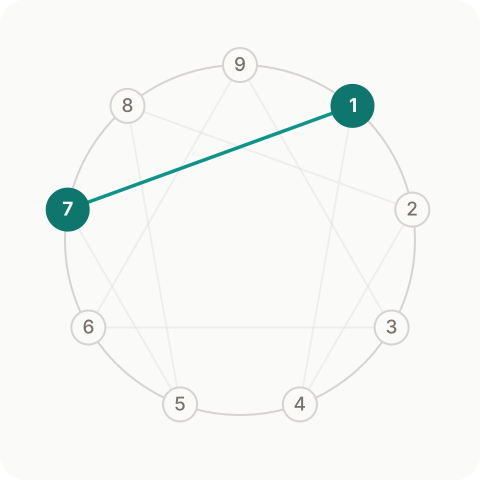
An unlikely pair made confusable by the growth arrow: Ones touching Seven discover appetite and spontaneity and wonder if they were Sevens all along. Both can also be idealists — one about correctness, one about possibility.
The same scene, two engines
Put both on vacation. The One packs the itinerary it built and — this is the tell — relaxes inside the plan: the day has been done right, so rest is finally permitted. The Seven treats the itinerary as a first draft: the beach at nine becomes the market at ten becomes lunch with strangers from the market. The One’s pleasure needs the box checked; the Seven’s needs the box open.
Two questions that settle it
- Is rest something you earn — or something you chase?
- Does an open, unplanned day feel like freedom or like a small threat?
The shared surface, mapped
The tradition describes this confusion arriving mainly through the stress door: Sevens under prolonged pressure develop average-One behaviors — perfectionism, need for order, sharpened criticism — and conclude they must be Ones. A quick life-review usually settles it: rigid self-control, harsh inner criticism and repressed impulses are not the Seven’s dominant history. The subtler shared ground is idealism and a sense of mission: both hold high ideals about the world and humanity, but the tradition draws the line at expectation — Sevens are optimistic that things will work out; Ones hold high standards and expect to be disappointed. One future is bright by default, the other flawed by default, and each type’s daily mood is downstream of that setting.
Why the map itself confuses them
The arrows connect these two directly: Type 1’s growth line points at Type 7, so extended periods of security make a 1 genuinely wear 7’s costume — a secure 1 borrows 7-qualities so convincingly it can test as one. If you tested during an unusual season of your life, that’s the first thing to rule out: re-read both types from a calmer month. The arrows guide covers the mechanics.
Under load, side by side
Strain pulls the two in different directions: a stressed One slides toward Four — moody, alienated, convinced nobody understands the burden; at the same time, a stressed Seven hardens toward One — critical, impatient, perfectionistic about its escapes. A person met only in a hard year can be typed exactly backwards, because the stress-face borrows another number’s wardrobe. Come back to this comparison from stable ground, and watch the recovery: how each pattern climbs back to normal is a signature the crisis can’t fake.
Three quick tells
- →Is your baseline future bright until proven otherwise (Seven) or flawed until corrected (One)?
- →Has harsh self-criticism been a lifelong companion (One) or a recent visitor during a hard stretch (Seven)?
- →Does an open, unplanned day feel like freedom (Seven) or like unsupervised risk (One)?
- →When you finally do relax, is it earned and slightly guilty (One) — or simply the day’s default setting resumed (Seven)?
- →Does your criticism aim at what’s wrong and must be fixed (One), or at what’s boring and must be escaped (Seven)?
Settle it
Still torn between The Reformer and The Enthusiast? The test separates the 1-7 confusion with dedicated forced-choice questions, and reads best alongside the full Type 1 and Type 7 profiles — weight the core-fear sections triple.
Frequently asked questions
Why do Type 1 and Type 7 get confused?
An unlikely pair made confusable by the growth arrow: Ones touching Seven discover appetite and spontaneity and wonder if they were Sevens all along. Both can also be idealists — one about correctness, one about possibility.
What single question best separates Type 1 from Type 7?
Is rest something you earn — or something you chase? Your honest answer usually settles it faster than any full test.
What are the core fears of Type 1 and Type 7?
Type 1 fears being bad, corrupt, wrong; Type 7 fears being trapped in pain or deprivation. Behaviors overlap, but these two alarms never do — identify which one has been ringing your whole life and the question usually settles.
What core desire separates Type 1 from Type 7?
Type 1 wants to be good and have integrity; Type 7 wants to be satisfied and free. Imagine both fully granted tomorrow: which one would actually let you rest? People usually know instantly — and that answer is the type.
Could my subtype explain why I test between 1 and 7?
Often, yes. The one-to-one 1 is Type 1's countertype and runs against its type's usual current, while the social 7 does the same for Type 7 — either can wear the other type's surface. If neither standard portrait fits cleanly, read both countertype pages before deciding.
Know your enneagram type. Understand yourself.
Take the free test