Enneagram Type 1 vs Type 6: How to Tell Them Apart
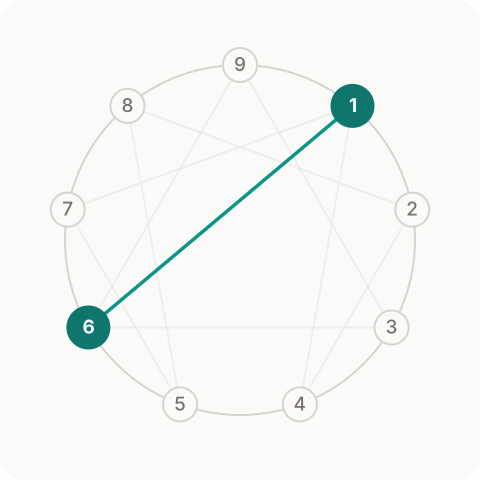
Two different engines
Type 1 (The Reformer)
runs on an inner standard — the fear of being bad, the drive to be right with its own conscience.
Type 6 (The Loyalist)
runs on security — the fear of being without support, the drive to anticipate what could go wrong.
Where the confusion comes from
Both are dutiful rule-keepers with loud inner commentary and a habit of anticipating what could go wrong. Their overactive superegos sound alike from inside — one moralizes, the other rehearses.
The same scene, two engines
A colleague quietly breaks the expense rules. The One burns: it’s wrong, and someone must say so — the discomfort of speaking up loses to the discomfort of tolerating it. The Six calculates: is this a threat? Who else knows? What happens to whoever reports it? The One’s tension is moral; the Six’s is strategic. One acts from the verdict, the other from the risk map.
Two questions that settle it
- When something’s wrong, is your first feeling indignation — or apprehension?
- Do rules bind you because they’re right, or because they’re safe?
The shared surface, mapped
The tradition gives this pair its most memorable image: the One has an Inner Critic; the Six has an Inner Committee. Both are compliant to demanding superegos, both feel guilty when they act against their inner authority, both need to organize their environments, and both are ‘should and must’ people who handle duties before rest. The compliance points in different directions: the One obeys its ideals — guilt comes from acting against principle — while the Six obeys its commitments to allies, beliefs and authorities — guilt comes from letting its people down. The tradition notes the two rarely mistake themselves for each other; it’s outside observers who blur them, watching two responsible rule-keepers and missing that one answers to a private tribunal and the other to a room full of consulted voices.
Why the map itself confuses them
These types share no wing border and no arrow line — the confusion is pure surface-lookalike, which makes it easier to resolve than neighbor or arrow mistypes: the engines have no structural bridge, so once you’re looking at motivation instead of behavior, the two rarely stay confusable for long. The stress-costumes are worth ruling out all the same: a stressed One slides toward Four — moody, alienated, convinced nobody understands the burden, while a stressed Six performs toward Three — workaholic proving, image management, competing for standing — check whether the type you tested as might be the costume of the other under load. Instinct subtypes are the other usual culprit: a countertype wears its type unusually, and can land on exactly this kind of distant lookalike.
Under load, side by side
Pressure rewrites both profiles at once: a stressed One slides toward Four — moody, alienated, convinced nobody understands the burden, while a stressed Six performs toward Three — workaholic proving, image management, competing for standing. Neither of those faces matches the type at rest, so a rough season is a misleading window for self-typing. If this page still feels unresolved, reread both profiles from a calmer month — and pay attention to the road each of you takes back to baseline, which is often more telling than the strain itself.
Three quick tells
- →When you break your own code, does the reproach come from one severe judge (One) or a committee replaying everyone’s possible reactions (Six)?
- →Are your rules derived from what’s right (One) or from what keeps your people and alliances safe (Six)?
- →Do you re-open settled decisions to check them against principle (One) or against everyone’s opinion (Six)?
Settle it
Still torn between The Reformer and The Loyalist? The test separates the 1-6 confusion with dedicated forced-choice questions, and reads best alongside the full Type 1 and Type 6 profiles — weight the core-fear sections triple.
Frequently asked questions
Why do Type 1 and Type 6 get confused?
Both are dutiful rule-keepers with loud inner commentary and a habit of anticipating what could go wrong. Their overactive superegos sound alike from inside — one moralizes, the other rehearses.
What single question best separates Type 1 from Type 6?
When something's wrong, is your first feeling indignation — or apprehension? Your honest answer usually settles it faster than any full test.
What are the core fears of Type 1 and Type 6?
Type 1 fears being bad, corrupt, wrong; Type 6 fears being without support or guidance. Behaviors overlap, but these two alarms never do — identify which one has been ringing your whole life and the question usually settles.
Can a subtype make a Type 1 look like a Type 6?
Often, yes. The one-to-one 1 is Type 1's countertype and runs against its type's usual current, while the one-to-one 6 does the same for Type 6 — either can wear the other type's surface. If neither standard portrait fits cleanly, read both countertype pages before deciding.
How do the passions of Type 1 and Type 6 differ?
Type 1's passion is anger (resentment); Type 6's is fear (anticipation). Watch a full week of your own behavior and ask which appetite quietly organized it — the passion is harder to fake than any answer on a test.
Know your enneagram type. Understand yourself.
Take the free test