Enneagram Type 1 vs Type 5: How to Tell Them Apart
Two different engines
Type 1 (The Reformer)
runs on an inner standard — the fear of being bad, the drive to be right with its own conscience.
Type 5 (The Investigator)
runs on capacity — the fear of depletion, the drive to understand before engaging.
Where the confusion comes from
Both are reserved, precise and principled thinkers who prefer correctness to charisma. On paper — meticulous, private, bookish — their résumés are near-identical; only the motive separates them.
The same scene, two engines
Hand both a broken boiler. The One reads the manual to do it right — there is a correct procedure and skipping steps is a character issue. The Five reads the manual, then three forums, then a thermodynamics primer — not because the fix requires it, but because understanding the system is the point and the repair is almost a byproduct. The One finishes and inspects; the Five finishes and keeps reading.
Two questions that settle it
- Do you learn in order to act correctly — or act only as a side effect of learning?
- Is your inner voice a judge grading you, or an analyst briefing you?
The shared surface, mapped
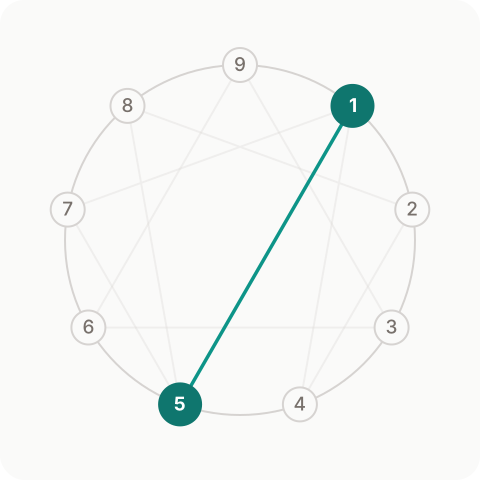
The tradition grounds this pair’s likeness in Jung’s typology: the One corresponds to the extraverted thinking type, the Five to introverted — ‘subjective’ — thinking. Both are serious, precise, principled minds; both prefer correctness to charisma; on paper their reserved, bookish résumés nearly match. But they sit in different triads, and that placement is the divergence: the One is an instinctive type — primarily a person of action, interested in ideas only insofar as they lead to practical results — while the Five is a thinking type for whom understanding is the point and application optional. The tradition sharpens it into method: Ones judge situations from idealistic standards, deducing from principles to applications — teachers and moralists; Fives question the standards themselves, inducing sweeping theories from data — inventors and iconoclasts.
Why the map itself confuses them
These types share no wing border and no arrow line — the confusion is pure surface-lookalike, which makes it easier to resolve than neighbor or arrow mistypes: the engines have no structural bridge, so once you’re looking at motivation instead of behavior, the two rarely stay confusable for long. The stress-costumes are worth ruling out all the same: a stressed One slides toward Four — moody, alienated, convinced nobody understands the burden, while a stressed Five scatters toward Seven — jumpy, distracted, escaping into projects and stimulation — check whether the type you tested as might be the costume of the other under load. Instinct subtypes are the other usual culprit: a countertype wears its type unusually, and can land on exactly this kind of distant lookalike.
Under load, side by side
Overload splits this pair cleanly: a stressed One slides toward Four — moody, alienated, convinced nobody understands the burden, and on the other side a stressed Five scatters toward Seven — jumpy, distracted, escaping into projects and stimulation. Because both stress-faces impersonate other numbers, a difficult stretch is the worst evidence to type from — and also the best tiebreaker to remember afterwards. Note which collapse was yours, then confirm from a steadier month before you settle the question.
Three quick tells
- →Do you learn in order to act rightly (One) — or act, occasionally, as a byproduct of learning (Five)?
- →When a rule seems wrong, do you campaign to fix it (One) or quietly investigate why it exists (Five)?
- →Is your inner voice a judge with a verdict (One) or an analyst with a briefing (Five)?
Settle it
Still torn between The Reformer and The Investigator? The test separates the 1-5 confusion with dedicated forced-choice questions, and reads best alongside the full Type 1 and Type 5 profiles — weight the core-fear sections triple.
Frequently asked questions
Why do Type 1 and Type 5 get confused?
Both are reserved, precise and principled thinkers who prefer correctness to charisma. On paper — meticulous, private, bookish — their résumés are near-identical; only the motive separates them.
What single question best separates Type 1 from Type 5?
Do you learn in order to act correctly — or act only as a side effect of learning? Your honest answer usually settles it faster than any full test.
What are the core fears of Type 1 and Type 5?
Type 1 fears being bad, corrupt, wrong; Type 5 fears being depleted, incapable, overwhelmed. Behaviors overlap, but these two alarms never do — identify which one has been ringing your whole life and the question usually settles.
What core desire separates Type 1 from Type 5?
Type 1 wants to be good and have integrity; Type 5 wants to be capable and competent. Imagine both fully granted tomorrow: which one would actually let you rest? People usually know instantly — and that answer is the type.
Could my subtype explain why I test between 1 and 5?
Often, yes. The one-to-one 1 is Type 1's countertype and runs against its type's usual current, while the one-to-one 5 does the same for Type 5 — either can wear the other type's surface. If neither standard portrait fits cleanly, read both countertype pages before deciding.
Know your enneagram type. Understand yourself.
Take the free test