Enneagram Type 1 vs Type 4: How to Tell Them Apart
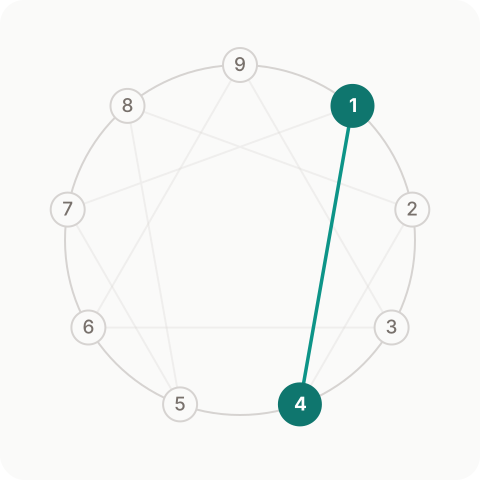
Two different engines
Type 1 (The Reformer)
runs on an inner standard — the fear of being bad, the drive to be right with its own conscience.
Type 4 (The Individualist)
runs on identity — the fear of being nobody in particular, the drive to find what’s authentically its own.
Where the confusion comes from
The bridge is the stress arrow: Ones under long pressure slide toward Four’s melancholy and start recognizing themselves in Four descriptions. Both also share high sensitivity to what’s wrong — in the world, or in themselves.
The same scene, two engines
Watch both receive criticism of something they made. The One hears an error report: it stings, gets audited, and triggers the internal tribunal — was I careless? The Four hears an identity verdict: the work was self, so the flaw is in the self, and the sting spreads into the old feeling of being defective in some unfixable way. The One re-checks the work; the Four re-checks the soul.
Two questions that settle it
- Does criticism make you review the work — or review yourself?
- Is your melancholy a visitor with a cause, or a homeland you return to?
The shared surface, mapped
The tradition describes this mistype as almost always one-directional: a One under stress — sliding along its arrow toward Four — begins to feel melancholy, depressed and alienated, then reads a Four description focusing on the unhealthy traits and concludes it must be a Four. The two do share real ground: high sensitivity to what’s wrong (in the world for the One, in oneself for the Four), strong aesthetic responses, and a capacity for withering self-criticism. The daily-order tell the tradition offers: Ones attend to their responsibilities first and deal with feelings later — their deferred emotions are actually a main cause of their depressions — while Fours must sort the feelings first and can struggle to mobilize for duties at all. A One’s melancholy interrupts its discipline; a Four’s discipline interrupts its melancholy.
Why the map itself confuses them
The arrows connect these two directly: Type 1’s stress line points at Type 4, so extended periods of stress make a 1 genuinely wear 4’s costume — a stressed One slides toward Four — moody, alienated, convinced nobody understands the burden. If you tested during an unusual season of your life, that’s the first thing to rule out: re-read both types from a calmer month. The arrows guide covers the mechanics.
Under load, side by side
Watch what a bad month does to each: a stressed One slides toward Four — moody, alienated, convinced nobody understands the burden — whereas a stressed Four clings toward Two — over-involved, needing to be needed, testing people’s love. That divergence is useful precisely because it’s involuntary; nobody curates their overload behavior. If the calm portraits blur together, the loaded ones rarely do. Just don’t type yourself from the loaded portrait: verify against a season when things were working.
Three quick tells
- →On a bad morning, do you work anyway and feel it later (One) — or need the feeling processed before work is possible (Four)?
- →Is your self-criticism about failing your standards (One) or about being fundamentally lacking (Four)?
- →Has your dark season a deadline — the project’s end, the audit passed (One) — or an address, somewhere you live (Four)?
- →Is beauty something the world should be corrected toward (One) — or something whose absence in your own life wounds you personally (Four)?
Settle it
Still torn between The Reformer and The Individualist? The test separates the 1-4 confusion with dedicated forced-choice questions, and reads best alongside the full Type 1 and Type 4 profiles — weight the core-fear sections triple.
Frequently asked questions
Why do Type 1 and Type 4 get confused?
The bridge is the stress arrow: Ones under long pressure slide toward Four's melancholy and start recognizing themselves in Four descriptions. Both also share high sensitivity to what's wrong — in the world, or in themselves.
What single question best separates Type 1 from Type 4?
Does criticism make you review the work — or review yourself? Your honest answer usually settles it faster than any full test.
What are the core fears of Type 1 and Type 4?
Type 1 fears being bad, corrupt, wrong; Type 4 fears having no identity or significance. Behaviors overlap, but these two alarms never do — identify which one has been ringing your whole life and the question usually settles.
Can a subtype make a Type 1 look like a Type 4?
Often, yes. The one-to-one 1 is Type 1's countertype and runs against its type's usual current, while the self-preservation 4 does the same for Type 4 — either can wear the other type's surface. If neither standard portrait fits cleanly, read both countertype pages before deciding.
How do the passions of Type 1 and Type 4 differ?
Type 1's passion is anger (resentment); Type 4's is envy. Watch a full week of your own behavior and ask which appetite quietly organized it — the passion is harder to fake than any answer on a test.
Know your enneagram type. Understand yourself.
Take the free test