Enneagram Type 1 vs Type 3: How to Tell Them Apart
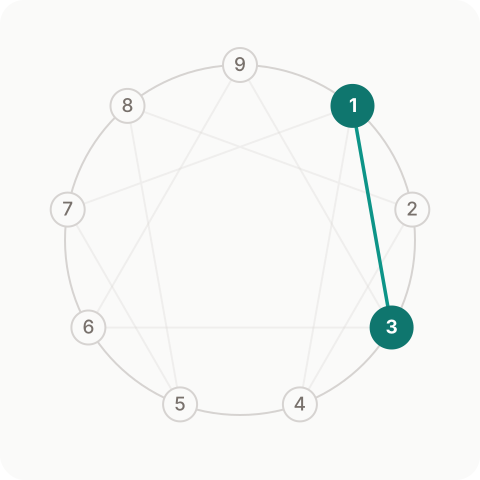
Two different engines
Type 1 (The Reformer)
runs on an inner standard — the fear of being bad, the drive to be right with its own conscience.
Type 3 (The Achiever)
runs on value-through-achievement — the fear of worthlessness, the drive to be seen succeeding.
The tell
Both are disciplined, effective, allergic to sloppiness. The engine differs: the One serves an inner tribunal — the method must survive inspection, and cutting corners feels like self-betrayal — while the Three serves the scoreboard: the result must land, and the method flexes instantly if a faster road opens. Ones are attached to doing it right; Threes to getting it done impressively. If you’d rather miss the deadline than do it wrong, read One. If you’d rather adjust ‘right’ than miss, read Three.
Where the confusion comes from
Both are polished, efficient and allergic to failure, and both look like ‘high standards’ from the outside. Organizations promote both for the same reasons — which is exactly where the mistype gets made.
The same scene, two engines
Give both a big presentation. The One rehearses because errors are intolerable — a wrong figure would gnaw at them for a week even if nobody caught it. The Three rehearses because the room must be won — a wrong figure matters exactly as much as the audience’s reaction to it. Cut the audience feed and the One keeps polishing; the Three starts asking who’ll see the recording.
Two questions that settle it
- If nobody would ever know, would you still fix it?
- After a flawless performance that nobody praised, what’s left — satisfaction or emptiness?
The shared surface, mapped
The tradition locates this confusion in isolated behavior: watch either type chair a meeting or plan a vacation and the organizational competence looks identical. Both are efficient and highly organized, both task-oriented, both put feelings on the back burner to get things done, and both share a genuine desire for self-improvement against high standards. The engines separate on inspection: the One is an idealist controlling self and environment so that error cannot enter, inner-motivated by conscience — attached to the right method (’this is the best way to do this’). The Three is a pragmatist driven by goals, caring more that the job gets done than how, switching tactics instantly when results lag. The emotional tell the tradition emphasizes: Ones can’t fully conceal irritation and disappointment — others notice their agitation almost immediately — while average Threes present whatever affect the situation calls for, adjusting from room to room with an ease that is itself the diagnostic.
Why the map itself confuses them
These types share no wing border and no arrow line — the confusion is pure surface-lookalike, which makes it easier to resolve than neighbor or arrow mistypes: the engines have no structural bridge, so once you’re looking at motivation instead of behavior, the two rarely stay confusable for long. The stress-costumes are worth ruling out all the same: a stressed One slides toward Four — moody, alienated, convinced nobody understands the burden, while a stressed Three fogs toward Nine — numb, disengaged, going through motions behind the smile — check whether the type you tested as might be the costume of the other under load. Instinct subtypes are the other usual culprit: a countertype wears its type unusually, and can land on exactly this kind of distant lookalike.
Under load, side by side
Strain pulls the two in different directions: a stressed One slides toward Four — moody, alienated, convinced nobody understands the burden; at the same time, a stressed Three fogs toward Nine — numb, disengaged, going through motions behind the smile. A person met only in a hard year can be typed exactly backwards, because the stress-face borrows another number’s wardrobe. Come back to this comparison from stable ground, and watch the recovery: how each pattern climbs back to normal is a signature the crisis can’t fake.
Three quick tells
- →Mid-project, does your attention guard the method (One) or the finish line (Three)?
- →Can the people around you read your frustration within minutes (One), or do they see whatever the situation requires (Three)?
- →Is ‘good enough’ a moral failure (One) or a strategic option (Three)?
Settle it
Still torn between The Reformer and The Achiever? The test separates the 1-3 confusion with dedicated forced-choice questions, and reads best alongside the full Type 1 and Type 3 profiles — weight the core-fear sections triple.
Frequently asked questions
Why do Type 1 and Type 3 get confused?
Both are polished, efficient and allergic to failure, and both look like 'high standards' from the outside. Organizations promote both for the same reasons — which is exactly where the mistype gets made.
What single question best separates Type 1 from Type 3?
If nobody would ever know, would you still fix it? Your honest answer usually settles it faster than any full test.
What are the core fears of Type 1 and Type 3?
Type 1 fears being bad, corrupt, wrong; Type 3 fears being worthless without achievement. Behaviors overlap, but these two alarms never do — identify which one has been ringing your whole life and the question usually settles.
What core desire separates Type 1 from Type 3?
Type 1 wants to be good and have integrity; Type 3 wants to be valuable and worthwhile. Imagine both fully granted tomorrow: which one would actually let you rest? People usually know instantly — and that answer is the type.
Could my subtype explain why I test between 1 and 3?
Often, yes. The one-to-one 1 is Type 1's countertype and runs against its type's usual current, while the self-preservation 3 does the same for Type 3 — either can wear the other type's surface. If neither standard portrait fits cleanly, read both countertype pages before deciding.
Know your enneagram type. Understand yourself.
Take the free test