Enneagram Type 1 vs Type 2: How to Tell Them Apart
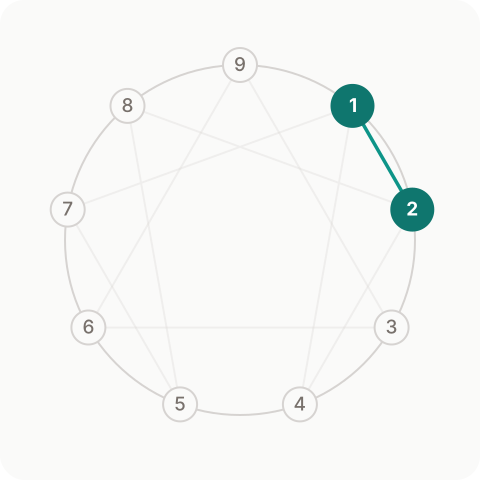
Two different engines
Type 1 (The Reformer)
runs on an inner standard — the fear of being bad, the drive to be right with its own conscience.
Type 2 (The Helper)
runs on connection — the fear of being unwanted, the drive to matter in specific people’s lives.
Where the confusion comes from
Both are conscience-driven helpers whose calendars fill with obligations — and the 1w2/2w1 wing zone genuinely blurs. The surface both share: responsible, service-minded, slightly tired.
The same scene, two engines
Both volunteer at the school fair — and both end up running it. But watch the motive at hour six: the One is still there because the job must be done properly and half the stalls are set up wrong; the Two is still there because Marta looked overwhelmed and the new family needed welcoming. Same apron, two engines: standards versus people.
Two questions that settle it
- When you overwork, is it because the job would otherwise be done wrong — or because someone would otherwise be let down?
- Whose disapproval cuts deeper: your own conscience’s, or a loved one’s cooling warmth?
The shared surface, mapped
The tradition notes this isn’t a common mistype in its pure form — it happens through the wings, where 1w2 and 2w1 genuinely blur, and it carries a documented gender skew: women who are 1w2s tend to see themselves as 2w1s, and men who are 2w1s may see themselves as 1w2s, cultural scripts pushing each toward the ’expected’ pattern. What the two share on the surface: both are serious and conscience-driven, both need to feel of service, both can be deeply altruistic — the responsible helpers of any community. The divergence underneath, per the tradition: Ones try to transcend the personal, appealing to principles and the evident rightness of a position; Twos are relentlessly personal, seeing their service in terms of specific people. Ones defend their autonomy and don’t want interference; Twos seek closeness and even merging. And the emotional expression runs opposite: Ones restrain their positive feelings but let irritation show, while Twos pour out warmth and struggle with hostile feelings.
Why the map itself confuses them
Wings do the heavy lifting here: the 1w2 and 2w1 sit in a genuinely blended zone, and a strong wing can outshine the core. The practical rule for neighbors: ask which side of the border your fear lives on, not your behavior — behavior is exactly what the shared wing blurs. Reading the two wing pages (1w2 and 2w1) side by side often settles what the type descriptions alone can’t.
Under load, side by side
Pressure rewrites both profiles at once: a stressed One slides toward Four — moody, alienated, convinced nobody understands the burden, while a stressed Two erupts toward Eight — blunt, demanding, suddenly loud about every unthanked favor. Neither of those faces matches the type at rest, so a rough season is a misleading window for self-typing. If this page still feels unresolved, reread both profiles from a calmer month — and pay attention to the road each of you takes back to baseline, which is often more telling than the strain itself.
Three quick tells
- →When you help, is it because the principle demands it (One) — or because this person’s need called you (Two)?
- →Does closeness feel like something to guard your autonomy against (One) or the whole point of the exercise (Two)?
- →Which leaks out despite you: irritation (One) or affection (Two)?
Settle it
Still torn between The Reformer and The Helper? The test separates the 1-2 confusion with dedicated forced-choice questions, and reads best alongside the full Type 1 and Type 2 profiles — weight the core-fear sections triple.
Frequently asked questions
Why do Type 1 and Type 2 get confused?
Both are conscience-driven helpers whose calendars fill with obligations — and the 1w2/2w1 wing zone genuinely blurs. The surface both share: responsible, service-minded, slightly tired.
What single question best separates Type 1 from Type 2?
When you overwork, is it because the job would otherwise be done wrong — or because someone would otherwise be let down? Your honest answer usually settles it faster than any full test.
What are the core fears of Type 1 and Type 2?
Type 1 fears being bad, corrupt, wrong; Type 2 fears being unwanted, unloved. Behaviors overlap, but these two alarms never do — identify which one has been ringing your whole life and the question usually settles.
Can a subtype make a Type 1 look like a Type 2?
Often, yes. The one-to-one 1 is Type 1's countertype and runs against its type's usual current, while the self-preservation 2 does the same for Type 2 — either can wear the other type's surface. If neither standard portrait fits cleanly, read both countertype pages before deciding.
How do the passions of Type 1 and Type 2 differ?
Type 1's passion is anger (resentment); Type 2's is pride. Watch a full week of your own behavior and ask which appetite quietly organized it — the passion is harder to fake than any answer on a test.
Know your enneagram type. Understand yourself.
Take the free test