Integration & Disintegration: The Enneagram Arrows Explained
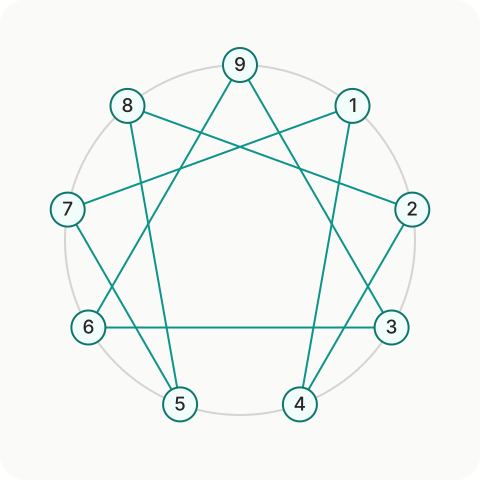
The lines across the enneagram symbol aren’t decoration — each type connects to two others. Under sustained stress, you borrow the average-to-unhealthy behaviors of one (the disintegration or stress direction); in growth and security, you gain the healthy qualities of the other (the integration direction).
Two things people get wrong: first, moving along an arrow doesn’t change your type — a stressed One acting moody and misunderstood is still a One, not a Four. Second, the stress move isn’t bad in itself; it’s information. Noticing “I’m doing the Nine-fog thing” is often the first clue a Three has that they’re burned out.
Each type guide lists both directions with concrete descriptions, and the Growth Path tool in Pro turns them into a practice plan.
The nine connections, briefly
Each line pairs a type with the qualities it most lacks and most fears. One↔Seven trades rigidity for play; Two↔Eight trades ingratiation for directness; Three↔Six trades image for loyalty; Four↔One trades mood for discipline; Five↔Eight trades hoarding for action; Six↔Nine trades vigilance for rest; Seven↔Five trades breadth for depth; Eight↔Two trades armor for tenderness; Nine↔Three trades merging for self-investment. Read your own two lines and you have a compressed map of your whole development: what leaks out under pressure, and what wants to grow in.
Using the arrows without superstition
Two practical rules keep arrow-work honest. First, direction is information, not destiny: noticing yourself in the stress move (“I’m doing the Nine-fog thing”) is a fuel gauge reading, not a failure — and it usually appears days before you’d otherwise admit the overload. Second, you can practice the growth direction deliberately: a One scheduling genuine play is doing Seven-work on purpose rather than waiting for security to gift it. The tradition’s insight is that the qualities you need most are already wired into your position on the figure — the lines show where.
Arrows, wings and instincts: which lens when
The wing explains day-to-day style; the instinct explains where energy goes; the arrows explain change over time — why you’re different under a bad quarter or a good year. When someone seems to have changed type, check the arrows first: a stressed Three reads Nine-ish for months at a stretch, a secure Six looks remarkably like a healthy Nine. The type never changed; the position on its lines did.
A worked example: the One’s two roads
Watch the arrows operate in a single life. A One under mounting pressure doesn’t become a worse One — it starts borrowing from Four: moody withdrawals, the sense of being uniquely misunderstood, melancholy that its usual discipline can’t schedule away. The same One in a season of genuine security borrows from Seven: spontaneity returns, plans multiply, the inner courtroom adjourns and the person becomes — briefly, surprisingly — fun. Neither visit changes the home address. The practical use: when you notice uncharacteristic behavior in yourself, ask which direction you’re traveling. Stress-direction behavior is a smoke alarm worth honoring; security-direction behavior is evidence that whatever you’re doing lately, it’s working.
Misreadings to avoid
The tradition is routinely flattened into two errors. The first is moralizing the arrows — calling one direction ‘disintegration’ and treating any visit as failure. Modern teachers note both arrows carry usable material: the One doesn’t just collapse toward Four, it can reach toward Four’s emotional honesty deliberately. The second error is typing from arrow behavior: a stressed One reporting Four-flavored moods will test as a Four in a bad month, which is why no serious typing should happen mid-crisis. The arrows explain the anomaly; they never replace the baseline. If a type reading only fits your worst season, you’re probably looking at someone’s arrow, not their home. The same logic rescues relationships: a partner behaving ‘out of character’ for a month hasn’t changed type — they’re traveling, and the map says exactly where, and which road brings them back.
Frequently asked questions
Do I go to my stress point only when things are bad?
Mostly, but brief visits happen daily — a deadline afternoon can produce an hour of your stress pattern. The sustained version is the diagnostic one.
Can I be 'in' my growth direction permanently?
The healthier you are, the more freely you access it — but it remains your type's resource, not a new identity. A One with good Seven-access is still a One.
Why do some schools draw the arrows the other way?
Notation differs; the underlying observation (each type borrows from two others, one in growth and one in stress) is shared across the main modern schools.
Is the stress direction bad for me?
No — it's often protective in the short term. The problem is living there. Treat its appearance as a signal to address the load, not as a flaw to suppress.
Should I practice my growth line's qualities deliberately?
Yes — that's the modern reading's main upgrade: don't wait for a secure season to deliver the growth direction; identify its healthy qualities and practice them on purpose. A Nine borrowing the Three's momentum weekly grows faster than one waiting for it.
Know your enneagram type. Understand yourself.
Take the free test