Two Type 9s Together: Enneagram 9-9 Compatibility
In love
Deep peace, doubled — the most comfortable couple alive, slowly disappearing into the sofa. Wanting something out loud is an act of love here.
At work
Everyone’s favorite colleagues; nobody’s decision-makers. Import urgency, export calm.
The recurring fight
When two Type 9s clash, both run the same play: each agrees in the room and resists after it. The collision is symmetric — both run the same play, so neither supplies the counterweight. What breaks the symmetry: one partner deliberately supplies what both are waiting for — for two Type 9s, that means disagreement made explicitly safe, with time for the real answer, offered first, without scoreboard.
What each needs from the other
The Peacemaker 9 + 9
Two Nines need imported urgency — deadlines, reservations made in advance, a decision die if necessary — because the most comfortable couple alive can defer its actual life indefinitely, one pleasant evening at a time.
Daily life together
The most comfortable home either has ever known: no performances, no audits, no sieges — two peaces stacked. Decades can pass beautifully. The famous hazard is the unlived list: the trip never booked, the business never started, the conversation never had — not from conflict, but from a shared talent for the pleasant meanwhile.
When it thrives
Thriving looks like the comfortable house with a compass: the peace kept, the list lived — trips booked in advance, decisions made by ritual, wants spoken as a daily practice neither skips. In the healthy version the two stillnesses stop being parallel and become one deliberate, chosen calm.
How the attraction works
The tradition describes double Nines recognizing each other by resonance — not physical likeness but a way of speaking that seems to reaffirm an ongoing agreement. From outside: a settled couple, few divisive questions, no jagged emotions, live-and-let-live acceptance without forced change, a mutual desire to stay comfortable. The inside story, the casework notes, is described quite differently — beneath the shared calm, each partner privately contends with the type’s confusion about its own wants, and the couple’s peace can be two separate fogs politely overlapping rather than one shared clarity.
The comfortable disappearance
The double-Nine hazard is the unlived list this site has named, and the tradition’s inside-story observation explains its mechanism: each partner, unsure what it wants, reads the other’s contentment as confirmation that nothing needs deciding — and the merge doubles. Years pass beautifully; the trip, the move, the conversation never book themselves. What works is deliberate structure held jointly, because neither partner will impose it alone: decisions made by ritual (the weekly meeting with one required choice), wants spoken as practice (each partner names one preference daily — the same practice this site prescribes for every Nine, doubled), and imported momentum — external commitments, standing reservations, friends with initiative — because a household of two peaces needs at least one scheduled disturbance to stay a life rather than a rest.
At work: everyone’s favorite, nobody’s engine
Professionally, double Nine is the calmest partnership in the portfolio: consensus builds naturally, conflicts de-escalate on contact, and everyone routes their friction through this desk. The structural absence is drive: two accommodators generate no deadlines, surface no problems, and can administer an operation into gentle, permanent drift. What works: urgency imported and treated as law (external dates, client commitments, a shared tracker neither can quietly ignore), the decision die — genuinely: for reversible choices, deciding by lot beats not deciding, and both types accept structure they didn’t author — and role-forced initiative: each partner owns domains where its vote is required first, converting the mutual deference from a decision vacuum into a division of labor.
Go deeper
Wings, instincts and health levels all modulate the 9-9 dynamic — health trumps type-matching everywhere. For a household of two Type 9s, each partner’s wing page is where the differences hide. The Pro report assembles the full picture for your specific pairing.
Frequently asked questions
Are Type 9 and Type 9 a good match?
The most comfortable home either has ever known: no performances, no audits, no sieges — two peaces stacked. Whether it thrives depends more on both partners' health levels than on the combination — this page maps where this specific pairing's friction and strength live.
What is the recurring conflict in a 9-9 pair?
What breaks the symmetry: one partner deliberately supplies what both are waiting for — for two Type 9s, that means disagreement made explicitly safe, with time for the real answer, offered first, without scoreboard.
How does a double Type 9 couple handle stress?
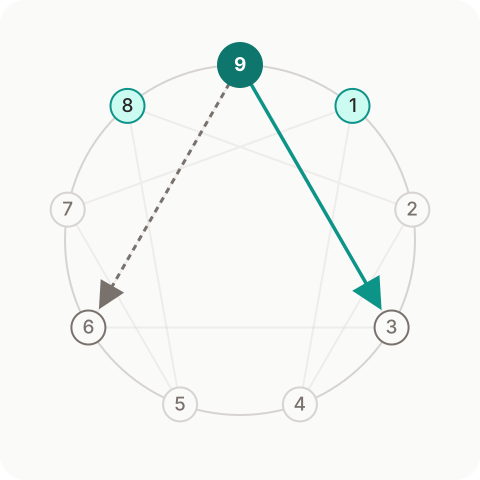
Doubly, in the same direction: under stress, Nines fret like an unhealthy Six: anxious, reactive, scanning for what could break the peace. When both partners travel that arrow at once, nobody holds the baseline — which is why same-type couples benefit from an outside stabilizer and an agreed signal for hard weeks.
What growth work helps two Type 9s most?
The shared growth line is an advantage: moving toward health, Nines gain Three's self-investment: their own goals get calendar time and follow-through. Two people working the same direction can genuinely accelerate each other — provided they don't also share the same excuse on the same day.
What does each partner in a 9-9 couple need to hear?
In love, Nines accept people wholesale — an ease that heals. They need their preferences actively asked for, or they vanish into the merge. In this pairing specifically, that need meets the The Peacemaker's pattern — naming it early keeps it a request instead of a resentment.
Know your enneagram type. Understand yourself.
Start 7-day free trial