Two Type 7s Together: Enneagram 7-7 Compatibility
In love
Double fireworks: the most fun couple anyone knows. The unpaid bill is whatever hurts. Whoever names a hard feeling first is the brave one that year.
At work
An idea machine with no brakes. Ship dates need an adult — hire one or become one on alternating weeks.
The recurring fight
When two Type 7s clash, both run the same play: each reframes mid-fight — it’s not that bad, look at it this way. The collision is symmetric — both run the same play, so neither supplies the counterweight. What breaks the symmetry: one partner deliberately supplies what both are waiting for — for two Type 7s, that means one full acknowledgment of the problem before any silver lining, offered first, without scoreboard.
What each needs from the other
The Enthusiast 7 + 7
Two Sevens need a feelings ledger — the monthly conversation where the hard things get their turn — because two escape artists can keep a household airborne for years without landing once.
Daily life together
The apartment is between trips; the kitchen table is a map. Two accelerators, no brake: everything is possible and much of it is booked. Joy compounds — so does avoidance: the drawer of unopened letters (metaphorical and literal) grows in perfect silence, because neither pattern has a native way to sit down with a hard thing.
When it thrives
Thriving looks like the map-covered table with one drawer that opens monthly: the adventures still multiply, and the hard things get their scheduled hour before they compound. In the healthy version each becomes the other’s permission to land — the rarest gift one Seven can give another.
How the attraction works
The tradition reports that Sevens describing an ideal mate pick the features they see in themselves: energetic, independent, optimistic, successful, adventurous — a mirror-image companion who’ll hike the trails the Seven likes, see the movies the Seven wants, and sign on to organize the Seven’s pet projects. Double Sevens commonly bond first as playmates, and the friendship-to-romance path runs through shared adventure rather than shared confession. Life together is genuinely larger: two option-generators pooling itineraries, each finally partnered with someone whose pace doesn’t need apologizing for.
Mirror hunger and the unopened drawer
The mirror that attracts also colludes: two reframers can keep a household airborne for years — every difficulty converted to silver lining in stereo, every hard conversation cheerfully rescheduled. The drawer of unmetabolized material (grief, money, the relationship itself) grows in perfect silence because neither pattern has a native way to sit down with a painful thing, and each partner’s avoidance licenses the other’s. The practice this site has prescribed — the monthly feelings ledger — gets its justification from the pairing’s structure: hard things need an appointment here, because they will never be walk-ins. The couple’s advantage once the appointment exists: two resilient optimists process pain faster than anyone, once actually facing it.
At work: the idea machine’s missing brake
Professionally, double Seven is ignition times ignition: brainstorms that generate real inventions, networks that multiply, an office everyone wants to visit. The documented deficits: no brake, no finisher, no bad-news channel. Plans multiply past any capacity to complete them; the boring middles of projects pile up unowned; and problems get reframed rather than escalated until they’re expensive. What works: the completion role imported (a hired or borrowed finisher with authority to close projects — and to refuse new ones until the count drops), commitments made scarce and public (fewer, spoken aloud, witnessed — both partners honor an audience), and the quarterly reckoning: one meeting where the only agenda is what happened to everything announced last quarter.
Go deeper
This page sketches the average band; your actual pairing shifts with each partner’s wing, instinct stack and current level. For a household of two Type 7s, each partner’s wing page is where the differences hide. For the complete interactive analysis, see the Pro report.
Frequently asked questions
Do Type 7 and Type 7 work as a couple?
The apartment is between trips; the kitchen table is a map. Whether it thrives depends more on both partners' health levels than on the combination — this page maps where this specific pairing's friction and strength live.
Where does a 7-7 couple clash most?
What breaks the symmetry: one partner deliberately supplies what both are waiting for — for two Type 7s, that means one full acknowledgment of the problem before any silver lining, offered first, without scoreboard.
How does a double Type 7 couple handle stress?
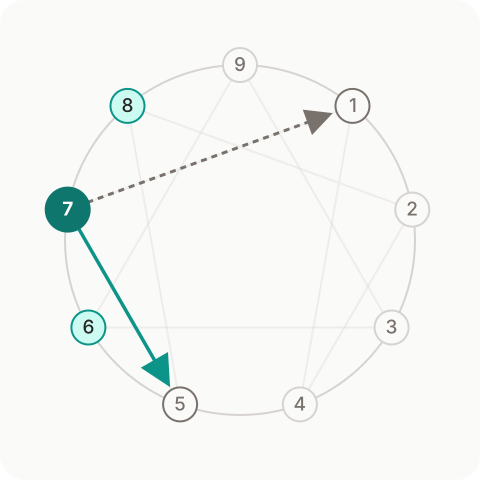
Doubly, in the same direction: under stress, Sevens turn harsh like an unhealthy One: critical, impatient, perfectionistic about their escapes. When both partners travel that arrow at once, nobody holds the baseline — which is why same-type couples benefit from an outside stabilizer and an agreed signal for hard weeks.
What growth work helps two Type 7s most?
The shared growth line is an advantage: moving toward health, Sevens gain Five's depth: fewer things, fully tasted; satisfaction replaces anticipation. Two people working the same direction can genuinely accelerate each other — provided they don't also share the same excuse on the same day.
What does each partner in a 7-7 couple need to hear?
In love, Sevens bring adventure and resilience — they metabolize hard days fast. They need a partner who joins the fun without caging it. In this pairing specifically, that need meets the The Enthusiast's pattern — naming it early keeps it a request instead of a resentment.
Know your enneagram type. Understand yourself.
Start 7-day free trial