Enneagram 6 and 9 Compatibility: Love & Work
In love
Loyalty and peace — a home that holds. The Six’s alarms meet the Nine’s calm; soothing when engaged, maddening when the Nine tunes out.
At work
Steady hands. Risk: worry meets postponement and nothing moves. External deadlines are friends.
The recurring fight
The signature collision: the Loyalist argues from the threat, worst cases deployed as evidence, while the Peacemaker agrees in the room and resists after it. What de-escalates this specific pairing: the Type-6 partner gets steadiness — the reassurance said before it’s extracted; the Type-9 partner gets disagreement made explicitly safe, with time for the real answer. Order matters less than both arriving in the same conversation.
What each needs from the other
The Loyalist 6
From a Nine, the Six needs answers with content — ‘whatever you prefer’ is not data — and the Nine’s calm explained as trust rather than left to be read as not caring about the threat.
The Peacemaker 9
From a Six, the Nine needs the alarms scheduled — worry o’clock, once a day — and its peace treated as a resource for the household rather than evidence of not paying attention.
Daily life together
His calm is the medicine her system craves and distrusts: how can anyone relax with the news on? Her vigilance is the care his peace never asks for and quietly relies on. The household works when the roles are honored as gifts — her scanning protects his rest, his rest proves her scanning can stand down.
When it thrives
Thriving looks like the home that holds and rests at once: her scanning granted its hour, his calm granted its credibility. In the healthy version the trade completes — she borrows his peace at bedtime, he borrows her foresight at planning time — and the household gets both weather systems’ gifts.
How the attraction works
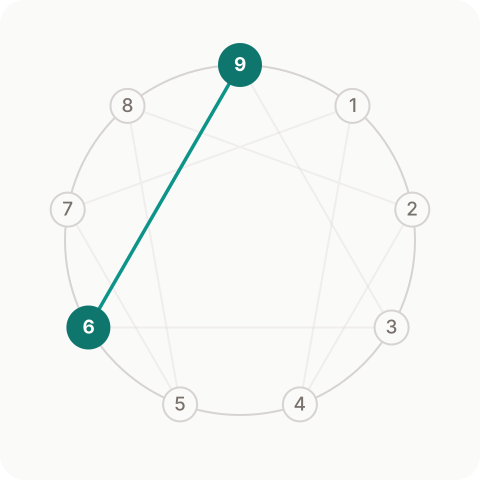
The tradition notes these types sit on a shared line of the diagram and exchange places readily: a Nine in stress takes on a startled, Six-like persona — cold panic that reliably elicits the Trooper’s sympathy, since no one reads fear more fluently. The deeper kinship is documented plainly: both partners have trouble taking action, and both find it easier to act in the name of another than for themselves. That symmetry makes the pairing either a partnership of mutual support — each championing the other’s causes with energy neither spends on its own — or a continuing battle about who should go first.
The ‘who goes first’ problem
The casework’s prescription for this couple is unusually direct: each must define personal goals rather than expecting the other to supply the initiative. The failure loop otherwise: the Six waits for certainty, the Nine waits for someone else to move, and the shared life idles in comfortable postponement — the Six’s worry providing the soundtrack, the Nine’s calm providing the excuse. The working structure: goals owned separately and stated aloud (the Six’s list and the Nine’s list, neither absorbed into the other), plus the trade this site has documented — the Six borrowing the Nine’s calm at bedtime, the Nine borrowing the Six’s foresight at planning time. The alarms scheduled, the peace credited: each partner’s default becomes the household’s resource instead of its friction.
At work: steady hands, slow wheels
Professionally the pairing is trusted everywhere and fast nowhere: the Six’s diligence plus the Nine’s steadiness produces careful, durable, thoroughly checked work on a timeline that tests everyone’s patience. Worry meets postponement — the documented compound — and external deadlines become the pair’s best friend. What works: dates imposed from outside and treated as law (both types comply with structure they didn’t author), the decision seesaw formalized (the Six drafts the risk analysis, the Nine holds the deciding vote once it’s read — reversing both defaults), and the Nine’s mediation gifts deployed on the Six’s behalf: no one de-escalates the Six’s alarm-spirals more effectively, and no one appreciates the Nine’s calm more than a scanner finally allowed to stand down.
Go deeper
Wings, instincts and health levels all modulate the 6-9 dynamic — health trumps type-matching everywhere. For this pairing specifically, Type 6 vs Type 9 sharpens the individual contrast. The Pro report assembles the full picture for your specific pairing.
Frequently asked questions
Are Type 6 and Type 9 a good match?
His calm is the medicine her system craves and distrusts: how can anyone relax with the news on? Her vigilance is the care his peace never asks for and quietly relies on. Whether it thrives depends more on both partners' health levels than on the combination — this page maps where this specific pairing's friction and strength live.
What is the recurring conflict in a 6-9 pair?
What de-escalates this specific pairing: the Type-6 partner gets steadiness — the reassurance said before it's extracted; the Type-9 partner gets disagreement made explicitly safe, with time for the real answer. Order matters less than both arriving in the same conversation.
How do Type 6 and Type 9 handle stress differently?
Their stress signatures differ, and knowing both helps: under stress, Sixes perform like an unhealthy Three: workaholic proving, image management, competing for security. Meanwhile, under stress, Nines fret like an unhealthy Six: anxious, reactive, scanning for what could break the peace. Reading a partner's bad season through their stress arrow — instead of taking it personally — is this pairing's cheapest repair.
What growth directions help a 6-9 couple?
Each partner's growth line points the way: moving toward health, Sixes gain Nine's calm: trusting themselves and life enough to rest inside it. And for the other: moving toward health, Nines gain Three's self-investment: their own goals get calendar time and follow-through. A couple that names these two directions out loud can back each other's practice instead of accidentally blocking it.
How do Type 6 and Type 9 collaborate at work?
At work, Sixes are the early-warning system and the faithful executor. Friction: ambiguity from leadership reads as danger. And the other side: at work, Nines mediate, steady the room, and see all sides. Friction: priorities blur, and 'no' arrives late or never. The collaboration works when each covers the other's friction point on purpose.
Know your enneagram type. Understand yourself.
Start 7-day free trial